

If you run paid media for a DTC brand, you’ve had this fight.
Your creative strategist builds something they believe in. They’ve studied the hooks, the angles, the audience. They’re proud of it.
Three days later, your media buyer pauses it. “Didn’t hit CPA.”
Your creative strategist is frustrated. “You didn’t give it enough time.”
Your media buyer is annoyed. “The data was clear.”
Both of them are usually half right.
I’ve managed over $100M in Meta ad spend across DTC brands, and this tension shows up in almost every account I’ve ever touched. It’s not a personality conflict. It’s a structural one. And if you don’t diagnose it correctly as a brand, you’ll either burn through creative talent or waste budget on ads that were never going to work.
Here’s what I see across accounts.
First, if you are readying this thinking “I wish I had enough creative to wonder if I cut too early” then you should really read this… this was brought to you by Billo,
I’ve been using Billo for 5 years across almost every client I manage creative for. One 9-figure brand, Billo’s content is around 50% of total ad spend, besting four other agencies producing creative. We put $3M behind a single Billo creator in 6 months for them (quite profitably). The process is simple: order wide, test a lot, cut the bottom, and scale the winners hard. Then go back to those creators for new angles and concepts. Take those winning ads and test them with new creators. Let the creators speak authentically and test at least 10. If you’re like me, you will find some real gems. If you’re running paid media and not using Billo as your UGC pipeline, you’re overpaying for creative. Check them out here.
I’ve had a dozen companies reach out about sponsoring this newsletter, but I chose Billo as a partner. After 5 years of using their tool, and seeing all the recent improvements (analytics, AI mashes, auto scripting) I feel very comfortable recommending them as a high-value partner that you can test out today.
Part 1: Is Your Media Buyer Actually Cutting Too Fast?
Before you take the creative team’s side, you need to test the claim. “You’re killing our ads” is a feeling. You need data.
There are two things to look at.
1. Are you spending too aggressively in the first 48 hours?
A new ad launches, gets $500 in spend on day one, and the CPA is $140 against a $90 target. It gets paused. The creative team says it never had a chance.
And sometimes they’re right.
If you’re front-loading too much spend before the algorithm has enough signal, you’re making decisions on noise, not data. Meta’s delivery system needs conversion events to optimize. If you’re spending $300-500 before you’ve gotten 5-10 conversions, you’re reading tea leaves.
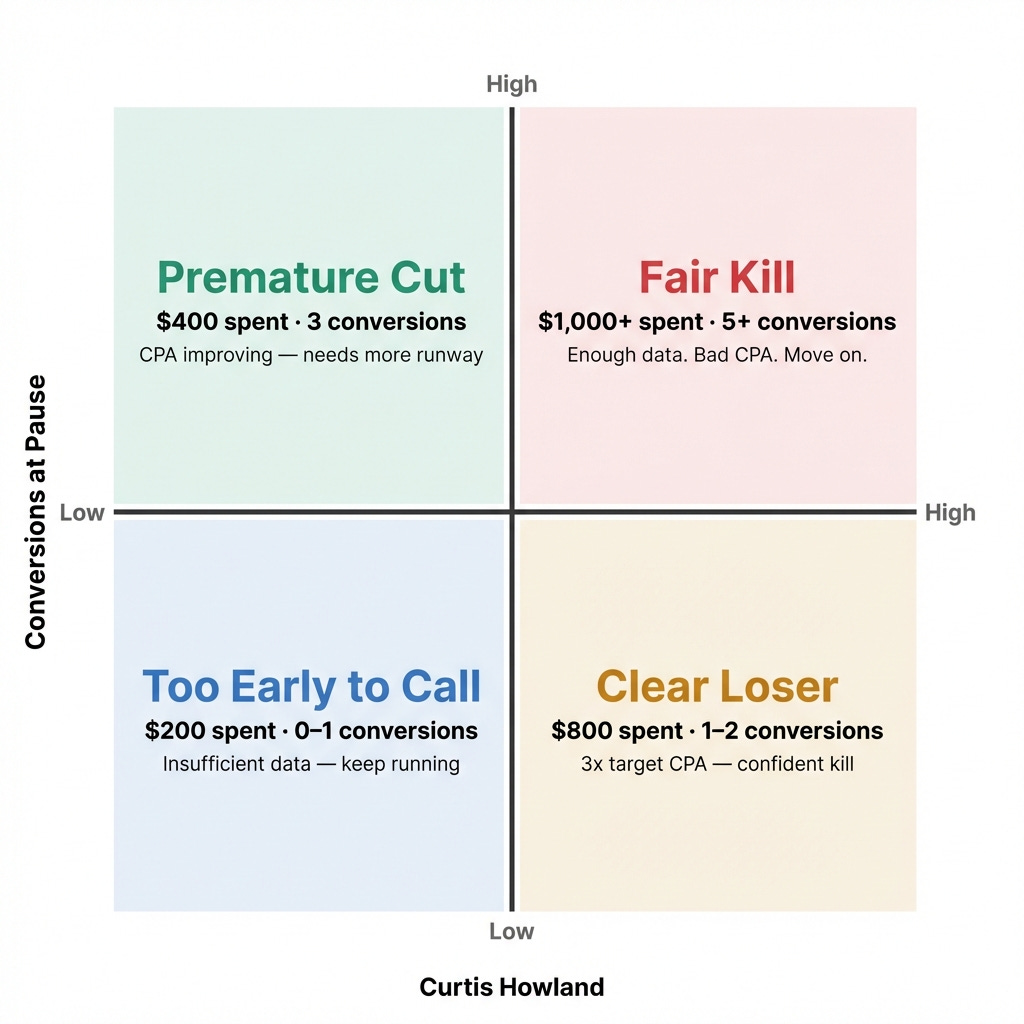
The fix is simple. Look at your recent launches and answer two questions: How much did we spend before pausing? And how many conversions did we get before making the call?
If the answer is “we spent $200 and got zero conversions so we killed it,” that might be premature. If the answer is “we spent $800 and got 2 conversions at 3x our target CPA,” that’s a different story.
This is our internal tool (demo data of a poorly managed account) where we plot this out. At each spend level the cut threshold gets closer and closer to the actual CPA as you have more data.
Dont let ads get into the red like this:
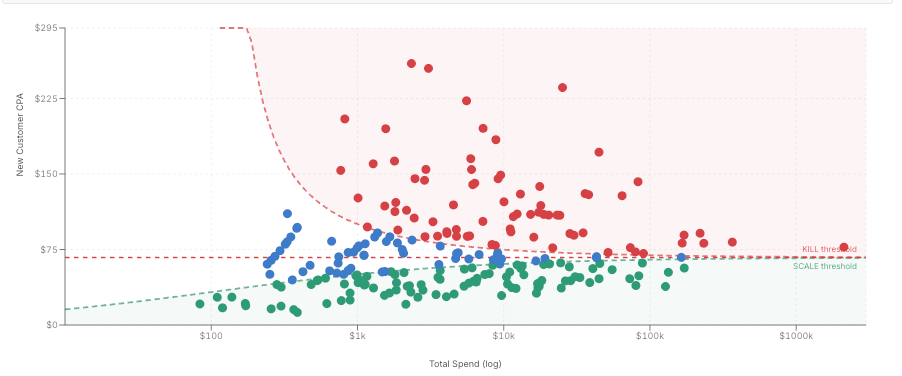
On the flip side, don’t leave too many in the green (over performing for their spend level). Try to balance it out.
4 scenarios to think through:
2. Are you giving ads enough calendar time to develop?
This is different from spend.
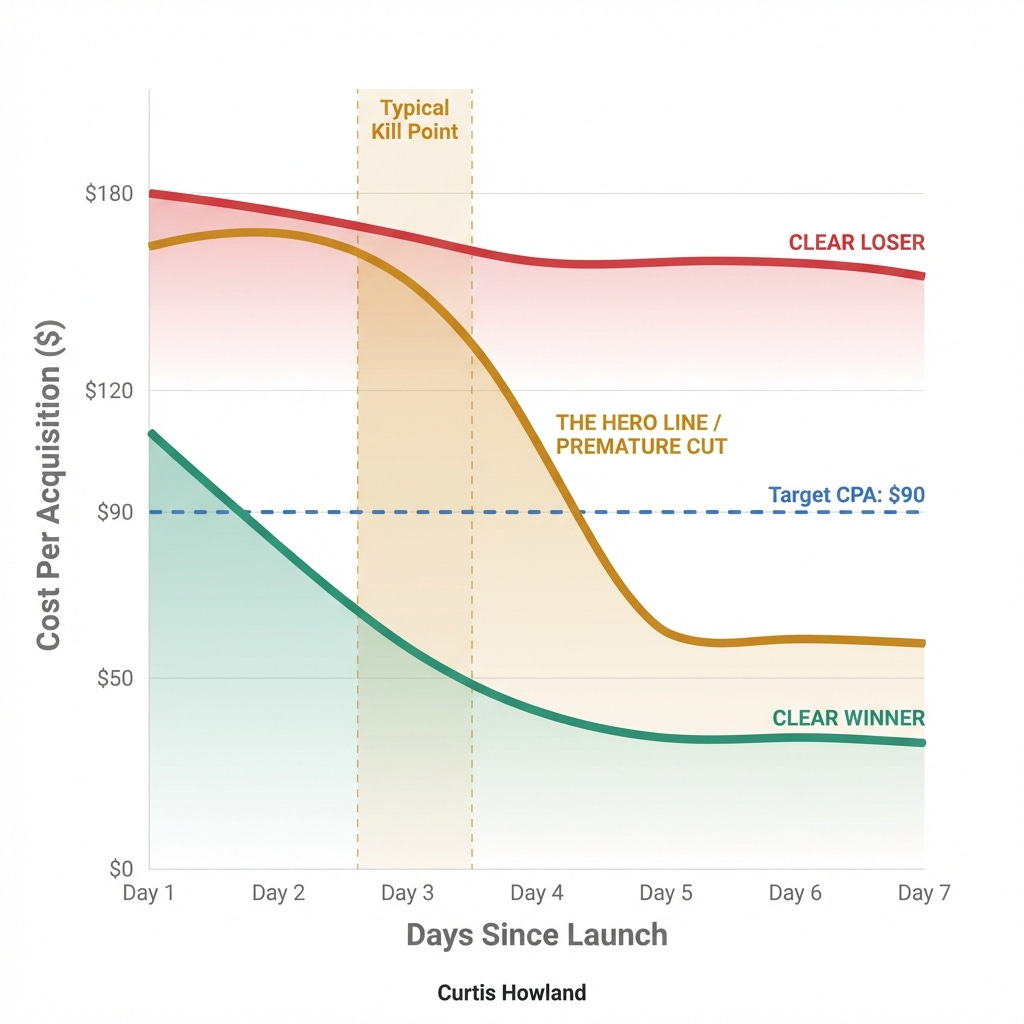
In my experience ads need 3-7 days to find their audience, especially if you’re testing a new angle or a new customer segment. An ad that looks mediocre on day 2 can look great on day 5 once Meta figures out who to show it to.
Pull your last 20-30 ad launches. For each one, chart the CPA trajectory from day 1 through day 7. You’re looking for two patterns:
Pattern A: Ads that started bad and stayed bad. These are clear losers. Cutting them on day 3 was the right call.
Pattern B: Ads that started rough but improved significantly by day 5-7. If you’re seeing a meaningful percentage of these, then give ads more time before you cut them.
You need to know in YOUR account how long ads take to develop but 4 days is a good place to start. Knowing this + your spend thresholds should help you set your testing budgets daily.
3. The fastest diagnostic I know: the low-spend retest
This is the test that settles the argument.
Go pull every ad in your account that spent less than $1,000 but had strong top-of-funnel metrics across two groups. Low CPA, low cost per add-to-cart, low CPC. These are ads that showed early promise but never got enough budget to prove themselves.
Build 3 ad sets, top 8 ads each:
Group 1: Low CPA ads that didn’t get scaled
Group 2: Low cost per add-to-cart (excluding Group 1)
Group 3: Low cost per click (excluding Groups 1 and 2)
Run it for a week.
If you find winners, your testing structure has gaps. You had good ads sitting in the account that never got a real shot. That’s a media buying process problem.
If nothing shows potential, your current testing is working fine and the creative team needs to hear that.
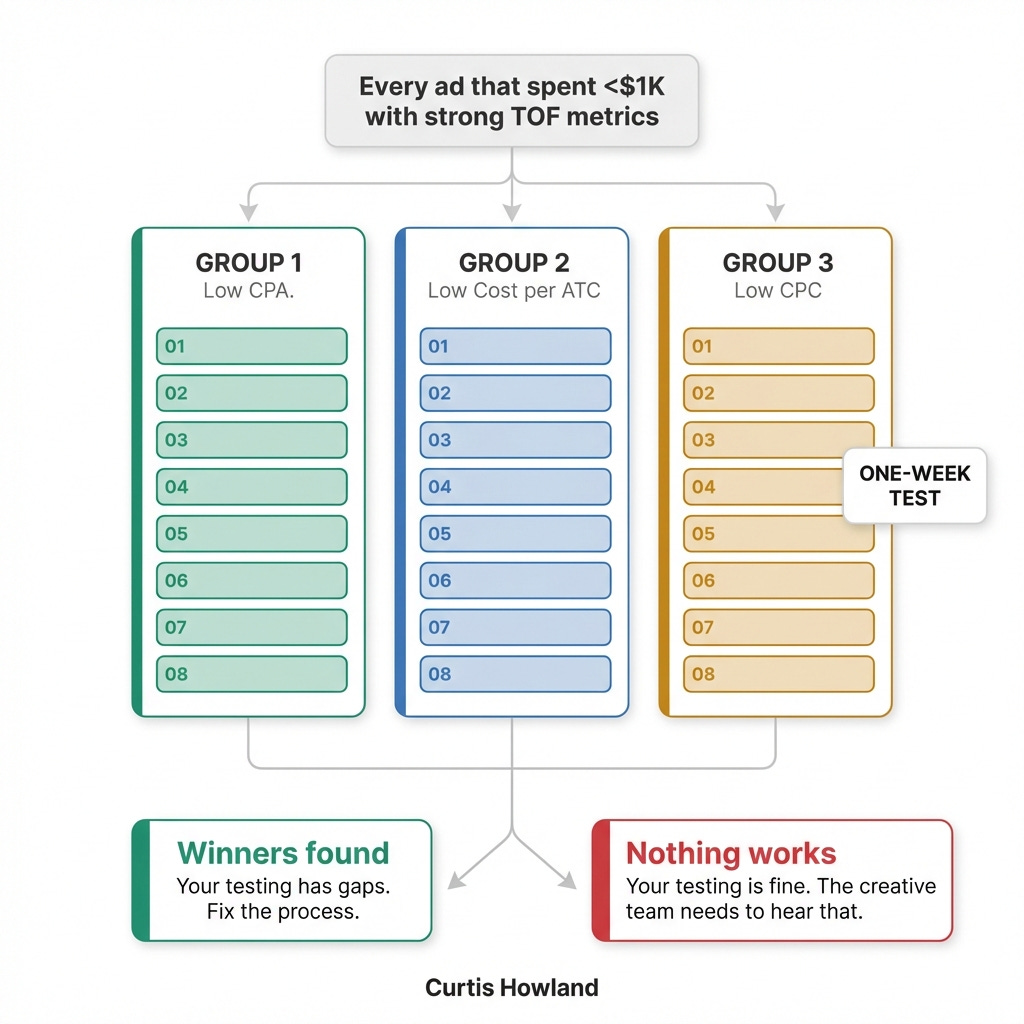
This is the fastest way to turn “you’re killing our ads” from a feeling into a fact. Either the data proves it or it doesn’t.
4. Stagger high-confidence with low-confidence launches
One more testing principle that most brands get wrong.
Let’s say you have a new skincare product and you drop 100 new ads in a week for it. All new products, all new creative. The result: ~10% win rate, and a ton of wasted test spend, and a week of terrible account performance while the algorithm sorts through the wreckage.
The fix is simple. Instead of launching 100 new ads in one shot, alternate between high-confidence and low-confidence batches. Launch an ad set of new product creative, then an ad set of proven winners (your core product, your hero SKU, whatever is already working). New batch, proven batch, new batch.
Why this works: you’re giving the algorithm ads that are likely to convert between the experimental ones. It stabilizes account performance while you test, and it means you’re not stacking 7 consecutive ad sets of unproven creative on top of each other.
Quick rule of thumb: Established products with proven creative angles hit at about a 20% win rate. Net new products with untested concepts hit closer to 10%. (Adjust if you measure hit rate differently) That difference is massive when you are trying to keep the account rolling and manage test spend.
If you’re launching 100 ads of established product variations, you can expect ~20 winners. If you’re launching 100 ads of brand new products, you’re looking at ~10. Plan your test budget and your expectations accordingly.
5. Use organic performance as a pre-filter (when you can)
This won’t work for every brand, but if you have an active organic presence, it’s a cheat code.
If a product or creative concept is performing well on organic social, prioritize it for paid testing first. If you have waitlist data, pre-order data, or any other signal of demand, use that to sequence what you test.
The goal is reducing wasted test spend by front-loading the creative that already has some signal behind it. It doesn’t guarantee a paid winner, but it tilts the odds.
Was this forwarded to you? I break down the systems behind scaling DTC creative and media buying every week.
Part 2: The Bar Keeps Moving (and That’s Not Anyone’s Fault)
Here’s where I need to level with the creative side.
Even if the data shows your testing process is fair, giving ads enough time, making good decisions... your hit rate is still going to feel terrible. And it’s going to feel worse over time.
Most brands don’t talk about this.
The bar is always going up.
I wrote about this in my post on The Power Law of Ad Creative, but let me put it in the context of how it feels when you’re the one making the ads.
Six months ago, your team made an ad that crushed. $80 CPA, scaled to $50K in spend, everyone was happy. They’re proud of it. They should be.
Today, that same ad concept might not pass your testing threshold.
Not because it got worse. Because everything around it got better.
Your account’s top performers set a new ceiling. The algorithm found more efficient delivery paths. Your ROAS targets went up. Maybe your spend scaled and you need ads that work at higher volumes now.
Your competitors also got better, and now you are competing against bigger players.
This is how power laws work. You’re always raising the floor. An ad that was “great” at $100K/month in total account spend might be “average” at $300K/month. The winners keep winning harder, and every new ad is competing against your best, not your average.
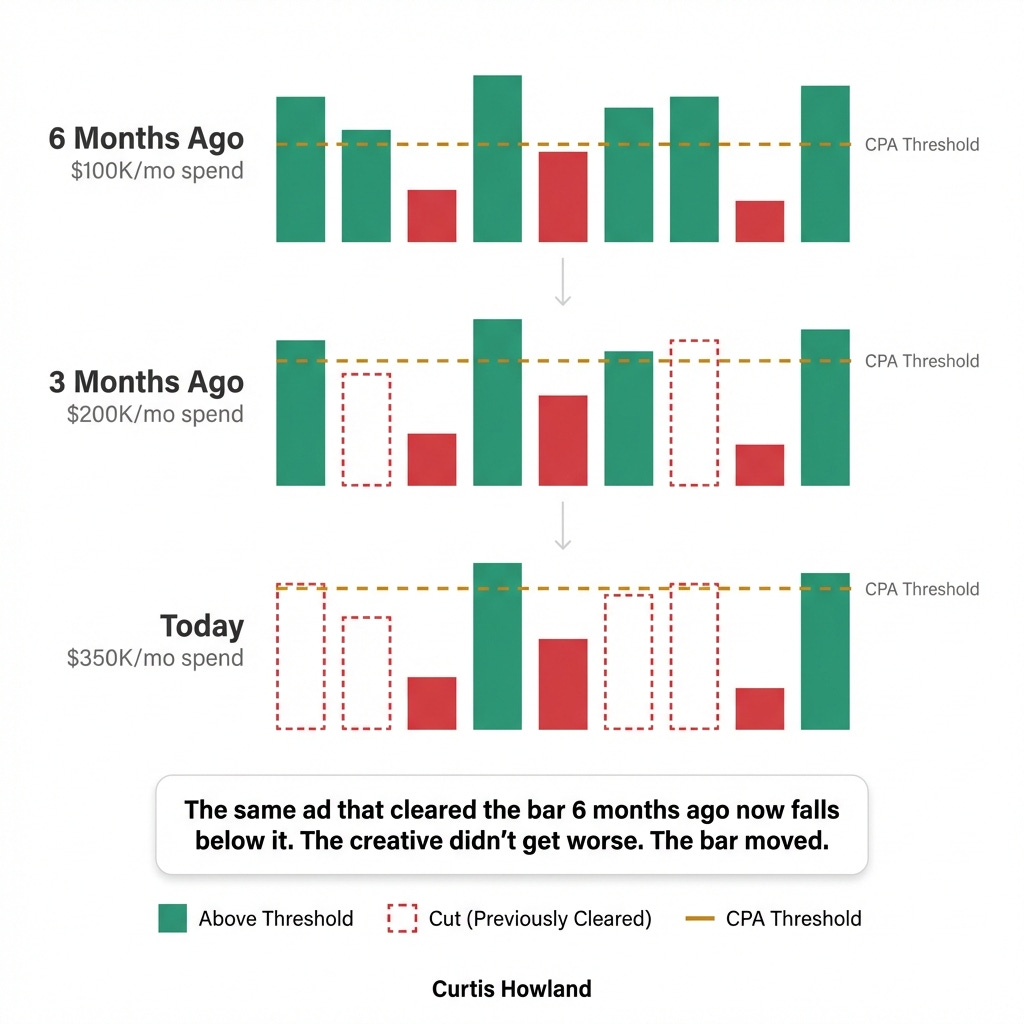
What this means for your creative team: their “hit rate” will naturally decline as your account matures. If they keep improving the hit rate might stay the same.
My solution is to measure “big hits” $25k ads / $100k ads or whatever makes sense for your team.
Anytime your creative team creates an ad that hits $100k study it, learn from it, and celebrate it.
As you scale this keeps you focused on those big wins (which drive the account) and you can still celebrate wins.
Part 3: The Power Law Hit Rate Problem
Studies show that people are happiest when they succeed 80% of the time. That’s the magic point where they feel stretched but accomplished. But in power laws most things fail which stings.
Meta advertising doesn’t follow a normal distribution. It follows a power law.
In a power law, a small number of ads do the vast majority of the work. That normally means: 1-2% of your ads end up doing ~50% of your total spend. The rest are either modest contributors or outright failures (the majority).
That means the realistic “hit rate” for a well-run creative operation is not 80%.
It’s closer to 15%. Maybe 20% on a good month.
At best, you’re looking at 20% successes and 80% failures.
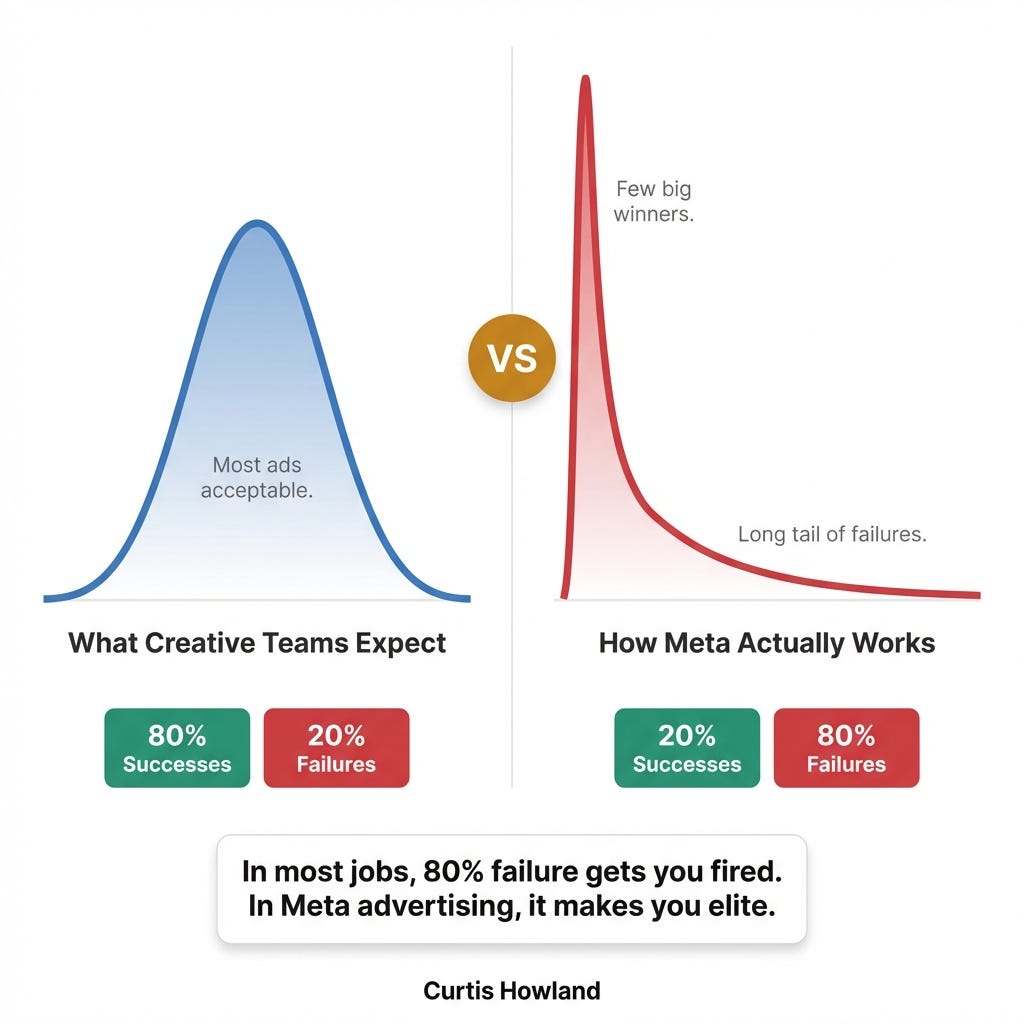
This is not how most professional feedback loops work.
In most jobs, if 80% of your output fails, you get fired. In Meta advertising, if 80% of your ads fail and the other 20% scale efficiently, you’re running an elite operation.
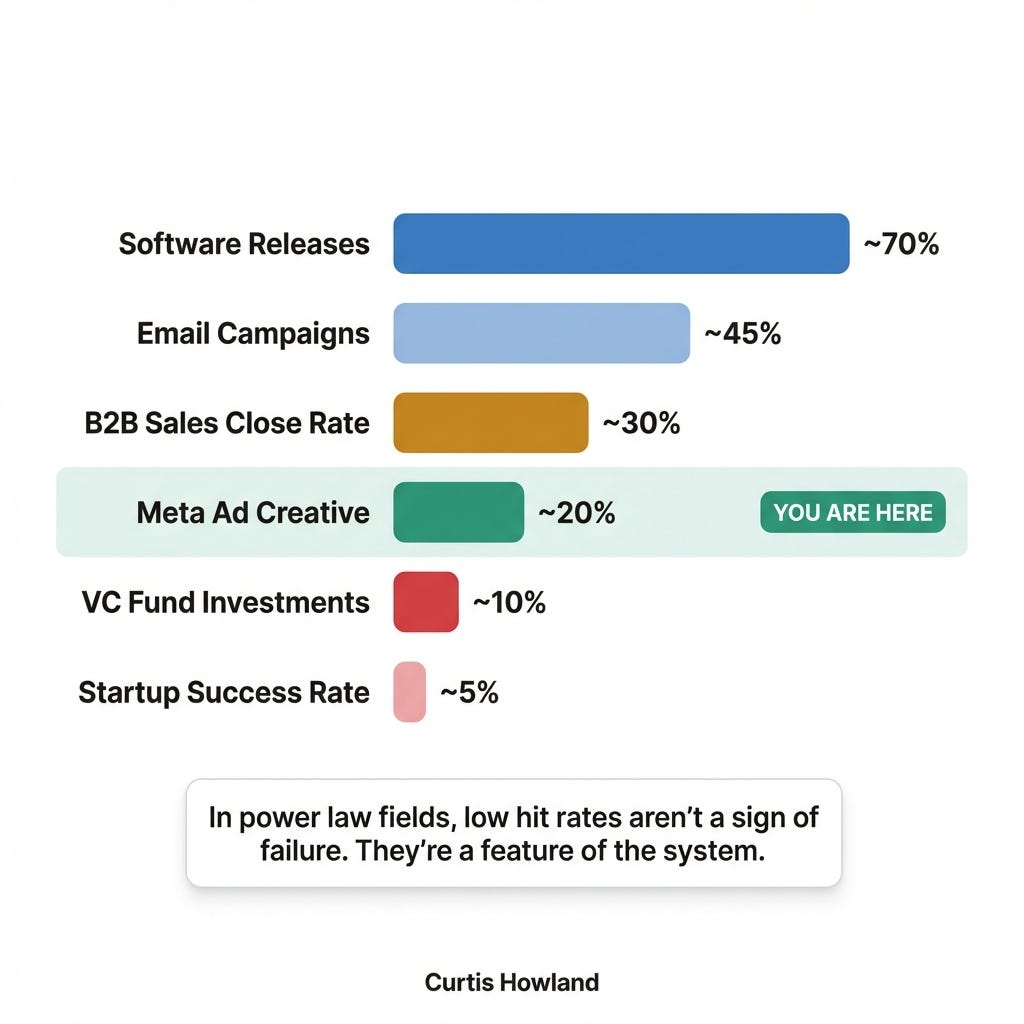
The disconnect between “how professional success normally feels” and “how power law creative production actually works” is the root cause of the tension between creative and media buying inside brands.
Your creative team feels like they’re failing because their mental model says 80% should work. The math says the opposite. And nobody noticed because both sides are using different scorecards.
The bias problem
There’s one more layer here that’s uncomfortable to talk about.
Every creative team loves their own work. That’s not a flaw. That’s what makes them good. You want people who believe in what they’re making.
But it creates a blind spot. I was talking to a team spending $1m+/mo recently and they felt confident there were more winners in there than they were finding. They thought they were too good for 15% hit rates.
And they are good. Their overall ROAS is well above average. Their content quality is elite. But even elite creative teams can’t beat power law math. Having great creative means your winners are bigger winners, and that the bar is now increased. You spend more and your hit rate stays the same. The difference between a great creative team and an average one isn’t 40% hit rate vs. 20%. It’s that the 20% that hit, hit harder and spend overall goes up.
When your team says “we should retest the losers because our content is too good to fail,” the honest answer is usually: it’s not worth the test spend. If an ad was going to be a big winner, it would have shown at least some signal in the first pass. Retesting to find a few more mediocre performers in the middle doesn’t change the math.
Part 4: The Similarity Tax
One more thing that kills creative performance and gets misattributed.
An ad that’s too similar to what’s already in the account won’t find its own audience.
Meta’s system is trying to find unique audiences for each ad. If two ads are nearly identical in concept, format, hook, and visual style, they’re competing for the same eyeballs. The system will pick the one with better historical data (your existing winner) and suppress the new one.
So your creative team makes a variation of something that worked. It launches. It dies. They blame the testing process.
But the real problem is the ad wasn’t different enough to find its own audience.
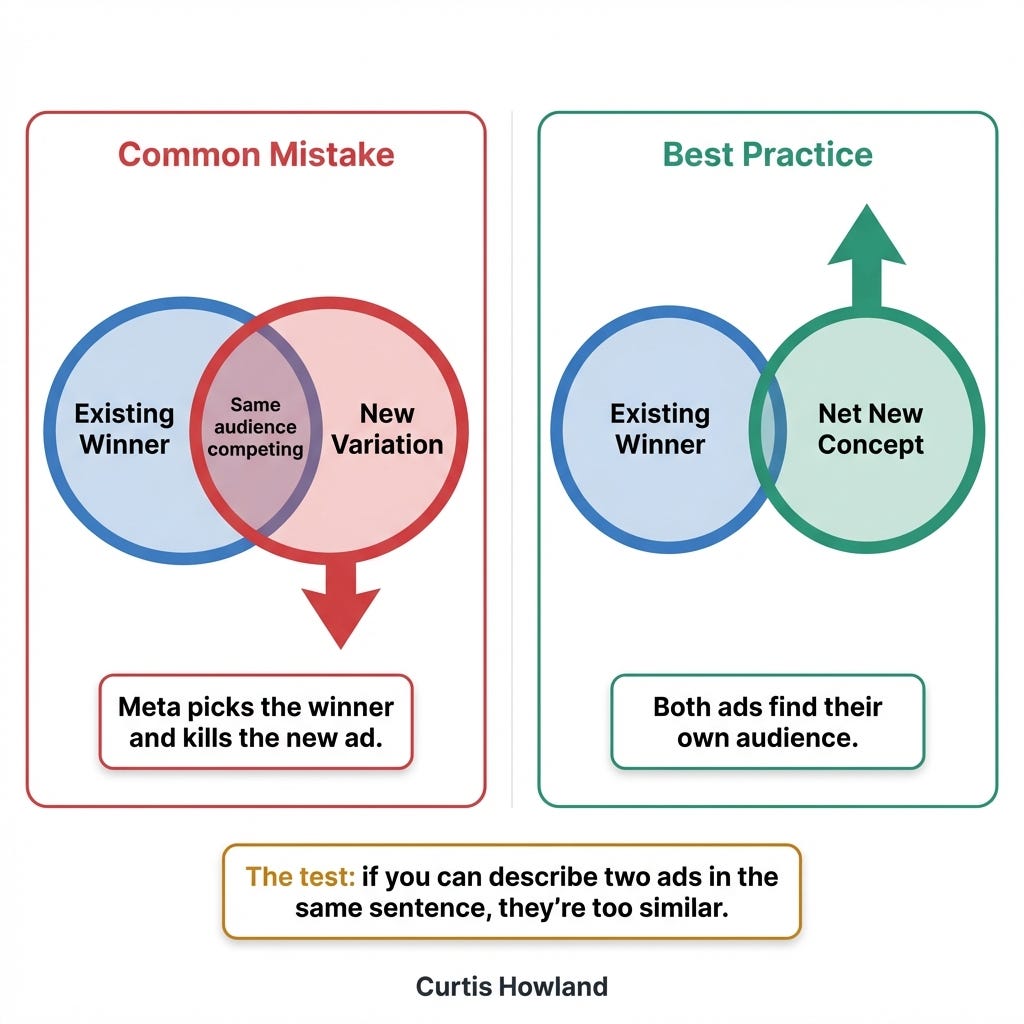
This is where it gets tricky. The best creative operations push hard on net new concepts, not just variations of winners. Variations have their place (they replace concepts that are fatiguing and help you improve), but the concepts themselves need to be different.
The practical rule: if you can describe two ads with the same sentence, they’re probably too similar.
Don’t take this too far though.
Take a concept and apply it to another product
Take an ad and apply to another format
Take a USP and speak to it in a new way
Just dont take the same static, same headline, and lightly tweak the colors or sub copy and expect it to win again.
Putting It All Together
Here’s what to do next time your creative team says, “You’re cutting our best ads too soon.”
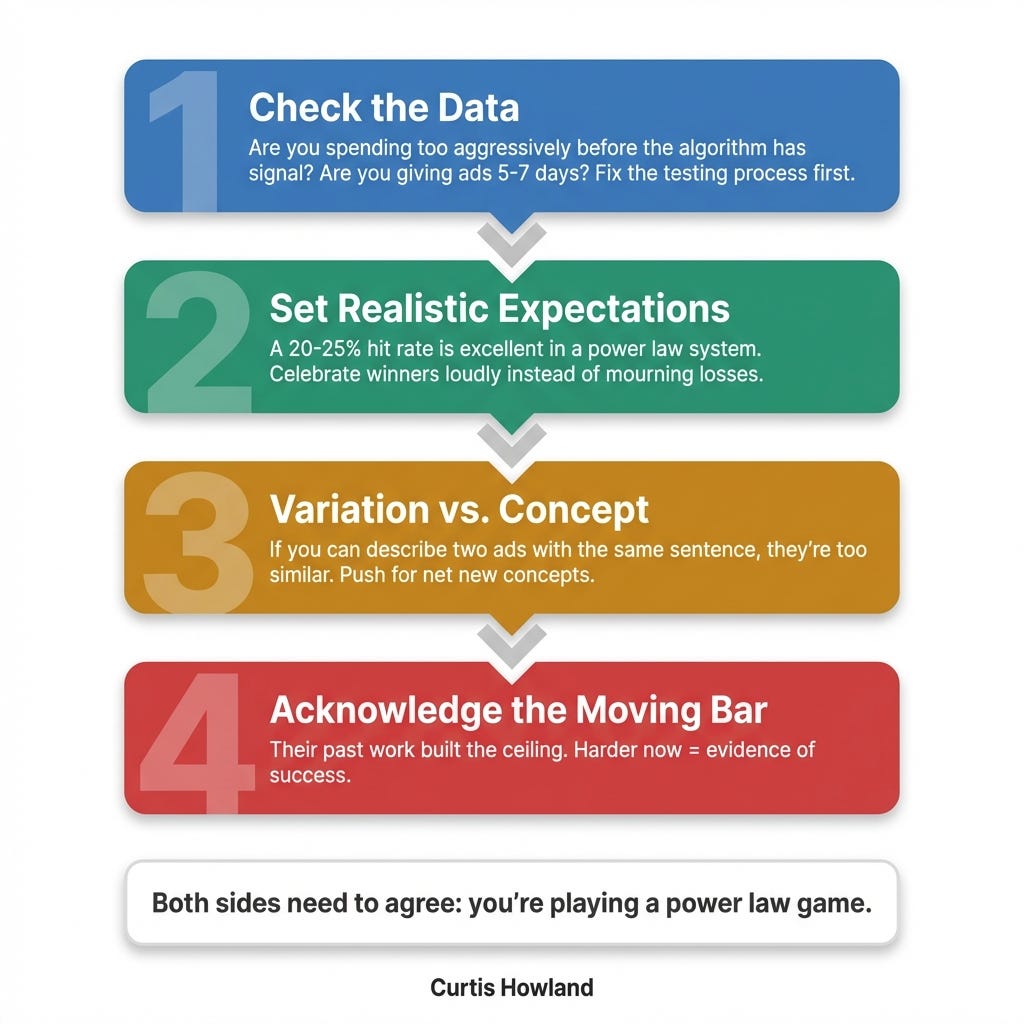
Step 1: Check the data. Are you spending too aggressively before the algorithm has signal? Are you giving ads at least 5-7 days before calling it? If not, fix the testing process first.
Step 2: Set realistic expectations. A 15-20% hit rate is excellent in a power law system. Frame it that way for your team. Celebrate the winners loudly instead of mourning the losses.
Step 3: Variation vs. concept. Variations of existing winners will underperform because of audience overlap. Push for net new concepts and accept that most of them will fail. That’s the game.
Step 4: Acknowledge the moving bar. Show your creative team how the account’s performance ceiling has risen over time. Their work from 6 months ago built that ceiling. The fact that it’s harder now is evidence of success, not failure.
The best brands I work with share one trait: the people making the ads and the people buying the media have agreed on what “winning” looks like in a power law system. They stopped keeping score the wrong way.
If this changed how you think about creative performance, send it to someone on your team who needs to see it.