

Builds credibility with an expert.
And only THEN introduces your product.
Most DTC brands do the opposite. They lead with the product, assume awareness, and wonder why their ads can’t scale past $2k/day.
Here’s what they’re missing:
In the Advantage+ era, creative doesn’t just communicate. Creative IS the targeting.
The structure of your ad determines which stage of the funnel it targets. Not your audience selection. Not your campaign setup. The creative itself.
And the ads that scale to $10k+/day? They all follow the same pattern.
Let me show you what separates top-of-funnel ads from middle and bottom-of-funnel—and why understanding this is the difference between a $3k/day account and a $30k/day account.
Quick Context: Why Creative Became Your Audience
Meta’s algorithm processes billions of impression opportunities per second.
Your “detailed targeting” is a suggestion it may start out with but then eventually ignores. (Im not against using it to start but just dont expect Meta to respect it)
When you use Advantage+, the algorithm decides who sees your ad based on who’s most likely to convert. And it figures that out by watching how people respond to the creative.
→ High engagement on a specific hook? Meta shows it to more people like that.
→ Someone watches 75% then bounces? Meta learns who NOT to show it to.
→ Unexpected converters from outside your target? Meta finds more of them.
The creative structure tells Meta who to target.
This isn’t about building separate campaigns for TOFU/MOFU/BOFU. That’s overcomplicating it.
This is about understanding: the internal structure of your creative determines which part of the funnel it targets, regardless of your audience settings.
Here’s how it breaks down:
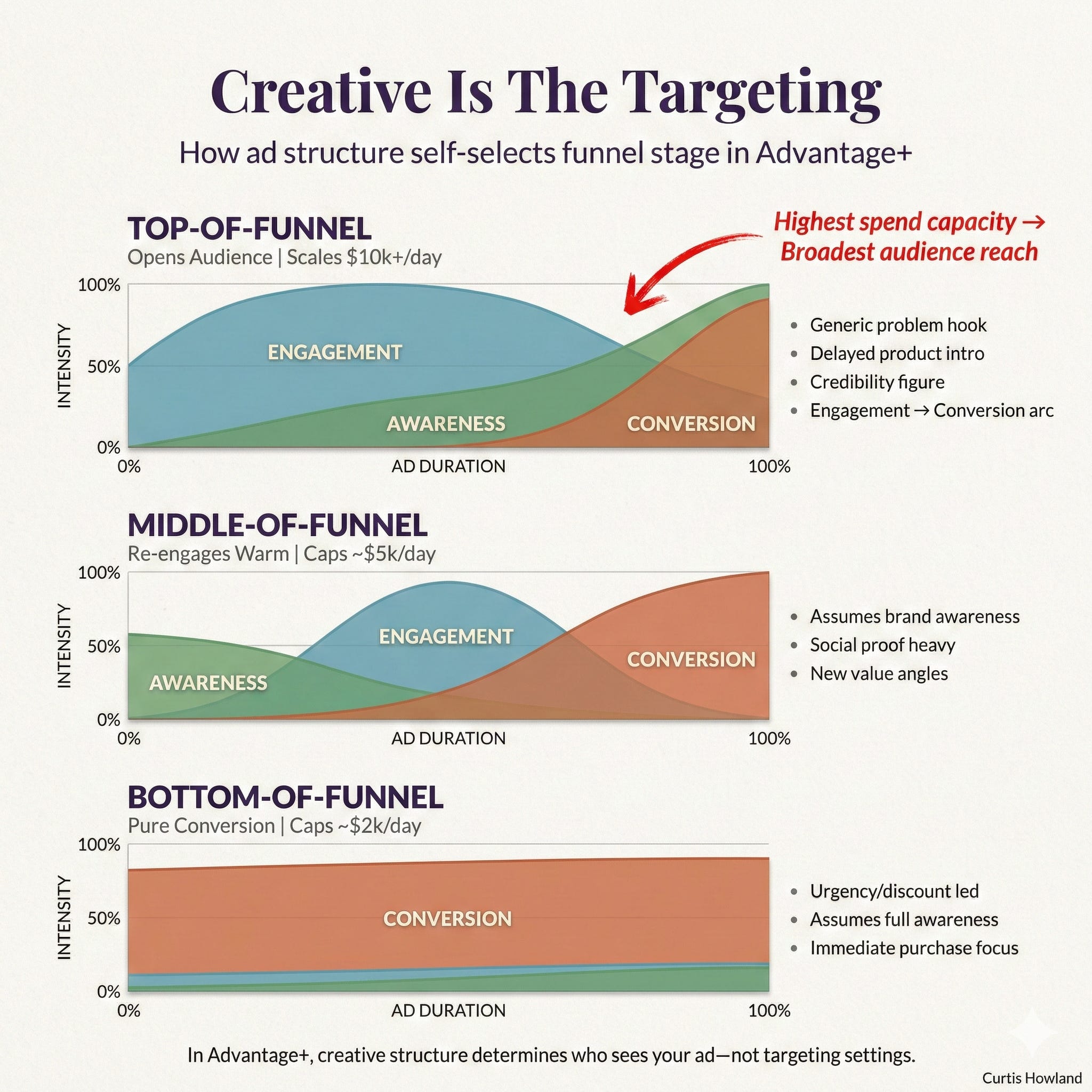
Top-of-funnel ads start with high engagement, build awareness, then drive conversion. They open up your audience and scale to $10k+/day.
Middle-of-funnel ads assume some awareness, spike engagement in the middle with proof points, then push conversion. They re-engage warm audiences but normally cap around $5k/day.
Bottom-of-funnel ads are pure conversion from start to finish. They extract immediate purchases and top out around $2k/day.
(These spends are relative to your business size and will change with seasons like black friday, but high-level, TOF ads have higher scale & lasting potential.)
The creative structure determines which audience Meta shows it to.
Let me show you exactly what this looks like with a real brand’s creative portfolio.
Case Study: Grüns’ Creative Portfolio
Grüns is one of the fastest-growing DTC brands in the greens category.
I analyzed 100+ of their top-performing ads and pulled out some favorites to show you the pattern.
Here’s what I found:
→ 70% their ads and a majority of long-running winners are “Identity” or “Problem” focused
→ The long-runners rarely lead with the product
→ I found only 1 ad that was a hard-sell discount (they do run some others, but its not their focus)
→ The TOFU ads target specific identities: van-lifers, Ozempic users, busy moms, hikers
Pattern:
The ads that scale target identity and problems.
The ads that discount aren’t the focus for them.
Lets break down exactly how each funnel stage works using these real examples.
Top-of-Funnel Ads: How to Open Up Your Audience
What makes an ad top-of-funnel:
Speaks to a generic problem (millions of people have it, not thousands)
Delays product introduction (builds intrigue first)
High engagement hook (pattern interrupt that stops the scroll)
Uses identity targeting (speaks to who you are, not what you need)
Engagement → Education → Conversion (start with stopping power, build to purchase)
Example 1: The “Van Life” Ad (TOFU Video)
What it does:
→ Opens with a relatable pain: spilled green powder in a tiny van kitchen
→ Targets a group (van-life aspirers) that interest targeting can’t find
→ Doesn’t mention Grüns until 8 seconds in
→ Agitates the specific pain of “messy powders in small spaces”
Why it ran for 6 months:
This creative does Meta’s job for it. It finds people who:
→ Care about nutrition
→ Live in small spaces
→ Value portability
→ Are lifestyle-oriented (not just deal-hunting)
Interest targeting would have said “target people interested in RVs and health food.”
The creative said “target people who identify as someone living in small spaces and struggling with nutrition.”
Those are different audiences. And the second one converts better.
Run time: 6 months (April – Oct) Estimated daily spend: $5k-10k+ based on longevity
Example 2: The “Ozempic User” Ad (TOFU Video)
What it does:
→ Trend-jacks a cultural moment (GLP-1 drugs like Ozempic)
→ Speaks to a hyper-specific problem: nutrient deficiency from appetite suppressants
→ Uses skepticism as the hook (”I keep seeing ads saying...”)
→ Builds credibility through the mechanism (GLP-1s curb appetite
→ hard to get nutrients)
Why this works:
You can’t target “Ozempic users” in Meta.
But you can make a creative that ONLY resonates with Ozempic users.
The algorithm figures out who that is by watching who engages, who converts, and who shares.
Within 48 hours, Meta knows exactly who this ad is for. And it starts showing it to people who’ve searched for Ozempic, engaged with weight-loss content, or fit the behavioral profile of GLP-1 users.
The creative did the targeting.
Run time: 6 months (April – Oct)
Example 3: The “2pm Crash” Ad (TOFU Static)
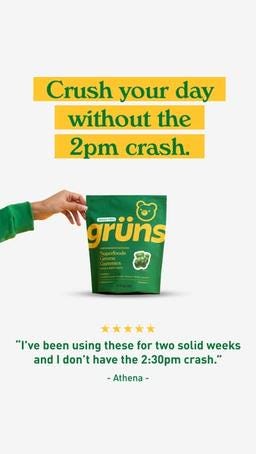
What it does:
→ Speaks to a specific time of day (2:00 PM) where the target audience feels maximum pain
→ Uses social proof in the creative itself (5-star review)
→ Product is secondary to the problem
Why it works:
Everyone who works in an office knows the 2pm crash.
But here’s the key: the creative doesn’t say “office workers.” It doesn’t say “9-5.” It just says “2pm crash.”
And Meta figures out who that resonates with:
→ Desk workers
→ Shift workers
→ Parents managing afternoon fatigue
→ Anyone who identifies with that specific pain point
The creative targeted the problem. Meta found the people.
Run time: 6 months (April – Oct)
The TOFU Pattern
All three of these ads ran for 6 months.
None of them lead with the product.
None of them use urgency or discounts.
All of them target identity or problems that millions of people have.
And that’s why they scale.
TOFU ads that work:
→ Find identity-based audiences interest targeting can’t reach
→ Speak to universal problems in specific ways
→ Let Meta’s algorithm figure out who converts
→ Scale to $10k+/day because the TAM is massive
Middle-of-Funnel Ads: Re-Selling People Who Already Know You
What makes an ad middle-of-funnel:
Assumes brand awareness (”We’re better than them”)
Leads with differentiation (Why THIS solution vs others)
Heavy on social proof (20,000+ reviews)
Comparison-focused (Us vs Them)
Example 4: The “Us vs. Them” Ad (MOFU Static)
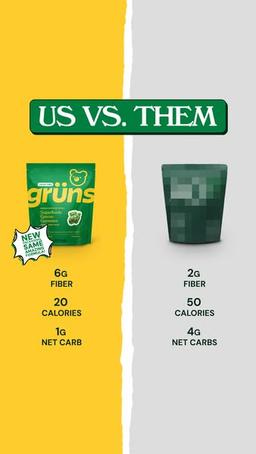
What it does:
→ Split screen comparison: Grüns vs AG1 (blurred out)
→ Wins on specs: 6g fiber vs 2g, 20 calories vs 50, 1g net carb vs 4g
→ Assumes you’re already shopping for greens supplements
Why this is MOFU:
This ad doesn’t explain what the product is.
It doesn’t build awareness of the problem.
It assumes you’re already in the market for a greens supplement and you’re deciding between brands.
The targeting happens through the creative:
If you’re not already aware of AG1 and comparing greens supplements, this ad means nothing to you.
But if you ARE in that comparison phase? This ad speaks directly to you.
Meta figures out who’s in “comparison mode” by watching:
→ Who engaged with greens supplement content recently
→ Who visited competitor sites
→ Who added to cart but didn’t buy
Run time: 6 months (April – Oct) Scale: estimated $2k-5k/day (scale is limited as it requires existing awareness)
Example 5: The “20,000+ Reviews” Ad (MOFU Static)
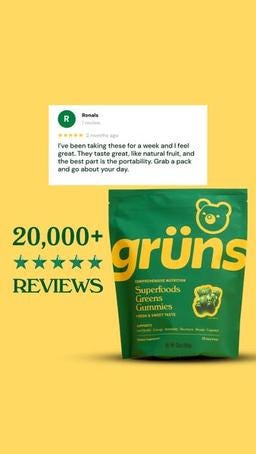
What it does:
→ Massive social proof number (20,000+ reviews)
→ Highlights a specific review about taste and portability
→ Uses “herd mentality” (if 20,000 people liked it, it must be safe)
Why this is MOFU:
This ad targets skeptics who already know about Grüns but haven’t bought yet.
It doesn’t educate about the problem.
It doesn’t build the mechanism.
It just says: “20,000 people already bought this. Join them.”
Run time: 6 months (April – Oct)
The MOFU Pattern
These ads ran for 6 months.
But they almost certainly didn’t scale as big as the TOFU ads.
Why?
They require existing awareness.
The comparison ad only works if you know what AG1 is.
The social proof ad only works if you’ve already considered buying.
But its still super valuable, you are speaking to different people with each of these.
You are building out your funnel like the old school days.
MOFU ads:
→ Re-engage warm audiences
→ Break through skepticism with proof
→ Top out at $3k-5k/day (limited by awareness pool)
Bottom-of-Funnel Ads: Pure Conversion
What makes an ad bottom-of-funnel:
100% conversion-focused (discount is the hook)
Urgency and scarcity (BOGO, limited time)
Assumes full awareness (you know the product, here’s a reason to buy NOW)
Transactional (no education, no identity, just the deal)
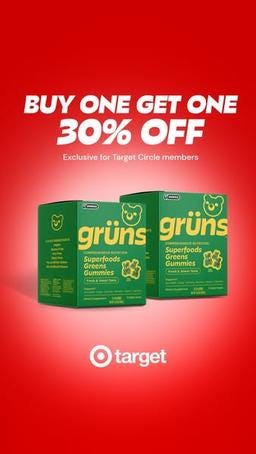
Example 6: The “Target Circle” Ad (BOFU Static)
What it does:
→ Lead with discount: “BUY ONE GET ONE 30% OFF”
→ Exclusive for Target Circle members
→ Red background (Target brand colors)
→ Product front and center
Why this is BOFU:
This ad does ONE thing: extract immediate conversions from people who already know the product.
No education. No identity. No problem awareness.
Just: “Here’s a deal. Buy now.”
The key insight:
This is the ONLY discount-led ad in Grüns’ 100 ads I reviewed.
Its currently running but It’s not designed to scale. It’s designed to extract.
Estimated run time: 2-4 weeks (promotional period only) Scale limited to existing awareness, which Grüns built with their TOFU ads.
The BOFU Pattern
This ad won’t run for 6 months like the TOFU ads.
Its going to run for a promotional period and then stop.
Because BOFU ads:
→ Extract conversions from hot prospects
→ Fatigue quickly (same offer to same people)
→ Can’t open up new audiences
→ Cap spend based on previous awareness
BOFU is helpful to close skeptical customers, especially during promo periods with limited timeframes. But it’s not where customers start their journey.
The Portfolio Breakdown
Here’s what Grüns’ portfolio tells us:
TOFU ads (Identity & Problem-focused):
→ ~70% of ads+
→ All ran 6+ months
→ Target identity (van-lifers, Ozempic users, busy moms)
→ Target problems (2pm crash, gut health, messy powders)
MOFU ads (Comparison & Social Proof):
→ ~20% of ads
→ Ran 6 months but didn’t scale as big
→ Target comparison shoppers and skeptics
BOFU ads (Discount-led):
→ Less than 10% of ads
→ Short-term promotional period
→ Target deal hunters and existing customers
Scale comes from identity and problems. Extraction comes from discounts.
If your portfolio is inverted (mostly BOFU creative), that’s your growth ceiling.
How This Changes Your Creative Strategy
Creative audit questions:
Pull your top 20 ads by spend.
Ask yourself:
→ Does this ad assume the viewer knows my brand? (If yes: MOFU or BOFU)
→ Does this ad lead with the product or a problem/identity? (Product = MOFU/BOFU, Problem/Identity = TOFU)
→ Do my ads last a long time?
What you’ll probably find:
Most brands over-index on BOFU creative due to reliance on easy quick conversaion and last click attribution:
→ Product-forward
→ Discount-led
→ Assumes awareness
And they wonder why they’re stuck at $5k/day.
The fix:
Build more TOFU creative that:
→ Targets identity (who they are, not just what they need)
→ Speaks to problems (not products)
→ Opens up audience pools (doesn’t close them down)
The portfolio target:
→ 70% of testing budget → TOFU creative
→ 20% of testing budget → MOFU creative
→ 10% of testing budget → BOFU creative
Bottom Line
The Grüns ads that ran for 6 months straight never asked for the sale.
They told stories about:
→ Van life
→ Ozempic side effects
→ Afternoon energy crashes
→ Hiking with kids
→ Gut health
They used creative to find the identity of the buyer.
The only ad focused on extraction (the discount) was temporary.
Scale comes from identity, not discounts.
In the Advantage+ era, creative structure determines who sees your ad more than targeting ever will.
TOFU ads open up your audience. They target identity and problems. They scale to $10k+/day and run for 6+ months.
MOFU ads re-sell people who know you. They target comparison shoppers and skeptics. They top out.
BOFU ads extract conversions from hot prospects. They’re efficient but limited.
Build your portfolio accordingly.