

You know the setup. You open Ads Manager, CPM is sitting right there in the column, and every instinct says lower is better. Cheaper is winning. A rising CPM feels like something broke.
And in some way, reaching more people is better, but it only matters if those people might ever become your customer (paying attention, the right audience, and the right timing) or remember to talk about you. Otherwise, it doesn’t matter how cheap it is.
The most expensive ad on earth is cheaper than you think
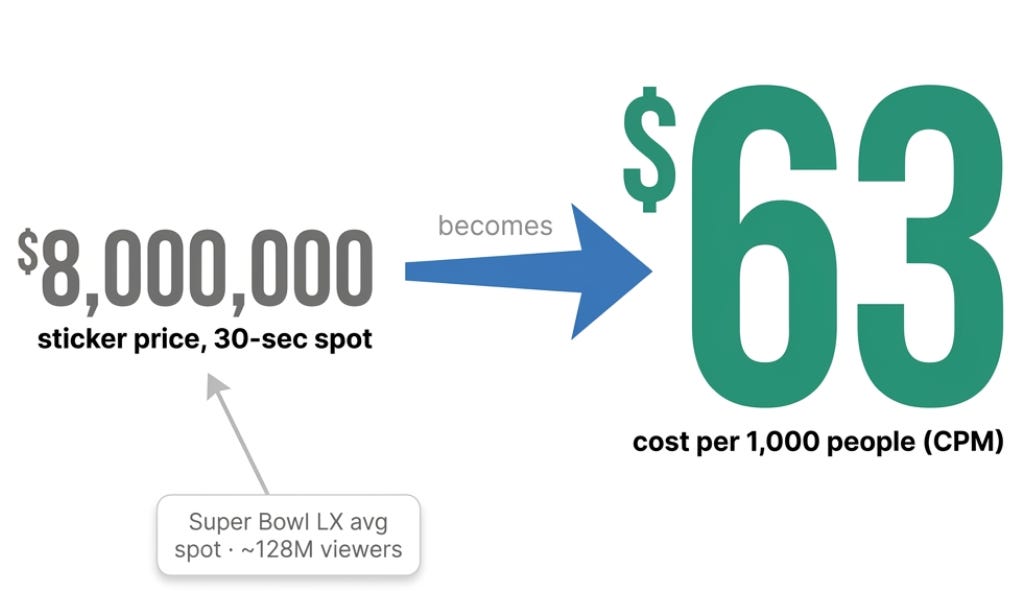
The Super Bowl. A 30-second spot in this year’s Super Bowl averaged $8 million.
The Super Bowl draws around 128 million viewers (last year’s set a record at 127.7 million). Eight million dollars, divided by 128 million people, times a thousand, is a CPM of about $63.
Sixty-three dollars to reach 1,000 people. During the Super Bowl.
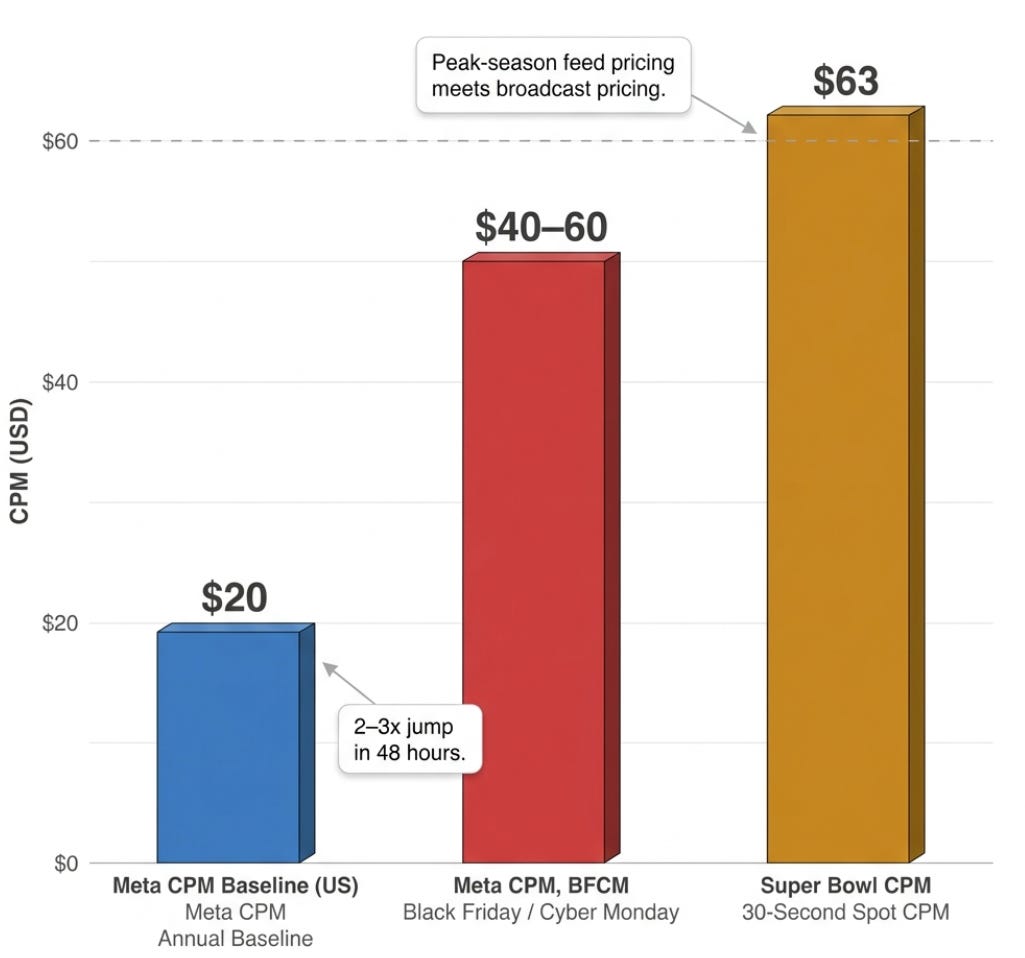
For reference, blended Meta CPMs for e-commerce sit around $13 to $14, and US CPMs run $20 to $23. So the single most expensive placement on the planet costs about three to four times what you are already paying in the feed. Consider the extra views after and the high engagement and it’s a very reasonable spot for a wide TAM product. (Is this a Tide ad?)
Meta CPMs on Black Friday and Cyber Monday routinely run two to three times the annual baseline. During BFCM, you are paying something close to Super Bowl CPMs to reach people scrolling on the couch.
The Super Bowl is not expensive because of its CPM. It is expensive because you have to buy 128 million people at once.
The ladder, from $2 to $1,000
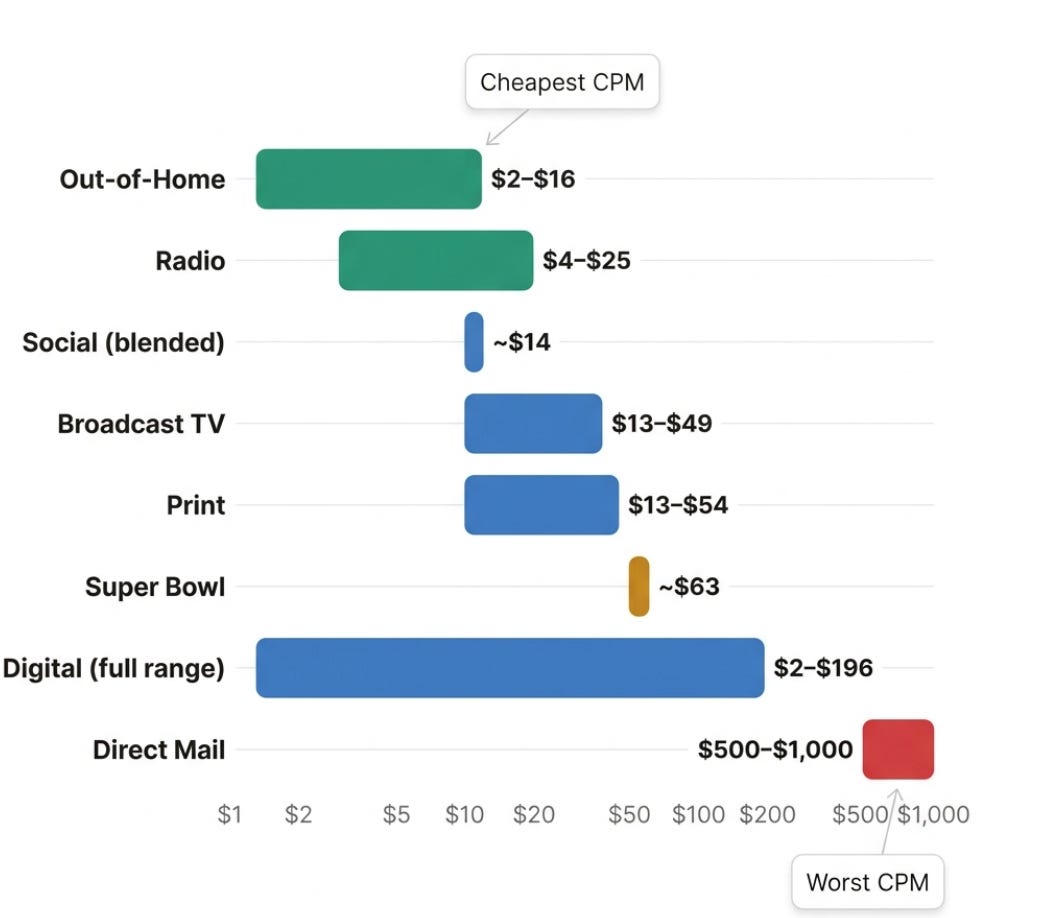
At the cheap end, out-of-home. Billboards run a CPM of about $2 to $16. Radio, $4 to $25. Those are the bargains of the media world on a cost-per-eyeball basis.
Then the middle. Social sits in the low teens to low twenties depending on objective and geography. Broadcast TV runs $13 to $49. Print, $13 to $54. Digital as a whole is all over the map, $2 to $196, because every targeting layer and premium placement stretches the range.
Direct mail runs a CPM of $500 to $1,000. Fifty cents to a dollar per piece. That is 30 to 70 times the cost of a billboard to reach the same 1,000 people.
The ranking by CPM is almost the inverse of the ranking by attention. The cheapest impressions, a billboard you drive past, a banner you never scroll to, are the ones people barely register. The most expensive impression on the list, a physical piece of mail someone holds in their hands, is the one that actually gets read.
Marketing that couldn’t get on that spectrum stops working. For example, airplane skywriting ads from the 1930s. TV CPMs obliterated the cost vs total view ratio, and it died a decade or two later.

Why the cheapest CPM is usually the worst buy
First, cheap impressions are often not real. Industry estimates put bot traffic at 10 to 30 percent of digital impressions. Those bots aggregate in certain areas so your $2 digital CPM is often a ton of bots.
Second, expensive impressions often convert better. Direct mail carries that eye-watering $500-plus CPM, but it averages a 4.4 percent response rate against 0.12 percent for email. Then it stacks, and those people tend to progress through the funnel more effectively as well. That’s the only reason direct mail can sometimes compete (Spectrum, please stop sending me mail, please).
Meta is the cleanest example. CPMs rose roughly 20 percent across 2025. Everyone felt it. But conversion rates rose about 8 percent in the same window, because the delivery system got better at finding buyers. The brands with strong creative absorbed the higher CPM and scaled.
The goal is not impressions. Its outcomes. CPM measures the shallowest end of the funnel, but it’s not really what you care about.
What to do with all this
CPM is an input. It answers one narrow question: what did it cost to be seen. It says nothing about whether being seen was worth it.
So two rules of thumb.
Use CPM to compare inside a channel and strategy, never across channels. A rising Meta CPM against your own Meta baseline in the same strategy is a potential signal. A Meta CPM against a billboard CPM is largely irrelevant in my opinion.
And judge every channel on cost per outcome, not cost per impression. The cheapest way to reach 1,000 people and the best way to reach 1,000 people are almost never the same thing. (Even if the goal is awareness not conversions).
Happy media buying!
Curtis
Sources
Super Bowl LX ad cost and viewership: eMarketer, https://www.emarketer.com/content/super-bowl-ads-will-reportedly-cost-8-million-per-30-second-slot ; AdWave, https://adwave.com/resources/super-bowl-commercial-cost
Meta / Facebook CPM benchmarks: Triple Whale, https://www.triplewhale.com/blog/facebook-ads-benchmarks ; Sovran, https://sovran.ai/benchmarks/meta-ads-cpm-by-industry
Cross-media CPM comparison (Solomon Partners 2025 Major Media CPM Comparison): Adams Outdoor, https://www.adamsoutdoor.com/blog/billboard-cpm-how-out-of-home-advertising-compares-to-tv-radio-and-digital-cpm-in-2026/
Digital ad fraud estimates: Adams Outdoor (citing Gitnux), https://www.adamsoutdoor.com/blog/billboard-cpm-how-out-of-home-advertising-compares-to-tv-radio-and-digital-cpm-in-2026/
Direct mail CPM: McCarthy & King, https://www.mccarthyandking.com/the-5-levers-of-direct-marketing/ ; response rate vs email: LettrLabs, https://www.lettrlabs.com/post/direct-mail-stats-2025