

I’ve spent $100M+ on paid social.
And here’s what I’ve learned: Meta is a Power Law game. If you’re playing it like a normal distribution, you’re going to lose.
You are fighting the way the algorithm was built.
Let me show you what I mean.
The $150K Account That Sold for $100M
A founder came to me frustrated. They were spending $150K/mo on Meta at a $110 CPA. Revenue had flatlined. They couldn’t break through.
I looked at their account and saw two problems:
Problem 1: Their creative was too safe.
Same formats. Same angles. Same UGC style. They were proud of their 30% “hit rate.” They thought that was good.
Problem 2: Their media buying wasn’t scaling winners.
They’d spent big on influencer content upfront. Now they were trying to “get their money’s worth” by forcing spend into those assets instead of letting the data pick winners. They were optimizing for sunk cost, not performance.
Additionally, they were struggling to make good decisions on the data.
The result? A flat, predictable account. Consistent mediocrity. A normal distribution of results where everything performed... okay.
Here’s what we changed:
On creative, we swung bigger. More diverse concepts. Riskier angles. We still had some iterations but we started exploring unknown territory.
On media buying, we let winners win. When something broke out, we scaled it hard. We stopped spreading budget evenly and started concentrating spend into the top performers.
The results:
We cut CPA by 48% in the first phase (just media buying). Then another 50% after that (creative hits started working).
Total: 74% lower CPA. Spend tripled to $500K/mo. All within the first 6 months.
They sold the company for over $100 million.
What changed? We stopped playing a normal distribution game and started playing a Power Law game.
The Two Inputs of a Power Law
Power Laws aren’t magic. They have two inputs:
1. Probability of Occurrence (Set by the quality of your ad production)
This is how likely any given ad is to perform strongly at 10k / 100k / 500k in spend. The potential is primarily a question of creative quality.
2. Exponential Impact (“unlocked via media buying”)
This is how much value you extract when you do find a winner. Its the 10k / 100k/ 500k in spend x ROAS.
So now the question is how do you:
Increase the probability of producing big winning ads
Increase the impact of those winning ads
Before we get into tactics let me make this more concrete by visualizing it with real data from the above account:
First, imagine we plot every ad launched over time in order of launch, with the bar being the total spend/impact.
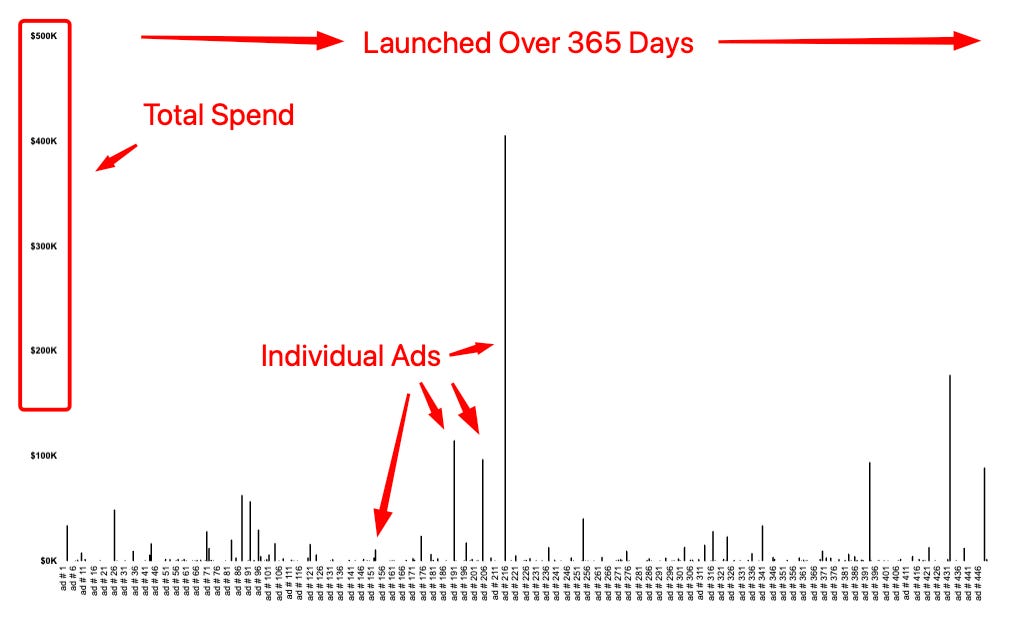
Then look at this chart. Same account. Same ads. Sorted by total spend instead of launch date. —>
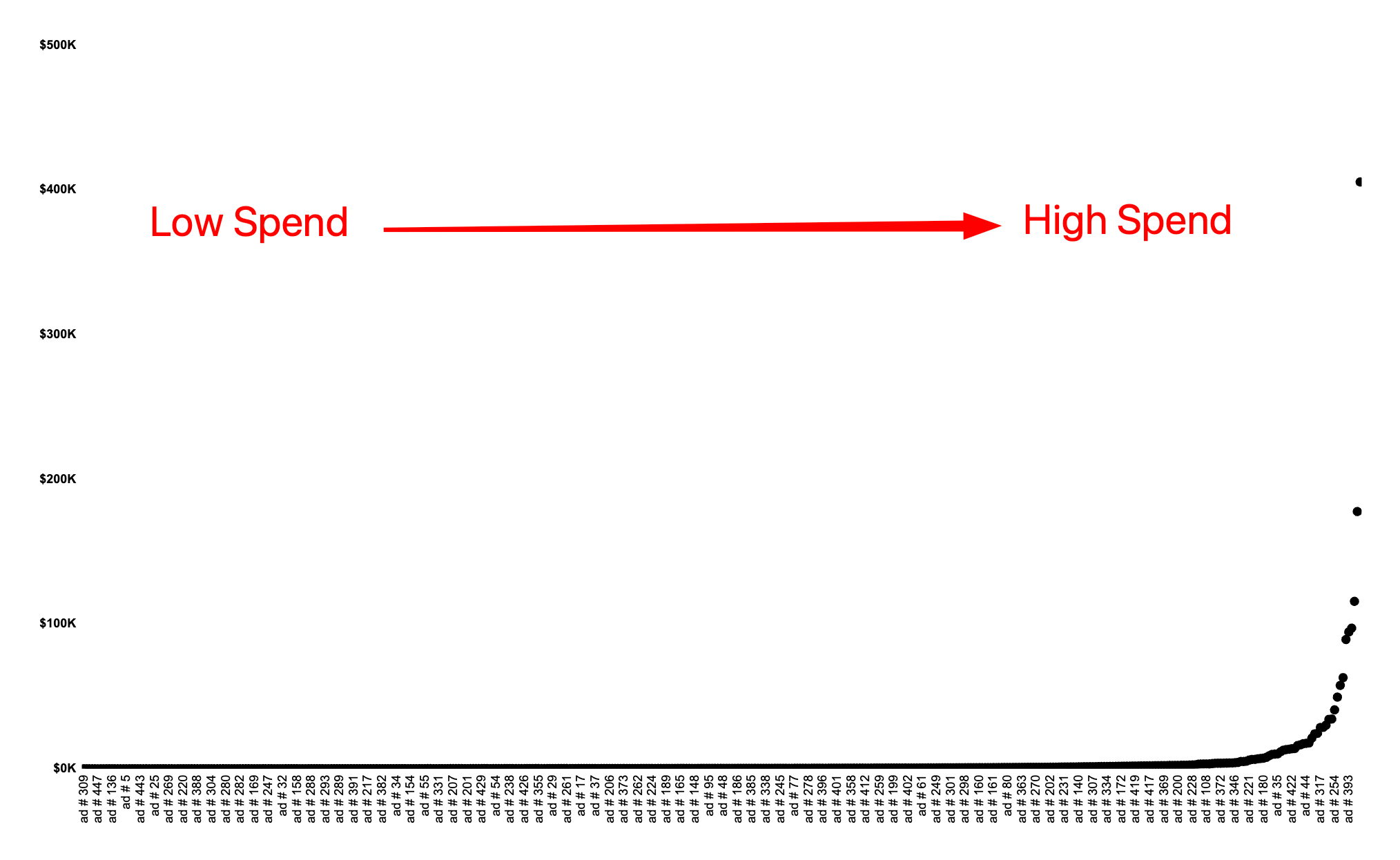
A Power Law looks different: a graveyard of failures on the left, and a vertical wall of outliers on the right.
1-2% of your ads should be doing ~50% of your total spend.
Here is the same data as a pie chart
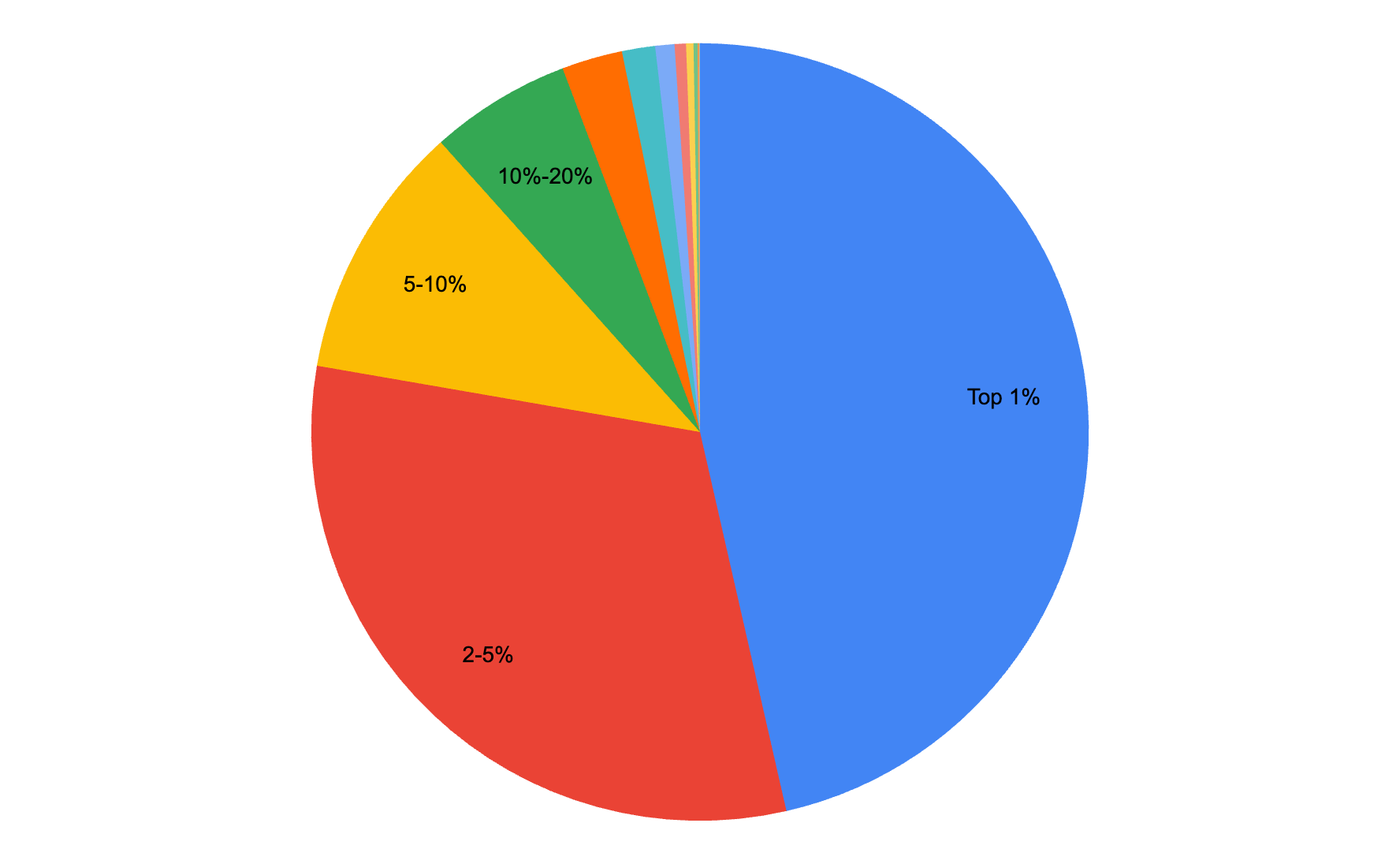
If your account doesn’t look like this, you’re leaving money on the table.
So now how do we scale with this data?
Input 1: Probability of Occurrence (Make great Creative & Take big swings)
The probability curve shows how likely any ad is to hit a given performance level.
For example, bucket the number of ads for each spend range 0-1k, 1-2k, etc. and then divide by the total ads, you should get a chart like this:
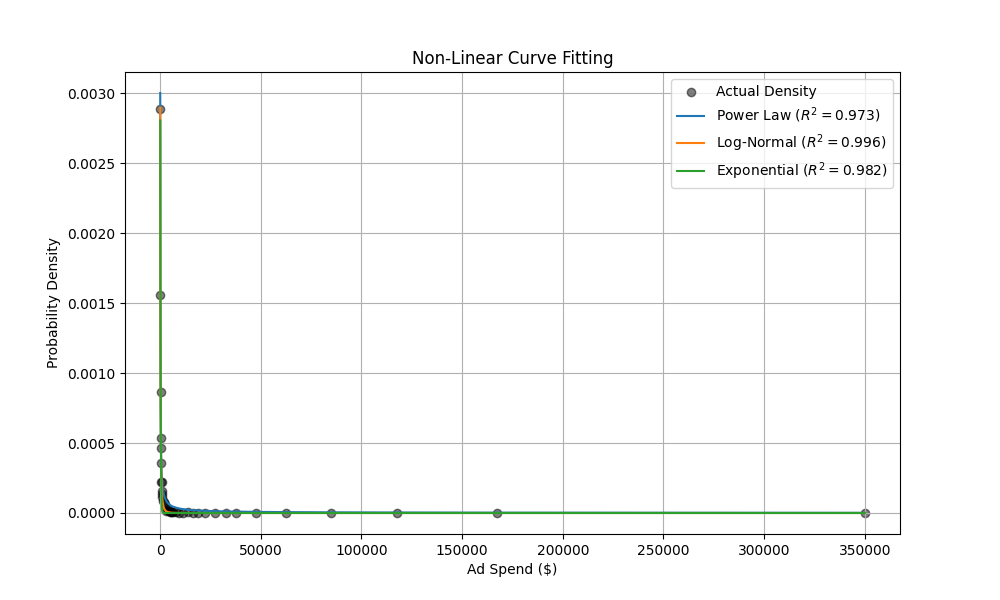
Most ads fail. A smaller number do okay. A tiny number spend $100k+ with strong performance.
This curve is shaped by your creative decisions.
Safe creative: Most ads cluster around average. Few outliers. You’re optimizing for consistency.
Risky creative: More variance. More failures, but also more shots at outliers. You’re optimizing for growth.
Here’s the counterintuitive part:
You can’t predict which ads will win. Take 100 ads from an amazing team and 100 ads from a novice team. Within both groups, you’ll still see the Power Law. Some expert ads will flop. Some bad ads will surprise you.
So why bother making better ads? Why hire an amazing team?
Because you’re shifting the whole curve. Raising the floor and the ceiling. You will grow faster but your failure rate should stay roughly the same as the bar increases.
But an amazing team managed poorly can accidentally optimize for consistency, thats what we need to avoid.
Heres why:
Making similar ads optimizes your hit rate. Low variance. Predictable. Safe.
Making different ads creates more outliers. High variance. Most fail. But this is where exponential growth comes from.
My suggestion for companies spending $250k+ a month?
50% variations (Somehow based on data from performance, winners, top angles, etc.) Aim for 20% hits.
50% Swings (Ideas from outside your accounts, competitors, customer calls, brainstorm sessions, organic ideas) Aim for 10% hits.
If your hit rate is above 20% blended?
Your creative is too conservative. You’re not swinging big enough.
If your hit rate is 10-15%, you’re in the zone.
Below that? You are either testing too much (Test 1 concept w/ variations for every 10k in spend) or you aren’t learning from your data and you are starting at the drawing board every time.
Input 2: Exponential Impact (Media Buying)
The impact curve shows how much value you extract from winners.
Take that sorted dot chart from above and draw a line, you’ll see an exponential line:
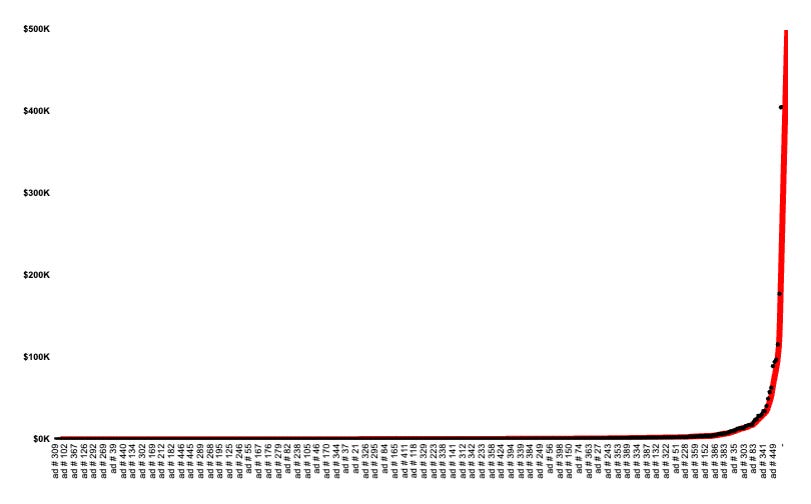
This is where most accounts silently fail.
They find a winner. It’s doing great. CPA is 40% below target. It could scale.
But instead of pushing into it, they:
Cap budget to “not put all eggs in one basket” or get excited and push budgets 50% and kill the ad “This ad is our answer!! Oh it died, kill it…”
Force spend into underperforming assets they paid a lot for
Spread budget evenly across campaigns to “test fairly”
This is normal distribution thinking. Treat every ad as roughly equal. Smooth out the variance. Optimize for consistency.
Power Law thinking is the opposite: When you find an outlier, figure out the exact level of spend it can perform at and still deliver strong results. Then keep tweaking.
The $150K account I mentioned? They were spending heavily on influencer content that wasn’t working because they’d already paid for it. They were optimizing for sunk cost instead of letting the algorithm find winners.
When we shifted to letting winners win, their top 1-2% of ads started doing 50%+ of spend. And those ads had the best CPA in the account.
That’s the exponential impact. That’s where the 74% CPA reduction came from.
The Game Meta Is Playing
Here’s what most people miss:
Meta’s algorithm is designed for Power Laws.
It’s constantly looking for outliers. It wants to find the ads that resonate and scale them. It wants to kill the losers fast.
If you fight this, you lose. If you spread budget evenly, cap winners, and force spend into underperformers, you’re fighting the algorithm.
If you embrace it, you win. Give the algorithm diverse creative to test. Let it find outliers. When it does, let them run.
Normal distribution mindset: Small, consistent changes. Reduce variance. Optimize for average performance. Spread budget evenly. Play it safe. One week of bad creative? Go back to winners.
Power Law mindset: Big swings on creative. Let the data pick winners. Scale outliers aggressively. Accept that 85% of your creative will fail. Play to win. Give every ad your very best.
If you’re stuck at $150K/mo or $300K/mo and can’t break through, ask yourself: which game am I playing?
How to Shift Your Account
On Creative (Probability):
Stop making variations of variations. Start swinging big.
New angles you’ve never tested
Formats that feel risky
Concepts mashed together from different sources
Producers with different styles
Target a 10-15% hit rate. If you’re above 20%, you’re being too safe.
On Media Buying (Impact):
Stop spreading budget evenly. Start letting winners win.
When an ad breaks out, scale it hard
Don’t force spend into assets just because you paid for them
Let the algorithm do its job
Your top 1-2% of ads should be doing 50%+ of spend. If they’re not, you’re leaving impact on the table.
The Bottom Line
Meta is a Power Law game.
Most people are playing it like a normal distribution.
Small changes.
Even budgets.
Safe creative.
Consistent results.
That’s why they’re stuck.
The accounts that scale, the ones that 3x spend while cutting CPA by 74%, are the ones that embrace the Power Law.
Swing big on creative to increase probability of outliers.
Scale winners precisely to capture their full potential.
Your creative creates the conditions for outliers to emerge.
Your media buying determines how much value you extract when they do.
Get both right, and you’ll break through the plateau.
If this sounds like your situation, let’s talk. My calendar is open. Click “Talk with Us” on misfitmarketing.co or email me directly at curtis@misfitmarketing.co.
Shout out to this Veritasium video for inspiring this post. If you want to dig deeper into power laws It’s 100% worth a watch!
Great article. How long do you run an ad for in terms of time and spend before culling it?