

This week a marketer in my DMs asked a question that I’ve gotten multiple times.
His example was perfect:
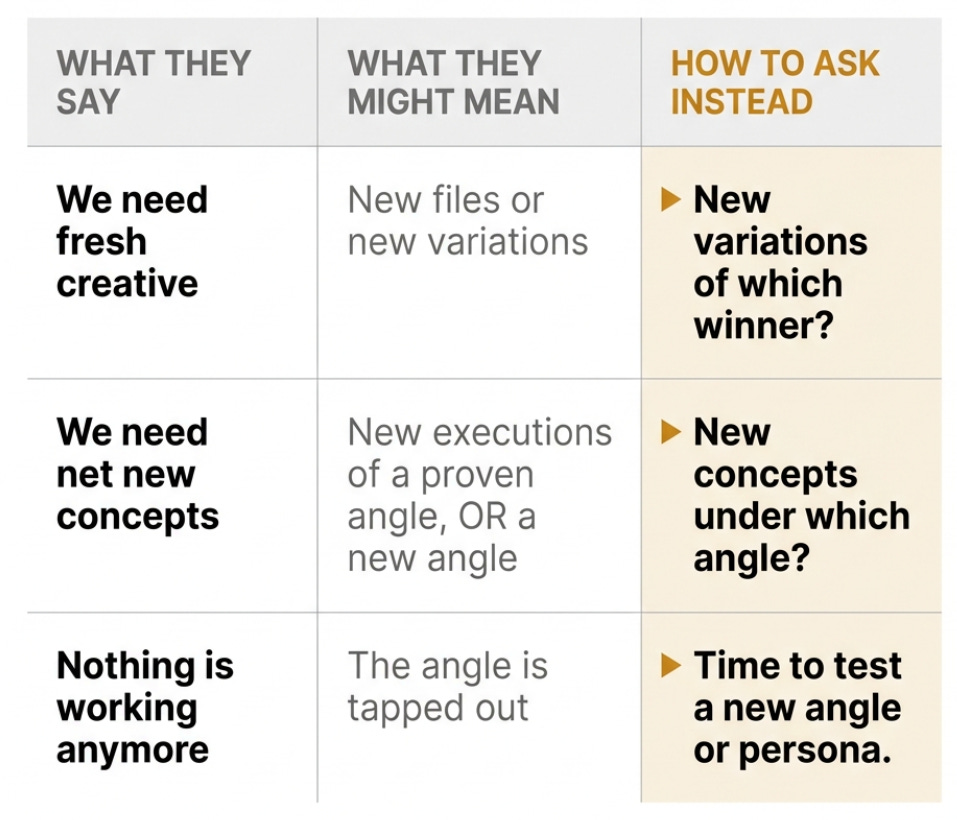
A teammate says, “We need more net new concepts!”
Someone else replies, “Great, let me whip up some new angles.”
And apparently, they’re talking about the same thing.
You’ve been in that meeting. The ask goes out for net new concepts, the folder comes back with fresh headlines on the same video, and three weeks later nobody can explain why the big creative push didn’t move CPA.
It’s because one team asked for diverse creatives (because it’s what drives Meta’s performance) and the other team HEARD variations on an ad (designers don’t speak the same language).
This is all literally semantics. But it can affect performance to not be on the same page.
It’s worth getting aligned (at least with your team) otherwise you can’t really set goals.
So I’m going to use Meta’s naming for a consistent framework.
A Simple Six-Layer Taxonomy
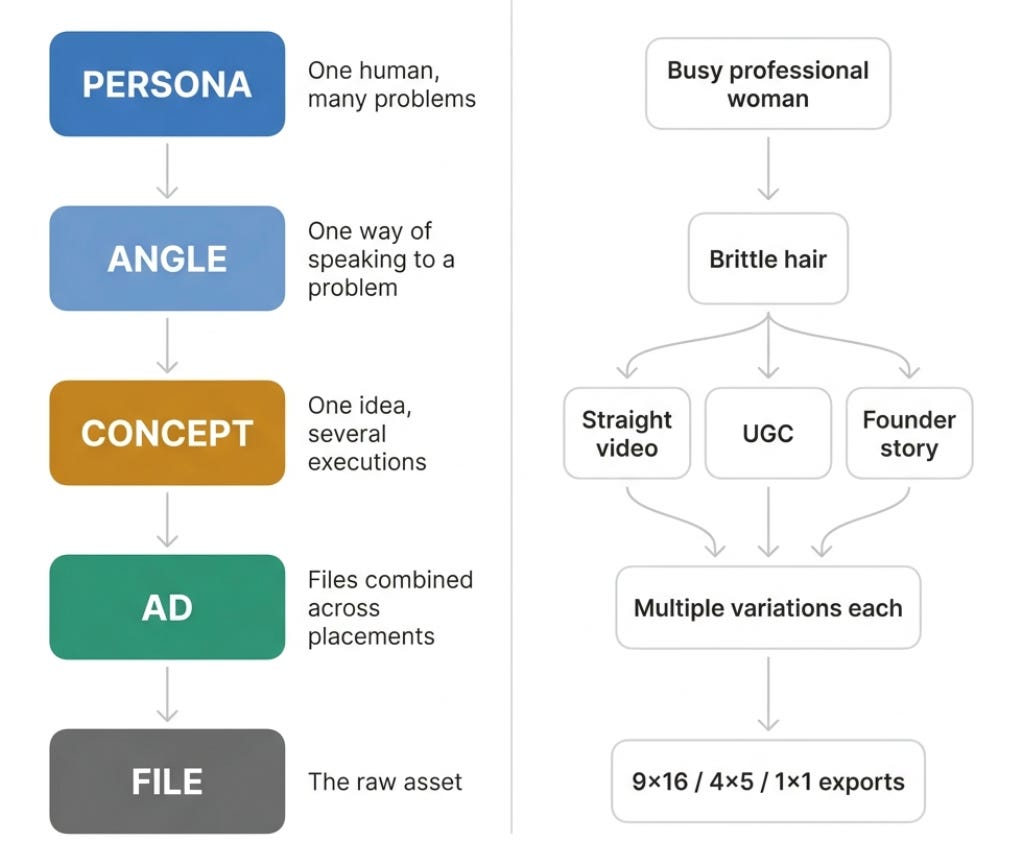
File. The raw asset. A single 9x16 video export sitting in a folder. No targeting, no destination, no ID. Just pixels.
Ad. Files combined across placements. A 9x16 plus a 4x5 plus a 1x1 becomes one ad in the account. This is the first layer where Meta starts assigning identity (more on that below).
Concept. Multiple ads that share an idea and production session. One idea, several executions within the same format and style.
Angle. A specific way of speaking to a problem. An angle can have many concepts (different formats or styles)
Persona. The person at the top. One human with multiple problems (multiple angles to speak to that persona).
Product. One product has multiple selling points/angles.
Here’s the whole ladder running through one example, brittle hair:
Product: Strong Hair Shampoo
Persona: a busy professional dealing with several hair problems
Angle: brittle hair specifically
Concepts under that one angle:
A straight video that speaks to it
A UGC creator that speaks to it
A founder story that speaks to it
A static with selling points
A static with a discount
Ads: multiple variations under each concept (Different hooks or ad lengths, skip the minor edits)
Files: the 9x16, 4x5, and 1x1 exports behind each ad
Product → Person → Persona → Angle → Concept → Ad → File
Quick honesty check: This is one way of doing it. As long as your team is consistent I don’t mind you having a different method. I don’t think my ladder is sacred.
The practical takeaway: every creative request lives on exactly one layer.
“New headlines” is a file request.
“New execution of the winner” is a concept request.
“We’ve tapped out this pain point” is an angle request.
Meta’s System: The Four IDs
Meta has its own internal system that is important to know as well.
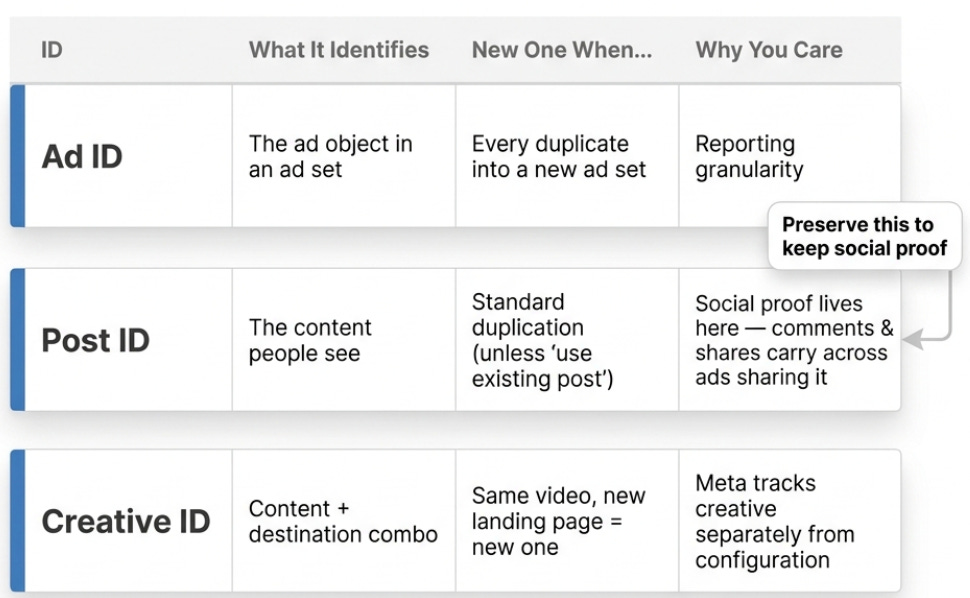
Ad ID. The ad object itself, the specific configuration inside an ad set. Duplicate a winner into a new ad set and you get a new ad ID, even if nothing about the creative changed.
Post ID. The content people actually see. One post can sit behind many ads, each with its own ad ID but sharing the same post ID.
Creative ID. The wrapper that ties content to a destination. Same video pointed at a new landing page is a new creative.
Entity ID. The one Meta never shows you. More on this in a second.
The post ID is worth real money:
Engagement lives at the post level, so ads sharing one post ID accumulate the same likes, comments, and shares.
Standard duplication creates a fresh post with zero engagement.
“Use existing post” carries the social proof with you when you scale a winner.
I’ve seen the performance gap at 15 to 25% in favor of ads that keep their engagement.
Andromeda / Entity ID
In December 2024, Meta’s engineering team announced Andromeda:
Runs on NVIDIA Grace Hopper Superchips and Meta’s own hardware
10,000x increase in model complexity over the previous delivery system
6% recall improvement and 8% better ads quality on selected segments (per Meta)
Quick run down of how it works:
Before the auction ever runs, Andromeda narrows tens of millions of eligible ads down to a few thousand candidates for each impression, in a few hundred milliseconds.
If your ad doesn’t survive retrieval, your bid never matters. The auction ranks a shortlist you may not be on.
To search that fast, Andromeda clusters ads by visual and thematic similarity in a hierarchical index. Media buyers call these clusters Entity IDs. Not official Meta terminology, but it describes the behavior well enough so people use it.
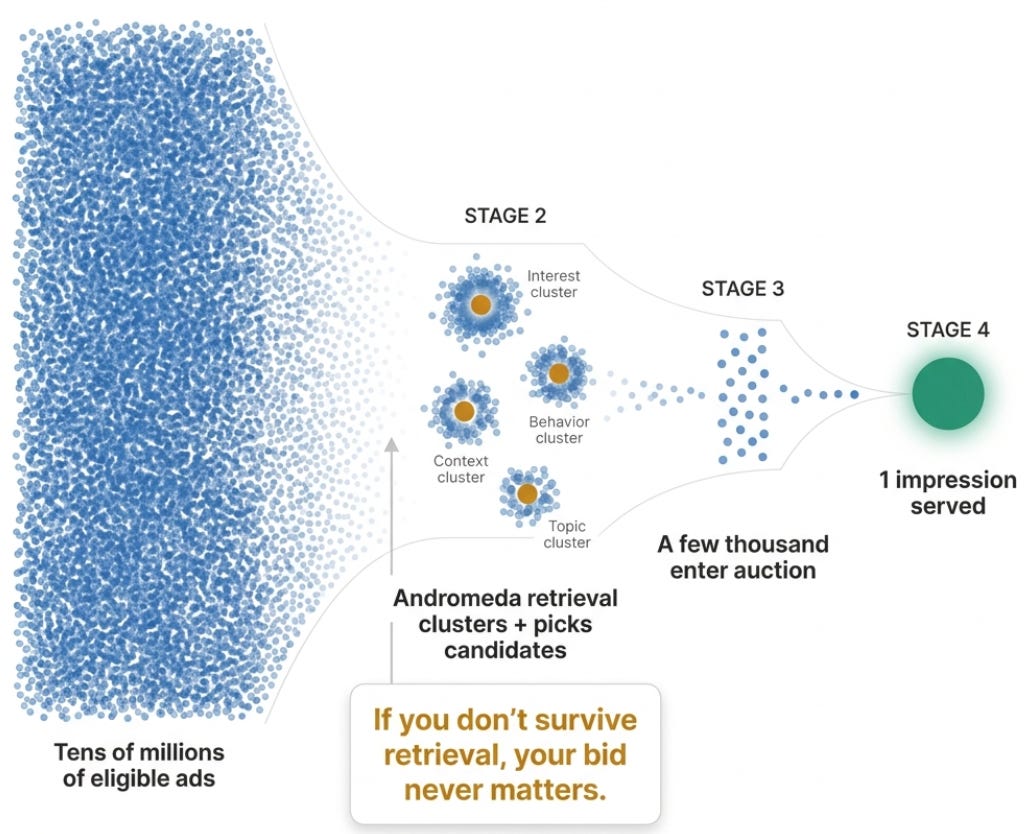
Minor edits don’t earn a new node. A headline color, a music swap, a tighter crop: the clustering sees the same idea and files it in the same place.
Here are variations I believe work
A new hook (different way of saying a problem/different context/etc.)
Different length of ad (60s vs 30s cut from the same footage)
Different creator or location (same/similar script and angle)
Refilming with a higher/lower energy level
I will use headline variations on statics to test for fit still but make sure they speak to different problems and people. Color and font variations are completely out.
How to Run This With Your Team
1. Translate every brief to a rung.
First get aligned on internal jargon
Then when someone asks for net new concepts, ask one question: new executions of a proven angle, or a new angle entirely?
2. Make the taxonomy machine-readable.
Ad naming should encode persona, angle, concept, and variation as separate fields.
If reporting can’t roll performance up from variation to concept to angle, you can’t see which layer is actually winning.
Without that rollup, you can’t start with performance data as easily
3. Run the concept audit.
Pull your active ads.
Strip the cosmetic edits: headline swaps, colors, crops, music.
Count what’s left. If 20 ads collapse into 3 real concepts, that’s your true test velocity. I aim for 3 variations (real variations per concept) and $10k of spend per concept. That’s $3k of spend per ad but the prior number is more important.
4. Give variations their actual job.
Variations aren’t dead. Iteration extends a winner’s life, covers placements properly, and helps you learn.
But variations exploit demand you already found.
Concepts and angles find new demand, and they’re the only layer that earns new entries into retrieval.
Budget your creative pipeline accordingly.
Questions/thoughts/ideas?
Reply!
Cheers,
Curtis