

I’m currently helping multiple brands build creator groups as their primary source for performing Meta ads. Multiple industries. Spend ranges from $50K to over $1M monthly.
Credit to Hugo - CMO of sassy saints who inspired this idea - if you want the full podcast from him ill share it at the end!
In this model direct creative cost runs about 3-5% of spend. A comparable agency runs closer to 7-15%, in my experience. That’s a nice benefit but not even the main one.
The interesting part is the moat that it builds (again shout out to Hugo for illustrating this clearly)
The 2026 AI Problem
Anyone can spin up 50 static variants in a Claude window. Anyone can generate decent imagery, decent hooks, decent copy. The barrier to making a passable ad collapsed somewhere around mid-2025. “Decent” is the new minimum bar now.
AI ‘UGC’ is getting better and sometimes outperforms standard UGC. You might be scaling an AI ad right now!
But the moat on that is $0. Any brand with any budget can copy that ad in an hour for their own brand. Meta ad library now sorts by impressions, look-a-likes pop up immediately. That causes quicker ad fatigue.
It means that layer of your account is now a commodity. Your competitor’s intern with a $20 Claude subscription can ship your top performer today if it’s a generic AI winner.
That doesn’t mean it can’t perform (I’ve seen it work) but it isn’t a moat you can build on.
Standard Model:
Brand pays for creative. Creator pulled from a roster, briefed, video edited, delivered.
The creator gets paid and then might repeat the next month with a different brand.
So many brands I know are stuck in this loop of deliver → reset and they are trying to compound instead. The question today is how we get to a compounding process.
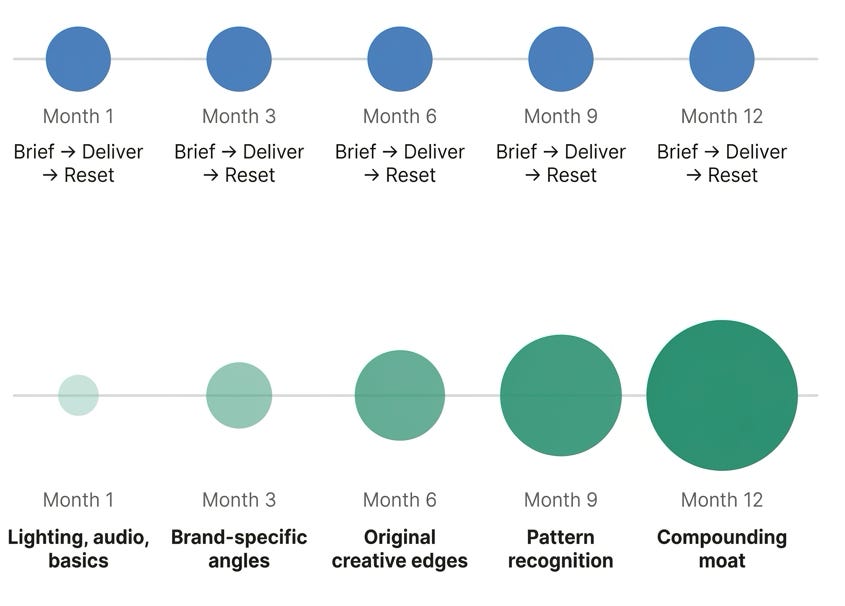
But you may say “no my agency is excellent, they take the top performers and pull them in and they get weekly scripts! They analyze data and improve each week”
Perfect: Keep them (really), but also, take that and put it on steroids. That is the creator group.
Take your top creators, pull them into a group (slack, telegram, whatsapp, whatever), and start coaching instead of scripting. The cost stays flat. The output gets weirder, more specific, more aligned with what actually scales in the account.
Cost Breakdown
Most creators charge a flat fee per video of roughly $200-300 which often comes out to around 3% of spend depending on scale.
Or once you get comfortable I recommend a model of 5% of spend.
The first is easier to get started, finance isn’t concerned. Creators get clear payments, etc.
The latter is better aligned. If a creator wants to make 20 ads in a day? Awesome, test them in a group and if they have 3 winners that scale, they get paid!
Either way it should include the following:
Lifetime usage of edited ads
B roll rights (No % of spend costs)
Partnership access for all ads from day 1
What Compounds (And Why It’s a Moat)
We evaluate a new creator (before they join the group). They make 1-2 ads, one of them is decent. We started them on the top product with our top USP. Best shot at success. Not bad, not stellar.
Then they join the group.
After a few weeks they hit their stride and start producing more winners. People recognize their ads in the comment as if they are an influencer (Which is great, many selling points, many angles, that is good for the brand) it builds familiarity and comfort.
After a few more weeks they start getting creative: What if we tried X or Y or a new product?
It’s distributed creative strategy.
That’s the moat.
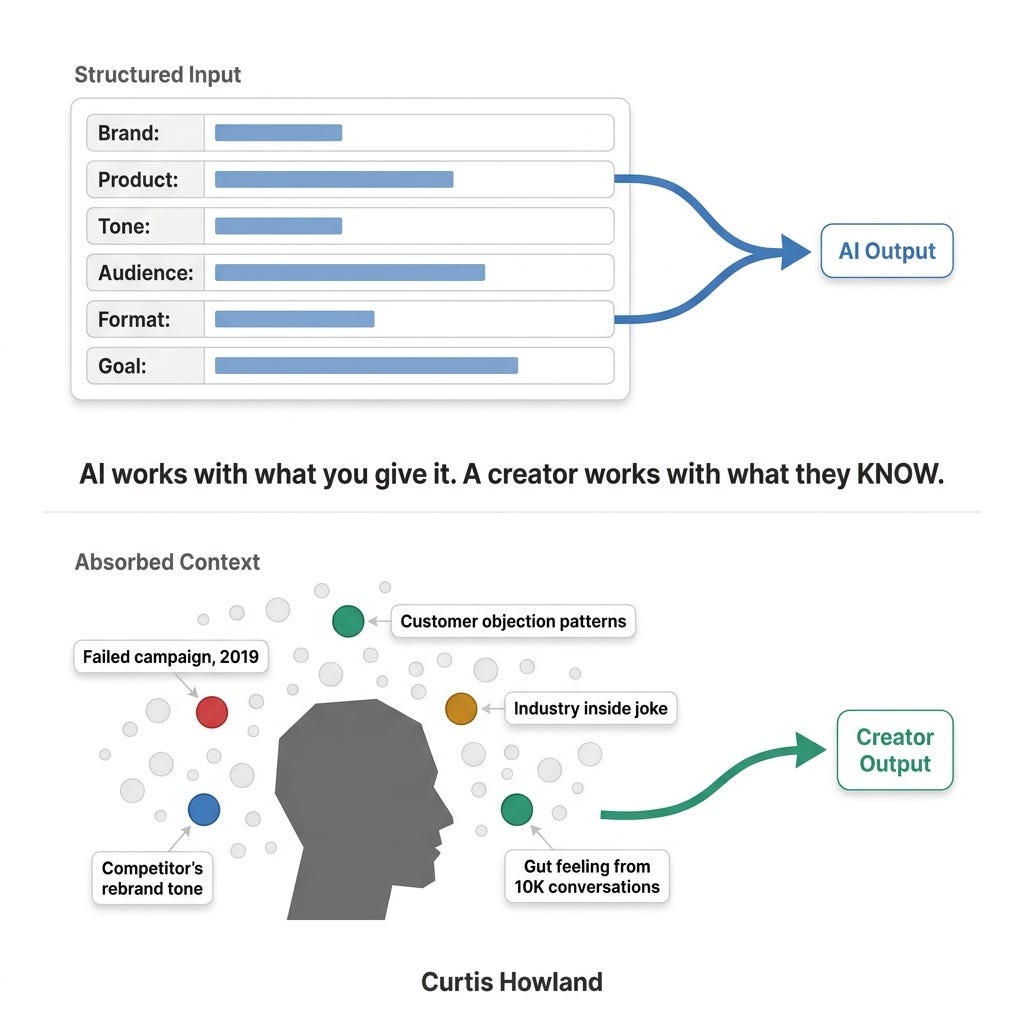
An AI can give you 50 variants of an ad concept in 60 seconds. It can’t give you the angle a creator developed over three months of paying attention to your brand’s actual customers. The AI doesn’t know what it’s like to use a product for months. It can’t personally try out your newest launch. AI UGC can only replicate authenticity at best. And it can’t execute on an angle that you never would have suggested in the first place.
The Partnership Ad Tailwind
If you were at Meta Performance Marketing Summit this year or if you’ve talked to a Meta rep in 2026 you’ve heard them pushing Partnership ads.
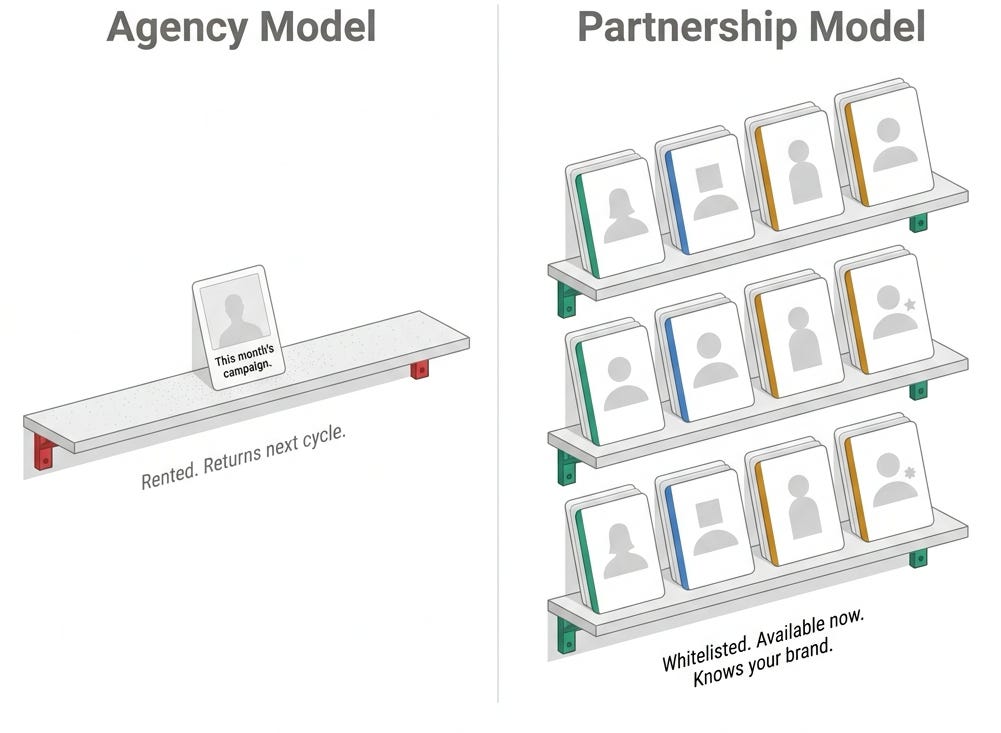
It’s the format where the creator’s handle appears on the ad and you whitelist their handle to run it from their account. Reps have told me these ads are getting actively favored by Meta’s algorithm right now.
Partnership ads feel more organic in the feed, which keeps users on platform longer. Meta wins, the creator wins, the brand wins. Everybody is incentivized to push that format.
In my experience ~70% of the time partnership ads outperform standard ads. It’s just hard to manage when you are using new creators every week.
We request whitelisting from every creator in our groups as a condition of working together. That gives us a stable pool of partnership-eligible accounts at all times.
The Playbook / Set up
Sourcing. Most of my top creators came from Billo, were past customers, or actors on backstage. Work with as many creators as you can, wherever you can find them, find the ones that resonate with your brand and pull them in!
Group size. Scales with spend. A brand spending $50K/month doesn’t need more than 5 to 7 active creators. A brand spending $500K+ should run 20+ as you scale (start small). The constraint is cost and keeping the group updated with feedback and approving new ads quickly or giving feedback.
Comms channel. One channel per brand, managed by our team. Ideas drop weekly. Creators can see each other’s work as we share top performers. This is the powerful part. They all want to get a ping that their ad was a winner.
Review workflow. Slack works fine to start. We eventually built an internal tool we call Ad Review that we use in our groups. Creators upload assets, AI reviews them immediately for a first pass, the team reviews and gives feedback in one place, captions automatically added (music coming soon), approved ads uploaded quickly, payments get tracked for creators easily + analytics on common mistakes in ads. Removes the back-and-forth scroll problem that big Slack channels create. Not required to run a creator group, but worth knowing the bottleneck is real and there are ways to engineer past it.
Pay model. Mix of flat and performance. Flat rate per asset to make the economics predictable for the creator. Performance bonuses tied to ads that scale past a threshold. Or % of spend once everyone is comfortable. Best creators end up making meaningfully more than they would on standard UGC rates, which is the loop you want. That keeps them loyal and you can scale quicker and save money testing bad ads. Win win.
Where This Doesn’t Work
A creator group is not a fix for a brand whose UGC was never working. It amplifies what’s already there. If your account has historically performed on statics and your video UGC has never scaled, this won’t change that. Different problem, different solution.
Four places I would not set this up:
Static-heavy brands. If your hero creative is product-on-white and you can’t remember the last UGC video that scaled, you don’t have a creator group problem. You have a format problem.
Brands under $50K monthly spend. The management overhead doesn’t pencil. You’re better off running standard Billo tests until you’re large enough to support the group. Just keep going back to those top creators!
Brands with no internal owner. Someone has to run the Slack. If it’s not your team, it has to be ours. If neither, don’t start.
Brands that need volume over authenticity. Some categories optimize for sheer asset throughput. If you’re testing 200 ads a week and authenticity is not your differentiator, then you can skip this.
The Layer Underneath
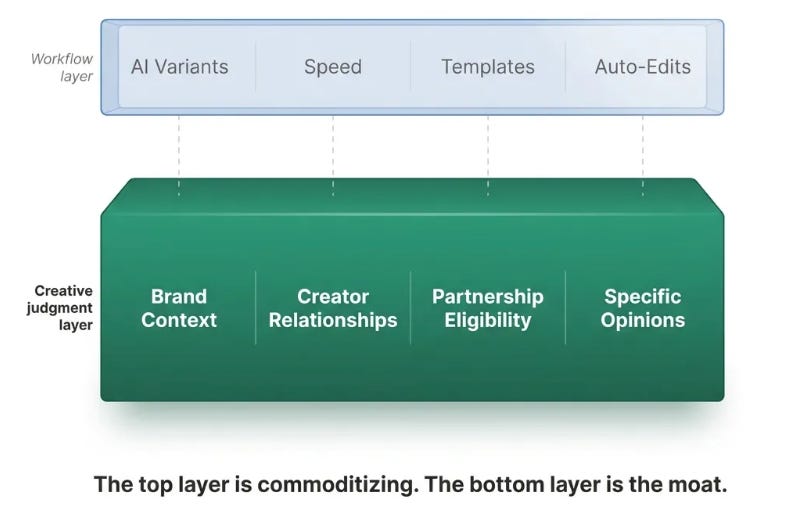
Most of the conversation about AI and DTC right now is about workflow. How fast can you generate concepts. How quickly can you spin up variants. How efficient can you make the production layer.
I often talk about a target of 1 ad for every $3k in spend (or 1 concept for $10k in spend). You need to not over optimize for this metric though. Quality first, volume second.
If you are tempted to AI-ify everything to hit the goal then this is for you.
The brands that own their creator relationships are building something AI can’t take from them and Meta is actively boosting.
If you build this out let me know!
As promised, here is the podcast from Hugo, worth a watch!
If this was useful, send it to your team or share on LinkedIn with your favorite graphic and tag me! Best compliment you can give!
What's a scalable way to source creators?