

The goal of a business is not ROAS.
It’s also not revenue. Or scale. Or profit. Those are the scoreboard. The goal (I would argue) is to make something that maximizes the value to people for less than it costs to produce. Everything else is a proxy so that you can fit it on a dashboard.
Understanding this is key to properly managing your ecom marketing team.
A few classic examples: Private equity over-optimizes for profit. Venture capital over-optimizes for revenue. Media buyers over-optimize for ROAS.
Three critiques I got on LinkedIn recently landed on exactly this point.


(to be fair it was arbitrary)
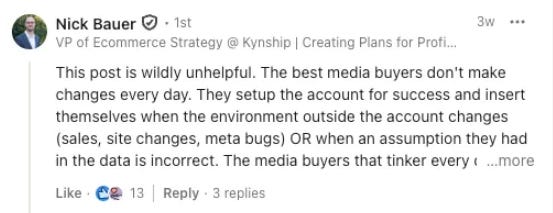
Each of these has its own separate specific critique I could debate, but there’s a more important pattern underneath them that’s I want to focus on, which I will wholeheartedly agree with.
The moment you promote a sub-KPI into a goal, it can become harmful.
That’s Goodhart’s Law. When a measure becomes a target, it ceases to be a good measure.
Nick is critiquing change-log analysis. Taylor is critiquing quality-vs-quantity targets. Barry is critiquing ad-level ROAS optimization.
All of these are powerful tools that are incredibly useful in my experience but if over-simplified and over-optimized, can be dangerous and unhelpful.
Each of the posts I share on LinkedIn is based on scaling companies, $150M+ in total ad spend, and careful attention to accounts. It’s not made up. But be careful over-optimizing into any single metric I share.
This is the trap most operators fall into. Look at my LinkedIn for a perfect example. Simple posts with a single idea engage far more than complex nuanced ones. I always try to post nuanced ideas but its the simple ones that get the bulk of the views.
A sub-KPI as a golden star/silver bullet is so much easier. It’s also a trap.
Goodhart’s Law, translated into ad accounts
Charles Goodhart wrote his paper in 1975 on UK monetary policy and produced the cleanest mental model in operations. When a measure becomes a target, it ceases to be a good measure.
The classic example is the Soviet nail factory. Told to produce more nails, the factory made tiny useless nails. Told to produce more weight of nails, it made oversized useless nails. The measure was fine until it became the goal. Then it collapsed.
Your ad account is full of these.

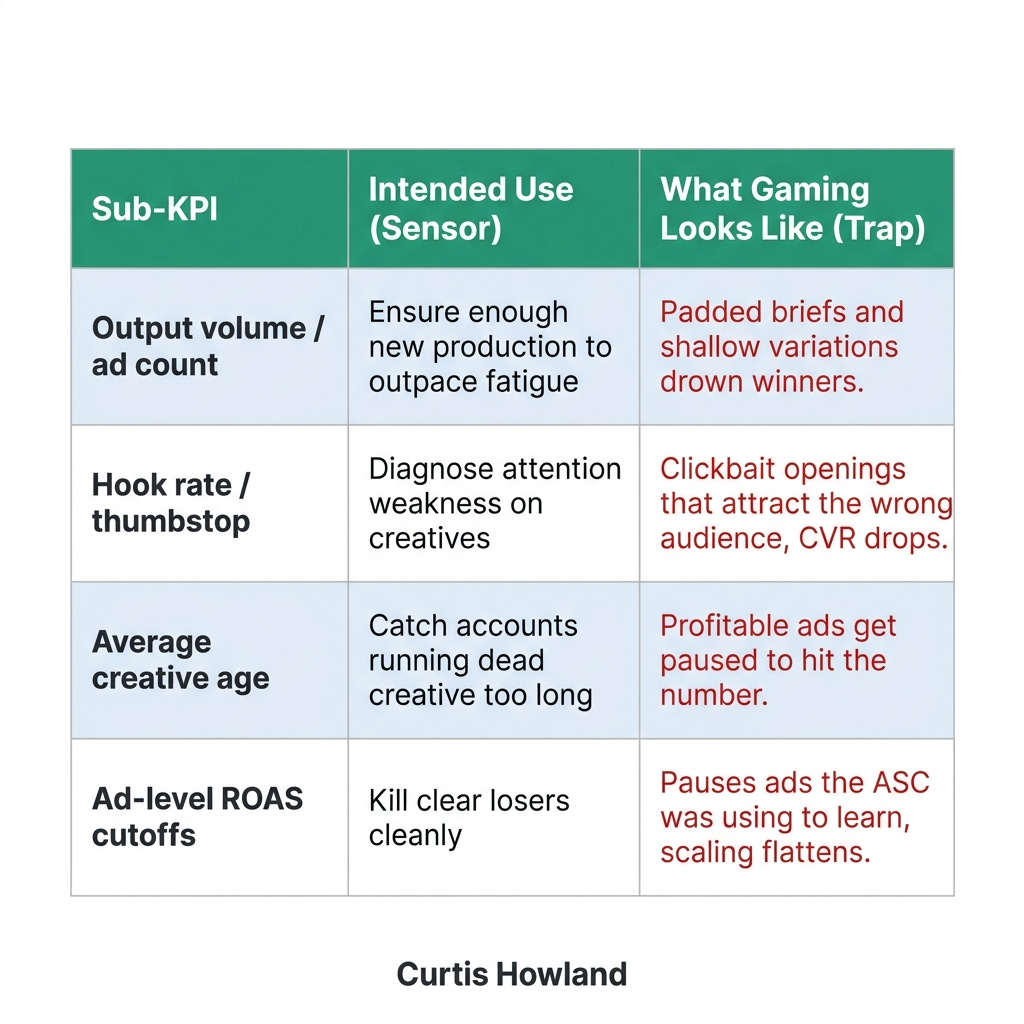
“Produce more ads.” The target becomes count, not impact. Briefs get padded, variations get shallower, winners get drowned in noise.
“Hit a hook rate benchmark.” You brief creators to optimize the first three seconds for thumbstop. They do. Your CVR drops because you hooked the wrong audience.
“Keep average creative age low.” You start pausing ads that are still profitable because they are old. You sacrifice efficient spend to hit the age number.
“Kill anything below X ROAS at the ad level.” You pause the ads that were enabling scale. The losing ads were part of how the ASC learned. Revenue flattens.
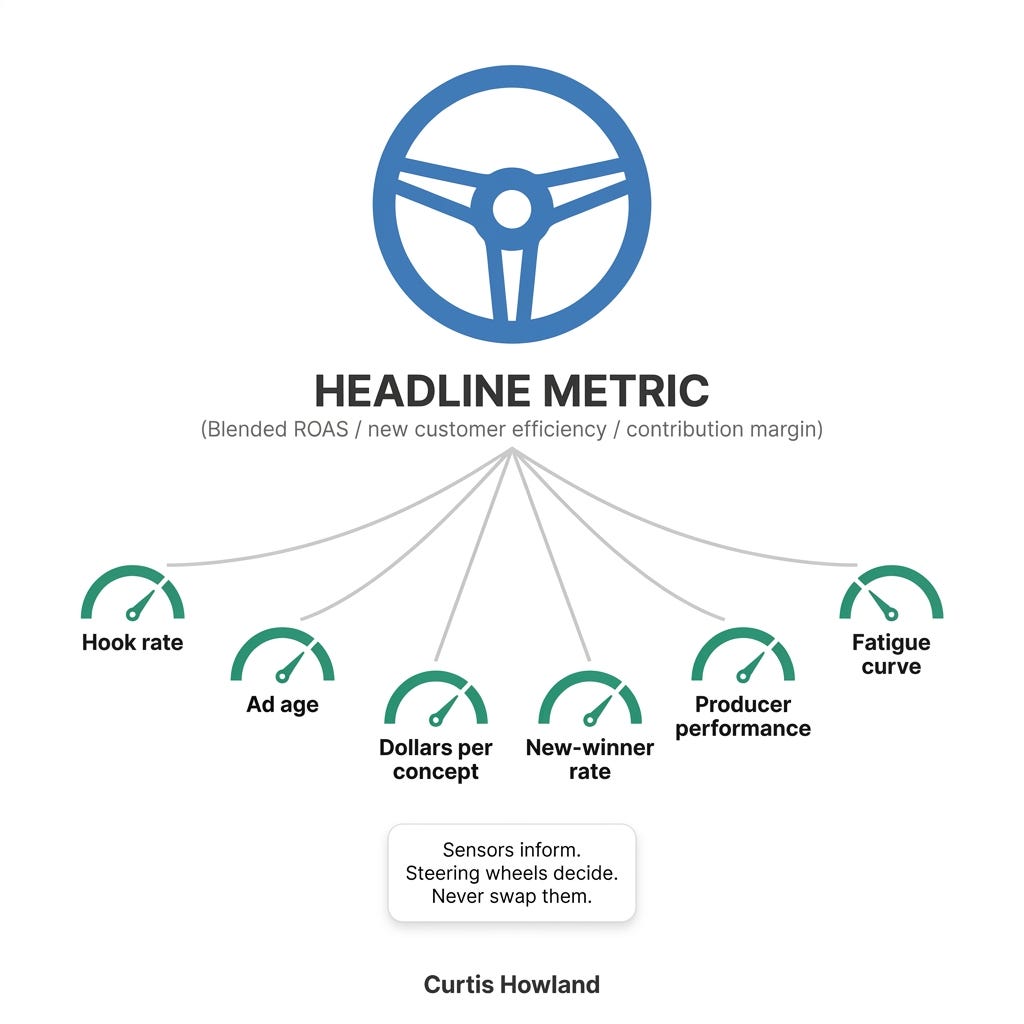
Every one of these is a sub-KPI doing its job as a sensor, then getting promoted to the steering wheel, and quietly destroying the thing it was supposed to build.
Why this hits winning accounts hardest
Plenty of sub-KPI in a top accounts looks “worse” than some theoretical best. That’s the nature of portfolio optimization. You cannot have every component be best in class and also have the whole system be best in class. Real portfolios have weak corners.
This is why Barry’s critique lands well. Ad-level last click CPA in a consolidated ASC setup will look ugly at the ad level for plenty of winners, because the algorithm is optimizing for more than last click (or any single attribution model). Pause them to “fix” ad-level CPA and you risk killing true performance. The headline performance flattens.
Nick’s critique is the same move at a different level. Daily tinkering against sub-KPI drift is how good operators accidentally break good accounts. The goal is to make the right decisions when they are needed, NOT to make decisions as a default.
Both of them are saying the same thing I’m saying here. The sub-KPI is not the lever.
It was never the lever.
The operator rule: sensors vs. steering wheels
My rule of thumb across accounts: sub-KPIs are sensors, not steering wheels.
They tell you what is happening. They are not what you optimize for. The headline metric (usually blended ROAS, efficient new customer acquisition, or contribution margin depending on the business) is what you optimize for.
ROAS is a sensor for Revenue which is a sensor for driving value. You need to know what problem you are solving for in order to understand which one it is.
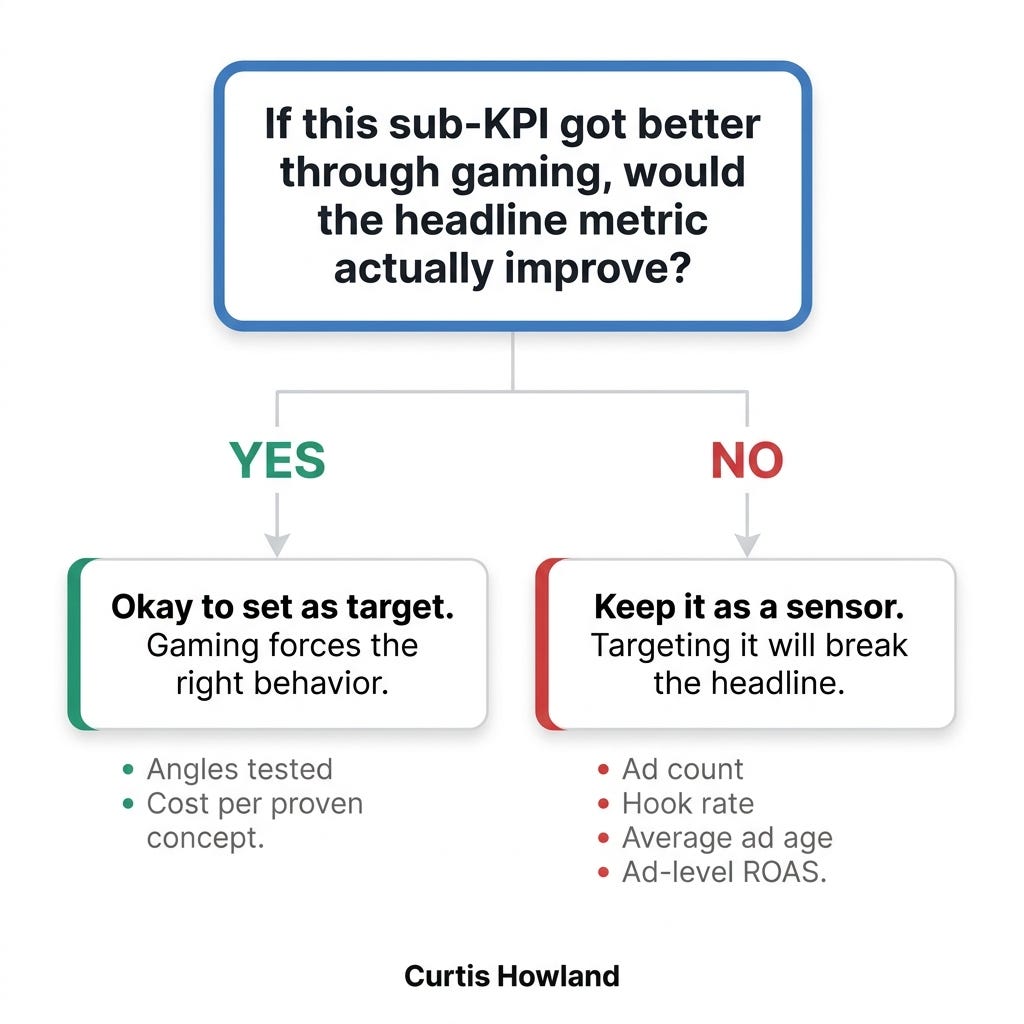
Another crucial test: if this number got better through gaming, would the headline metric actually improve?
Produce more ads? Usually no. Count can be gamed with low-effort repeats.
Produce more tested angles? Usually yes. Gaming it forces real creative exploration.
Hit a hook rate target? Usually no. Easily gamed with clickbait.
Cut production cost per proven concept? Usually yes. Gaming it forces better briefs upstream.
Be extra careful when using game-able metrics as targets.
The takeaway
A dashboard is only useful to the extent it makes you smarter about the real job.
And the real job hasn’t changed. Make something valuable. Get it to the people who want it and offer it for less than they’ll pay for it. Everything inside Ads Manager is a tool in service of that, not the end goal.
So each time I send a KPI be careful with the nuance. Sub-KPIs sense. You steer.
If this was useful, send it to your team or share on LinkedIn with your favorite graphic and tag me! Best compliment you can give!
Super interesting - appreciate you sharing this POV and really respect how you're handling the debate with others. Reminds me how metrics have also gotten political inside companies because specific stakeholders (finance vs. growth vs. media buyers vs. ops) define value differently. I like how you said the goal is to "make something that maximizes the value to people for less than it costs to produce". I personally would modify it to say it's value creation (what you're saying) under BUSINESS CONSTRAINTS. So common for operators to default to universal metrics vs. constraint-aware metrics. Or at a minimum, helping those in the business connect the dots better and having healthy debates around tradeoffs.
Caveat: I'm not a media buyer but I work very closely with them in Growth and I feel it's my job to give media buyers the context (constraints) they need to do their job well. For example, if retention is suffering in the business, I'm not going to expect a media buyer to make CAC more efficient if that means attracting an audience with a greater likelihood to lapse just because it looks better on the dashboard. My job is to make others aware of that nuance and trade off. And also I never pick "sensor" and "steering wheel" metrics unless I've thought through what their "failure" mode could be so I can pick a "counter-metric" I can monitor (I.e. for revenue maybe it's something to do with margin or retention.