

After years of running these accounts, my opinions on what works have hardened. Some tactics I used to defend I now think are a waste of time. Some I dismissed I now consider table stakes.
Im sure ill change my mind on some next year again!
So I built a tier list.
F Tier is “stop wasting time on this.”
S Tier is “this is what compounds.”
If you disagree with where something landed, email me!
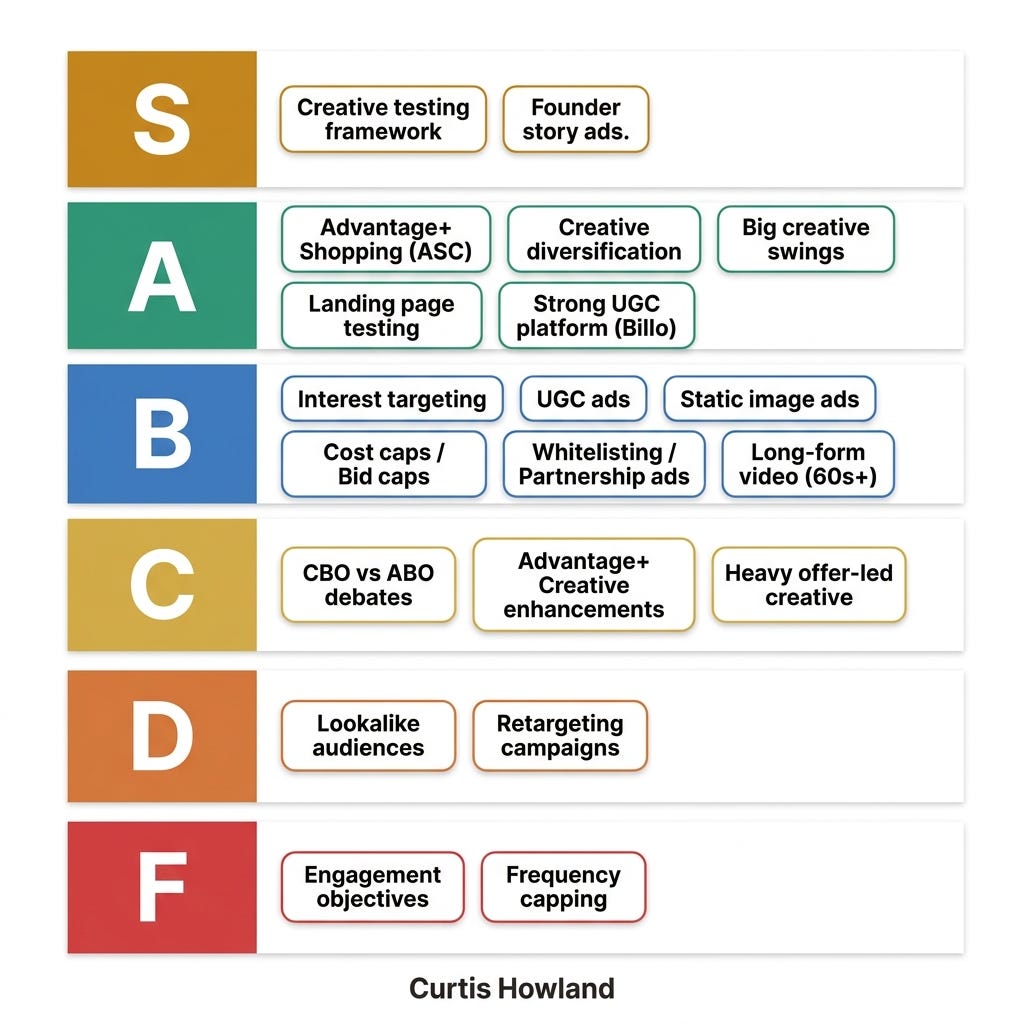
F Tier: Stop Doing These
Engagement objectives. You are paying Meta to optimize for the cheapest metric on the platform. Likes don’t buy your product. Unless you are hyper-focused on utilizing these correctly (and using the low-quality ones a good way’s a good way to burn money.
Frequency capping. Every hour you spend tuning frequency caps is an hour you didn’t spend making a new ad. If your audience is fatiguing, the answer is more creative, not less delivery on the creative you have.
D Tier: Mostly a Waste
Lookalike audiences. Meta’s algorithm finds your buyers better than any seed list you’ll ever build. Lookalikes felt like magic in 2018. In 2026 they’re a worse version of adv+ or broad targeting.
Retargeting campaigns. Most retargeting is showing ads to people who were going to buy anyway. The incremental lift on a clean lift test is often very low. If you run these, don’t measure them on click basis (unless they are underperforming on clicks, which we often see, then definitely cut them).
C Tier: Fine, But Stop Obsessing
The CBO vs ABO debate. The honest answer: it depends on whether your media buyer is actually in the account. If they are, ABO gives you more control and lower CPAs. If they aren’t in the account every day, don’t run ABO. Either way, the structure isn’t what’s holding your account back. Its utilizing it well for the product and creative you have that is.
Advantage+ Creative enhancements. Letting Meta auto-crop your ads and overlay random text is often really bad. And many of them just don’t perform well.
Heavy offer-led creative. Promo ads work. They convert. The problem is they train your customers to wait for the next sale. If 70% of your creative is “20% off,” its going to hurt long term growth. I generally target 70 non promo / 30 promo.
B Tier: Solid, Use Them
Interest targeting. (Im going to get hate for this one) Still works on launches when you don’t have data yet. Broad and Advantage+ Audiences outperform it once you have scale. Find an audience of a few million and turn on Advantage+ Audiences, it works like a seed into broad and outperforms on most tests we run.
UGC ads. Table stakes now. Every brand runs UGC. The bar has moved from “do we have any” to “do we have creators who can actually sell on camera.” The format is B Tier because everyone has it. Your creator roster and selling points is what determines whether it actually works.
Static image ads. Fast to produce, easy to iterate, still convert at scale. AI image tools have made these even more efficient. We use designers who use AI to move faster. Most ecom should run 20-30% spend on statics.
Cost caps and bid caps. Great for protecting CAC. The tradeoff is they throttle delivery when you want to scale. I use them most when the performance is volatile.
Whitelisting and partnership ads. Useful format. The lift over standard UGC is real but overhyped, otherwise this would be A tier. If a creator already converts well as a non-whitelisted ad, expect a 10 to 30% lift, not a 2x though. Focus on creators with real names in their handles OR problem specific handles. Worse for generic non person handles.
Long-form video (60s+). 15-30 second ads usually win for DTC. But when a long-form ad rips, it really rips. They tend to be founder stories, documentary-style ads, or product demos where the length is the value. Worth testing!
A Tier: This Is Where Scale Happens
Advantage+ Shopping Campaigns (ASC). Almost every brand should run ASC. Especially low-SKU brands selling to a consistent customer base. Feed it creative, set your budget, and get out of the way. Track performance vs your other campaigns and allocate budget.
Creative diversification. More concepts equals more shots on goal. The brands scaling fastest ship 100+ new ads a month. Not 100 versions of the same concept. 100 different ideas. If your team is shipping 10 ads a month, your ceiling is built in.
Big creative swings. The ads that 10x your account are never the safe ones. Ugly, weird, unexpected. The ad you almost killed in review. Every account I’ve scaled past $1M/month had at least one ad that the brand team initially hated.
Landing page testing. Massively overlooked. Creative testing gets all the attention, but a landing page change can move CVR and doesn’t fatigue. The reason brands ignore it: it’s harder, slower, and requires dev resources. The reason it’s A Tier: the upside is enormous.
S Tier: The Two Things That Compound
After 8 years of running these accounts, only two things consistently compound across every brand I’ve worked with.
A creative testing framework. Not a vague “we test creative.” A system. Specific volume targets, a defined testing window, a kill rule, a scale rule, a rotation schedule. The brands with a real framework outpace the ones without one by 3-5x on creative output and scale much faster.
Founder story ads. Especially when your founder is also your ICP. Nothing I have ever tested outperforms a founder who can sell on camera. The trust signal is impossible to replicate with UGC. The conversion rates are 30-50% higher in my accounts, the ads last longer, and the lift across the whole account is real.
The catch: most founders can’t sell on camera. The ones who can have a permanent advantage.
What did I miss? What did I rank wrong? Reply to this email and tell me where I’m off. Every tier list exists to be argued with.