

I’ve had the chance to audit accounts running Meta ads from $500/day to $400,000/day this year.
The theme I saw in brands spending $1m/month+?
Every account I look at is different. Different team structures, different creative pipelines, different attribution stacks, different stages of brand maturity. Across consulting and auditing close to half a billion in total ad spend reviewed, I want to share some themes.
But these aren’t a checklist. Checklists work for the binary, settled stuff. Tracking. Attribution setup. Pixel events. Things where the answer is “this is set up” or “it isn’t.”
They fall apart for the most important pieces.
First, almost every brand I’ve audited has an “affiliate program.” Almost none of them actually have one that works.
What they have is a discount code distribution channel.
The pattern I see over and over: brand hands promo codes to anyone who asks → codes leak to Honey, RetailMeNot, coupon Reddits → existing customers find them at checkout → brand pays commission on revenue that was already coming through.
That’s basically just a tax on your conversion rate.
A real program has per-affiliate trackable codes, fraud detection, multiple commission structures, a creator marketplace, and automated payouts.
Brands doing affiliate right pull 15-40% of total revenue from it. Brands doing it wrong pay 5-10% commission on revenue that was already going to come through the door.
But here’s what most brands miss: a properly tracked affiliate program doesn’t just generate revenue on its own. It becomes your best creative testing lab. You get real purchase data on which creators, which angles, and which content formats actually convert, before you put a single dollar of ad spend behind them.
Brought to you by UpPromote, the Shopify-native affiliate platform powering 150K+ DTC brands. $1B+ in tracked GMV. [Check out UpPromote →]
Now onto the core themes I see.
1. The Power Law of Ad Spend
People often ask “what structure should I use” and I’m happy to share what we do 90% of the time (ABO for testing & scaling / ASC for scaling, tweaking based on account specific tests).
But a better question is “when I test a structure, what tells me it is working?”
3 things
Good ads get through testing (breaking ads out later doesn’t produce winners)
Fatigued ads get cut (they don’t keep spending forever)
Best ads get scaled.
In every Meta account I audit, 5-10% of the ads do 60-80% of the productive work. That part is consistent across scaling accounts. The goal is getting those ads scaled up and then down once they fatigue.
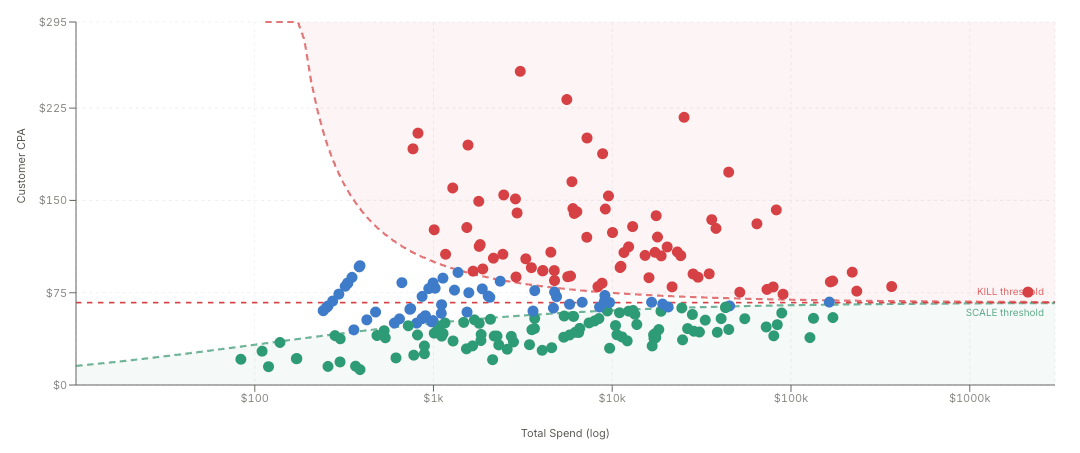
The above chart is dummy data from our internal dash. An example of an account where good ads were overspent and wasted money (ads deep in the red). And other good ads were never scaled enough (deep green). Breaking out tests creates new winners in this case.
Two symptoms show up in the same account:
Roughly 30% of ads are statistically dead but still spending. Past the point where the math says they’ll hit target. Still running. Still spending. Adset/campaign is still live and forcing spend. No new winners for Meta to rotate to so they just keep chugging along.
Roughly 5% of ads are early winners getting starved. Low CPA, low spend, sitting there doing nothing while breakeven ads scale by inertia.
If you are testing, cutting, and scaling ads within your structure then keep it.
I’ve seen it work well in 100% CBO, 100% ASC, a mix of all three. My point is that outcome is more important than structure. I’ve seen bad accounts with every structure and good accounts with every structure.
It depends on the product, the optimization strategy, and the ads. You need all three to align here to get a strong account outcome.
The goal is to get more winners through learning and pull back on fatigued ads before they waste spend. Not to check the box on the “right structure”
2. The Wall Between Media Buying and Creative
One super common disconnect: Target around “producing more ads” but then creative ships ads. Media buying runs them. Nobody is closing the loop between the two.
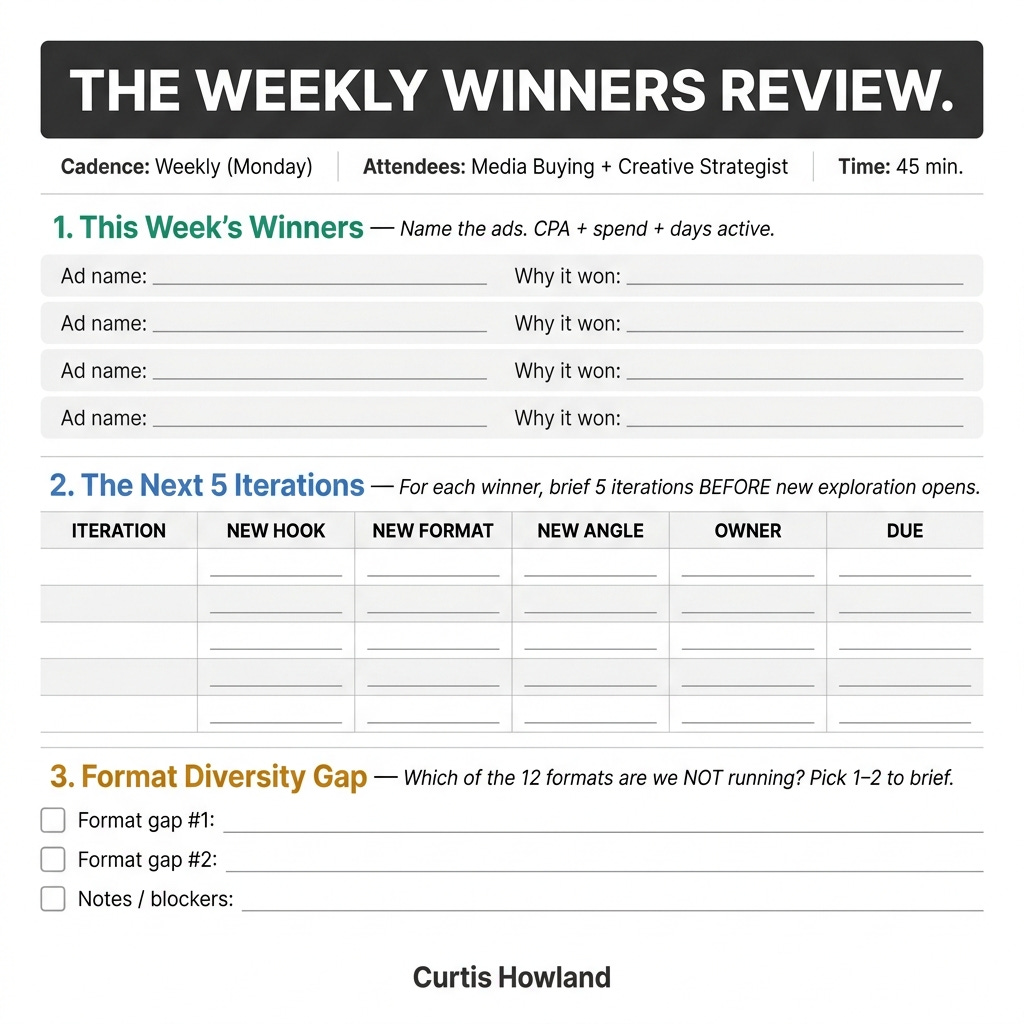
When a creative wins, what happens next?
Three things should happen
Scaling (new tests within Meta + new budget)
Iterations (how can we build on this with new creators/formats/angles)
Learning (discussion in the team)
The result is a creative pipeline that produces compound learning.
If you don’t do this, you are just repeating the same process over and over. Your team needs to be improving and learning. That’s what keeps setting the bar higher, and puts you in front of your competitors.
It’s important to note that if you don’t optimize your strongest winners it’s hard to tell what to lean on. (Do you iterate on High ROAS or High spend ads??) Once you have an account where fatigued ads are cut and great ads are scaled, this process becomes much easier.
But the media buying team should be involved. There is nuance to which ads are driving top of funnel, which are scaling the fastest, which are seeing fatigue in the last 2 days. Those things all need to be communicated to the creative team.
The highest scaling accounts have a quick weekly cadence here. But they know when to build off a winner and when to wait for data.
3. Creative Diversity Across 5 Axes
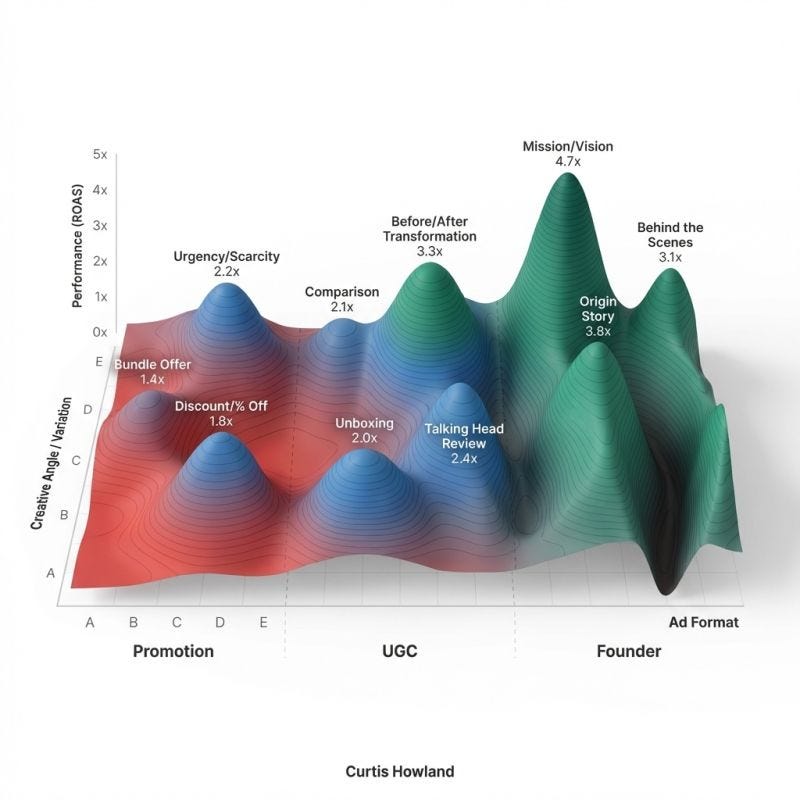
Most accounts I audit have “creative volume” as their KPI. That’s great, but meaningless without Creative Performance and Creative Diversity.
Meta’s algorithm rewards genuine creative variation more than it rewards quantity, and most accounts solve volume before diversity.
5 axes I find are consistently important:
Format. Static, video, carousel, story, collection, catalog, dynamic product ads, UGC, lifestyle, founder POV, problem-solution, testimonial.
Visual style. Polished brand creative, lo-fi UGC, editorial photography, mixed media, meme format. Running the same visual treatment across every format is still a form of creative sameness.
Messaging angle. Pain point, aspiration, social proof, curiosity, humor, education. Each angle attracts a different segment of your potential audience.
Offer type. Free gift with purchase, percentage discount, dollar-off, BOGO, no offer. You should be testing across multiple offer constructions even if you have a primary one.
Audience persona. Same product, different person in the ad, different landing page. One SKU can become 20+ distinct ads if you build it around different personas.
Most high scaling accounts are concentrated on one of these dimensions and diverse on the rest. I rarely see brands that are truly diverse across ALL of them and creating excellent ads. But, if you are concentrated across multiple of these - work hard to start diversifying as much as possible, it reduces your fatigue and increases the volume you can scale.
Don’t force diversity, test diversity and lean into what works. Key difference, it’s fine to have some concentration just not too much.
4. Attribution as a Decision Problem, Not a Tech Problem
The standard attribution conversation goes like this: numbers don’t match between Meta and Triple Whale. Meta says 200 purchases, Triple Whale says 140, Shopify says 175. The team spends weeks trying to figure out which one is “right.” They want to report something clean and easy and set KPIs to know if they “hit” or “miss”.
The key thing to understand is that no single attribution model is perfect and can be relied on. Forcing one is bad for the business.
If you use MTA, it undercounts view-through, long-term attribution impact, and omni channel halo.
If you use an MMM, you can’t optimize quickly enough, and you risk a poorly calibrated model.
The best brands know their North Star metric: total customers acquired per dollar or aMER (acquisition MER). They measure channel performance based on total impact, not just clicks. Within each channel, they use click-based tracking tools to ensure the right ads are getting the right spend, either by setting up the Meta algorithm or optimizing on top of it.
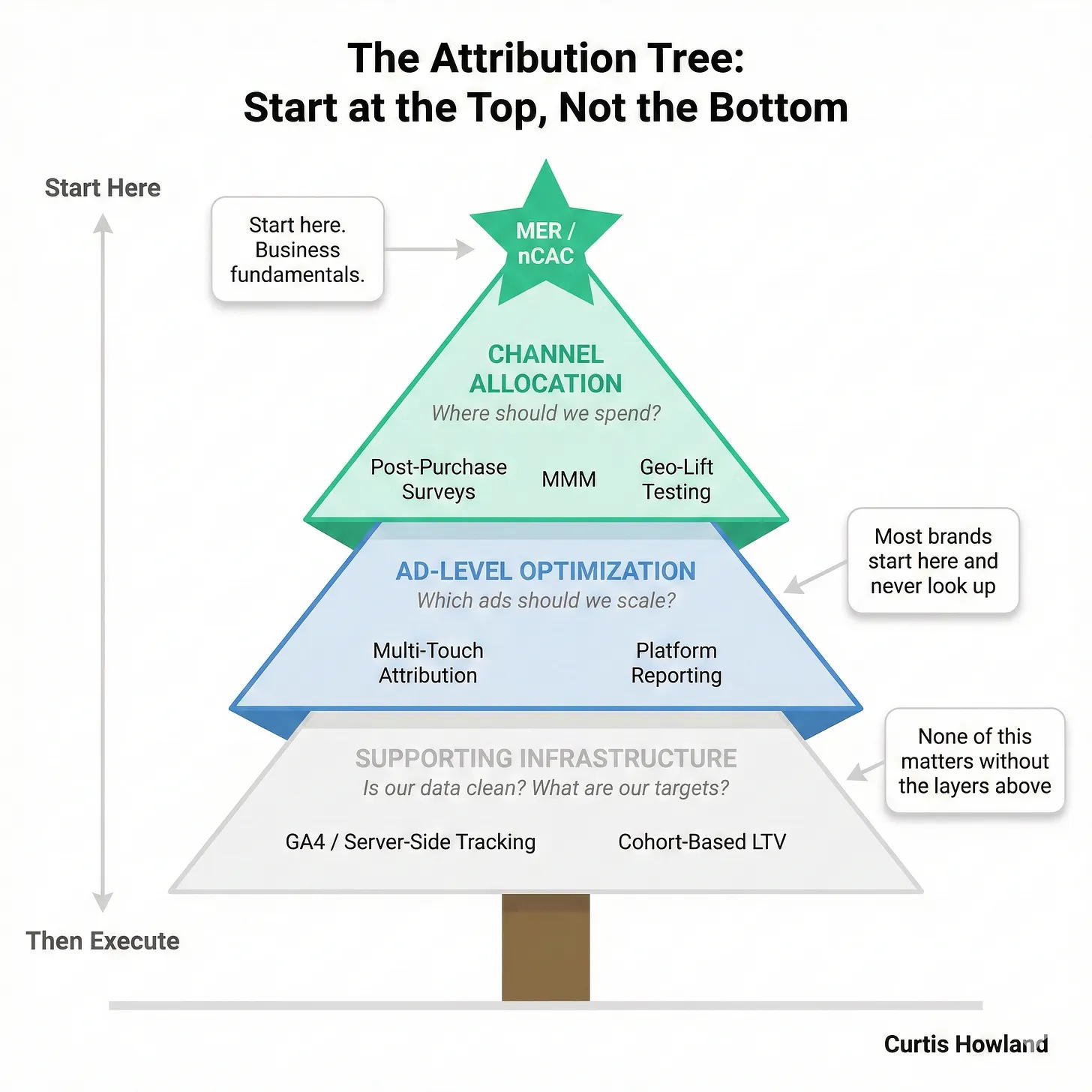
They also have all their tracking set up correctly, and they understand the unit economics and LTV numbers. That means they know how to optimize and what numbers to look for.
Too often, brands focus on which single tool they should trust. The better approach is to understand the web of tools and where each one works and where it does not.
5. Okay, Fine, A Short Checklist
I know I just spent too many words telling you not to audit your account like a checklist.
There are a few things that are worth checking anyway.
Do you have your Pixel set up correctly with deduped CAPI events?
Is your Conversions API sending hashed email and phone, plus IP and fbp/fbc cookies?
Are you testing partnership ads (whitelisted creator content)?
Are you testing ad copy variations, or are you testing landing pages? (Both work. Pick one as your primary lever.)
Have you evaluated Advantage+ Enhancements and made an explicit decision about which ones to enable?
If you can answer “yes, intentionally” to all five, you get a gold star. ⭐
If you can’t, fix those first.
The Practical Takeaway
Be careful about following the “right system” the “right number of ads” the “right attribution tool” and work to understand the gaps in each. This is the theme I’m seeing across the biggest accounts. It’s not perfection but reliable systems and strong thinking:
4 things
Your structure gets good ads scaling and bad ads paused
Your creative team compounds learnings
Your creative production is expanding ideas not narrowing in
Your attribution is nuanced not mono-focused.