

Across millions in Meta spend the pattern I see over and over is this: the brands that grow 2-3X year-over-year are not the ones that have “that one incredible ad”
I’ve seen the metrics behind billion-dollar brands with Super Bowl ads that everyone is talking about.
A consistent Meta system was driving 80% of true performance, not that.
The brands consistently hitting 100%+ growth annually are the ones with the most boring stuff, right, repeatable creative production system.
That’s a weird thing to say in an industry obsessed with “winning creative.” I fall into that trap myself. But this is HOW you get winning creatives, good ideas at scale, with a system.
The Winning Ad Trap
Too many brands think about creative like a slot machine. Keep pulling the lever with no system until you hit the jackpot. Find the one ad that prints money, then ride it until the wheels fall off.
And sometimes it works. You get a hero ad that scales to $50K, $100K, maybe even $500K+ in spend. Feels great.
But then it fatigues. And when it does, you’re back to zero. No pipeline. No system. Just a team scrambling to recreate lightning in a bottle while your CPA climbs 30-40% week over week.
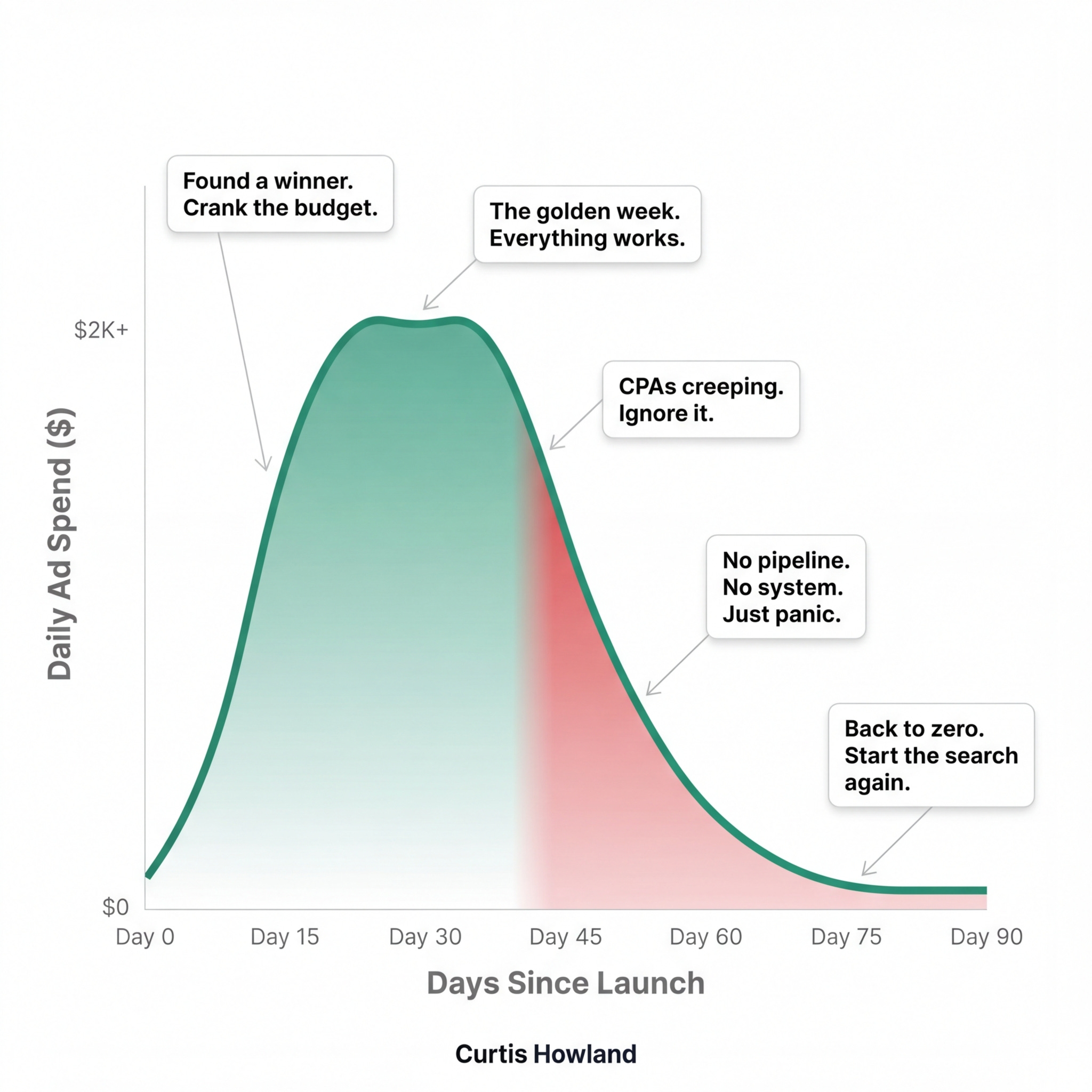
I’ve watched this cycle kill growth plans at brands spending $200K/month and brands spending $2M/month. The scale doesn’t matter. The pattern is the same.
They think they have a creative quality problem. Or a media buying problem.
It’s a systems problem.
Facebook Ads Churn. That’s the Starting Point.
Every Meta ad account has a natural churn rate. Ads fatigue, audiences saturate, and performance degrades over time. This is not a bug. It’s how the platform works.
Across the accounts I manage, I normally see creative churn rates between 20-30% monthly. That means roughly a quarter of your active ads will stop performing every single month regardless of how good they are.
(Or more technically, 1/4 of the spend on current creatives will have to be pulled back in order to balance CAC.)
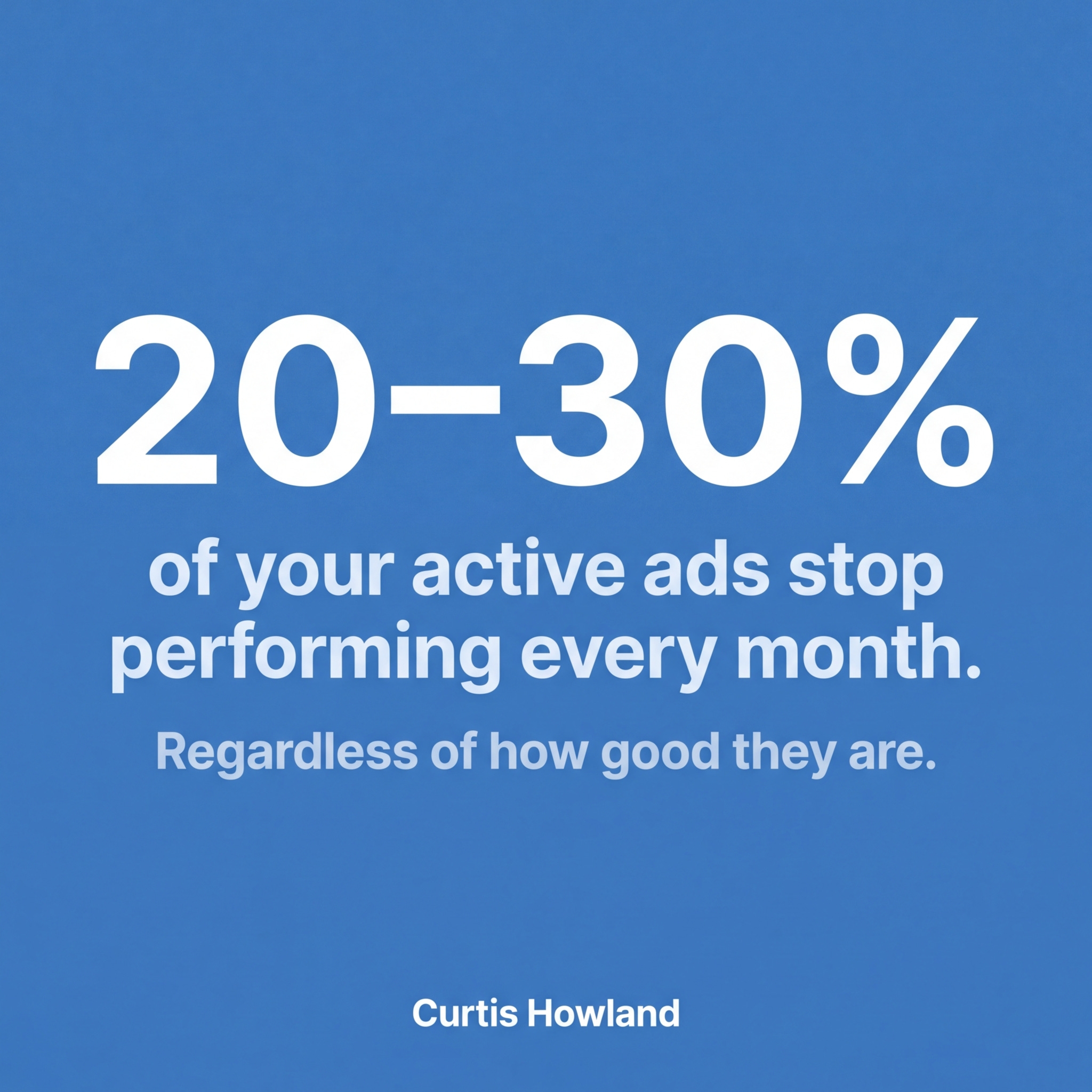
So the question isn’t “how do I find a winning ad?” It’s “how do I consistently replace 20-30% of my creative library every month while also producing enough new ads to grow?”
(And find winning ads while I do it.)
That’s a production problem, not a talent problem.
The Math You Need To Do:
Most brands know ads fatigue. They know they need more creative. But they never do the actual math on what “enough” means.
Take your monthly spend, divide by the average spend per ad launched, and that’s roughly how many ads you need flowing through the account.
At $500K/month with an average of $3K spent per ad launched, you need roughly 167 ads per month. Not 167 winners. 167 ads in the system, with all the testing, iteration, and failure that comes with it.
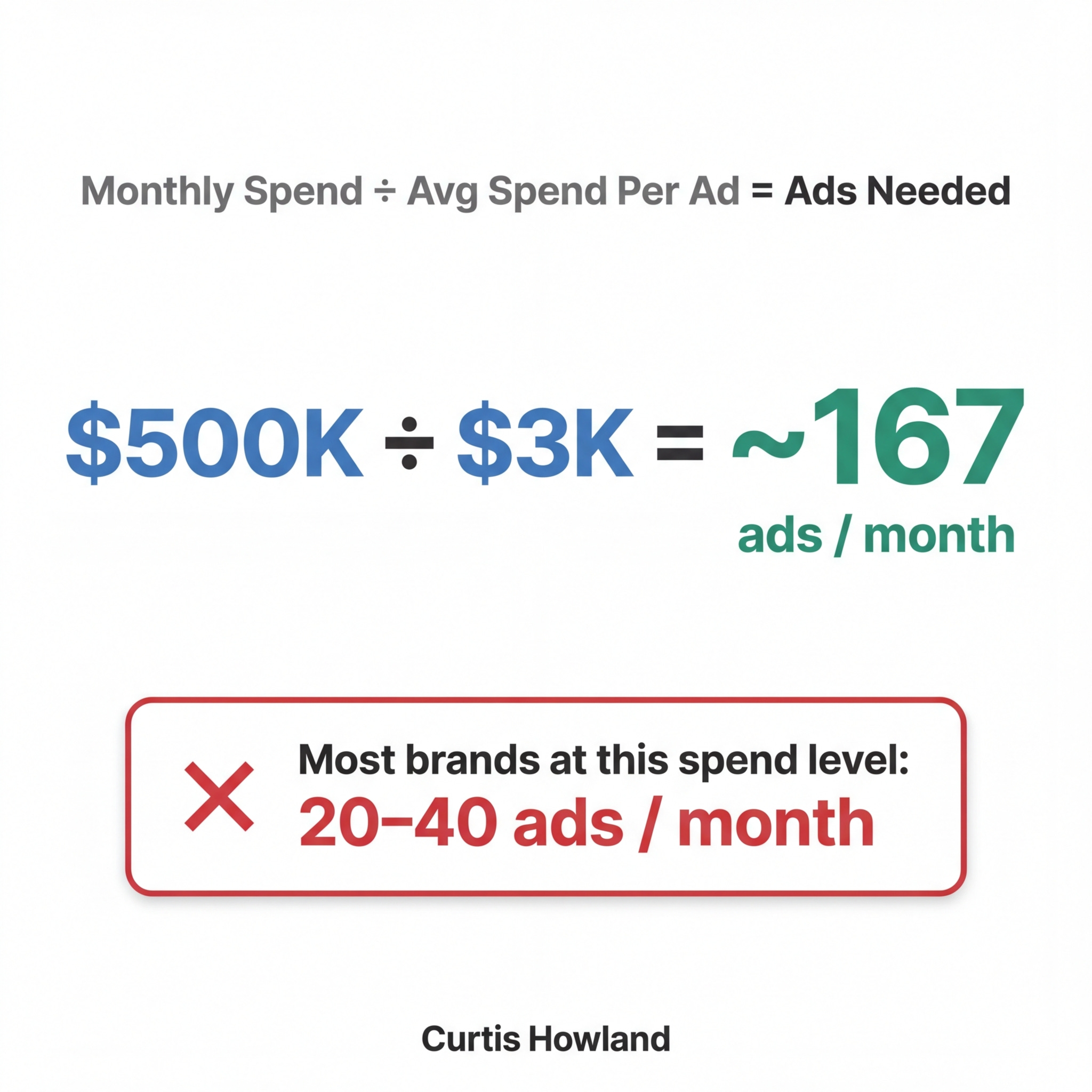
Most brands at that spend level are producing 20-40 ads per month and wondering why they plateau every quarter.
That $3K number isn’t universal. It depends on how quickly your ads churn (higher churn needs more creatives) But I’ve seen it hold surprisingly well across DTC accounts spending $100K-$1M+/month on Meta. Pull your own data: total spend over the last 90 days divided by total unique ads launched. That’s your number.
The 10/50/40 Split
Once you know the volume, what kind of ads should you be making?
Not all creative serves the same purpose. Here’s the split I use with clients:
10% Big Swings. Hard to make, hard to replicate, completely different from anything else in your account. Founder-led content, street interviews, podcast clips, something with a totally unique hook. Hit rate is around 5%. But when they hit, they can become your next $500K+ ad. One street interview at a brand I work with drove the majority of its revenue growth for an entire quarter. Nobody on the team expected it to work.
50% New Concepts. Different format, different angle, different selling point than what’s currently running. These are the workhorses. Hit rate around 7-10%. They won’t all scale huge, but they keep your creative library diverse and give Meta’s algorithm fresh signals.
40% Iterations. Same format and approach as a proven winner, but with a meaningful variation. Different headline angle, different creator, different setting. Hit rate around 15%, fastest to produce, most reliable. But they fatigue faster because Meta pushes them to the same audiences as the original.
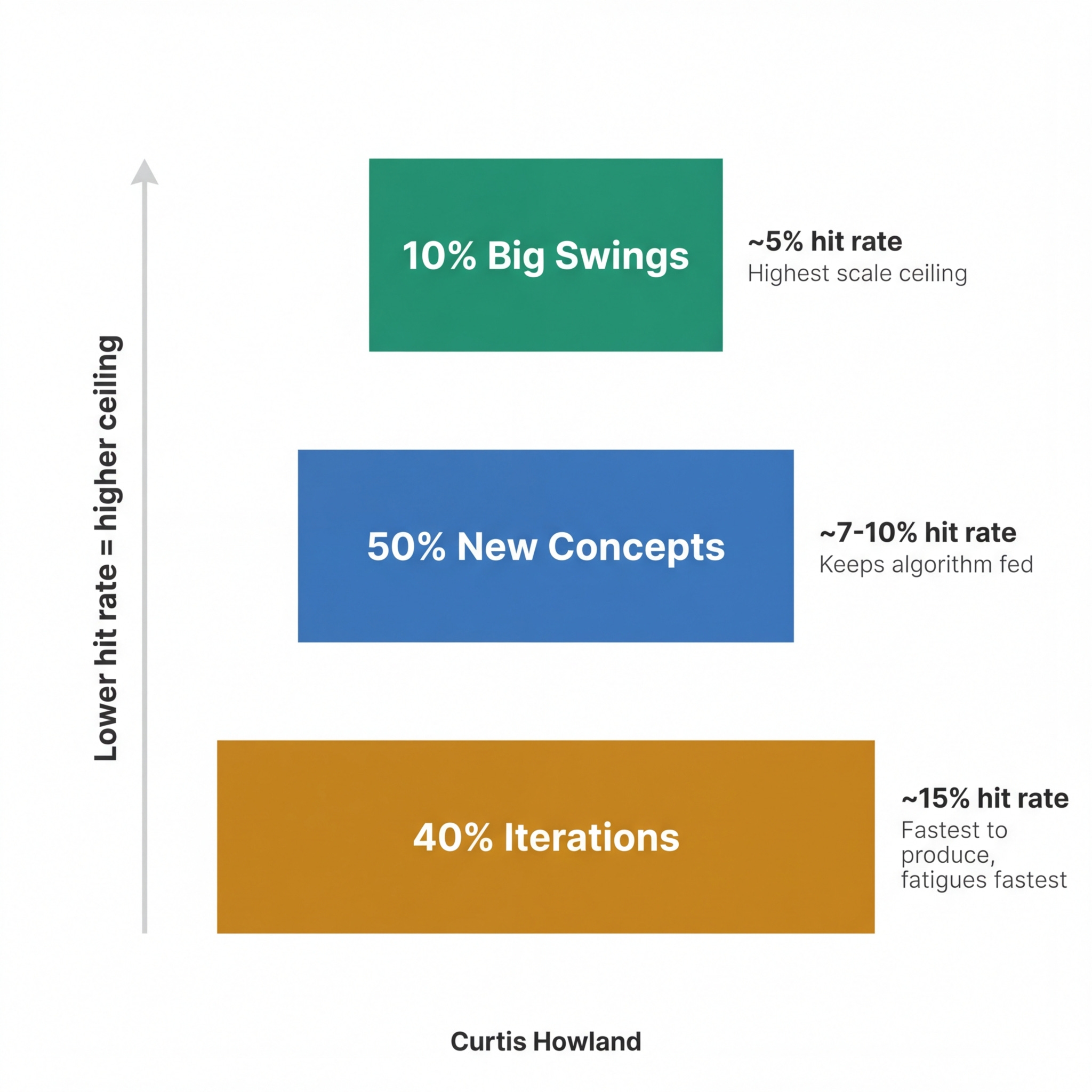
The thing most people miss is the inverse relationship. The categories with the lowest hit rates have the highest scale ceilings. And the categories with the highest hit rates fatigue the fastest. That’s the whole tension. You need all three running at the same time or the math breaks.
Iterations keep the lights on. New concepts keep the algorithm fed. Big swings create the breakout moments.
You may be thinking of some brands that do exclusively founder content or on-the-street interviews. For them, these are iterations. They figured out the system and cracked it, and now their big swings are different ideas.
Most brands over-index on iterations because they’re easy and the hit rate looks good on a report. Then they wonder why growth stalls in Q3. It stalls because you starved the pipeline of the stuff that actually moves the needle at scale.
What Counts as an Iteration (and What Doesn’t)
Quick distinction because creative teams get this wrong all the time. Changing a background color or swapping a font is not an iteration. Meta’s visual recognition models will see a slightly different version of the same image and treat it as the same ad.
A real iteration changes something that would plausibly speak to a different person.
Same visual format, completely different headline angle? Iteration. Same script, different creator (different age, setting, energy)? Iteration. Same concept translated from a static to a UGC video? That’s actually a new concept, not an iteration, because you’re reaching a completely different placement and user behavior.
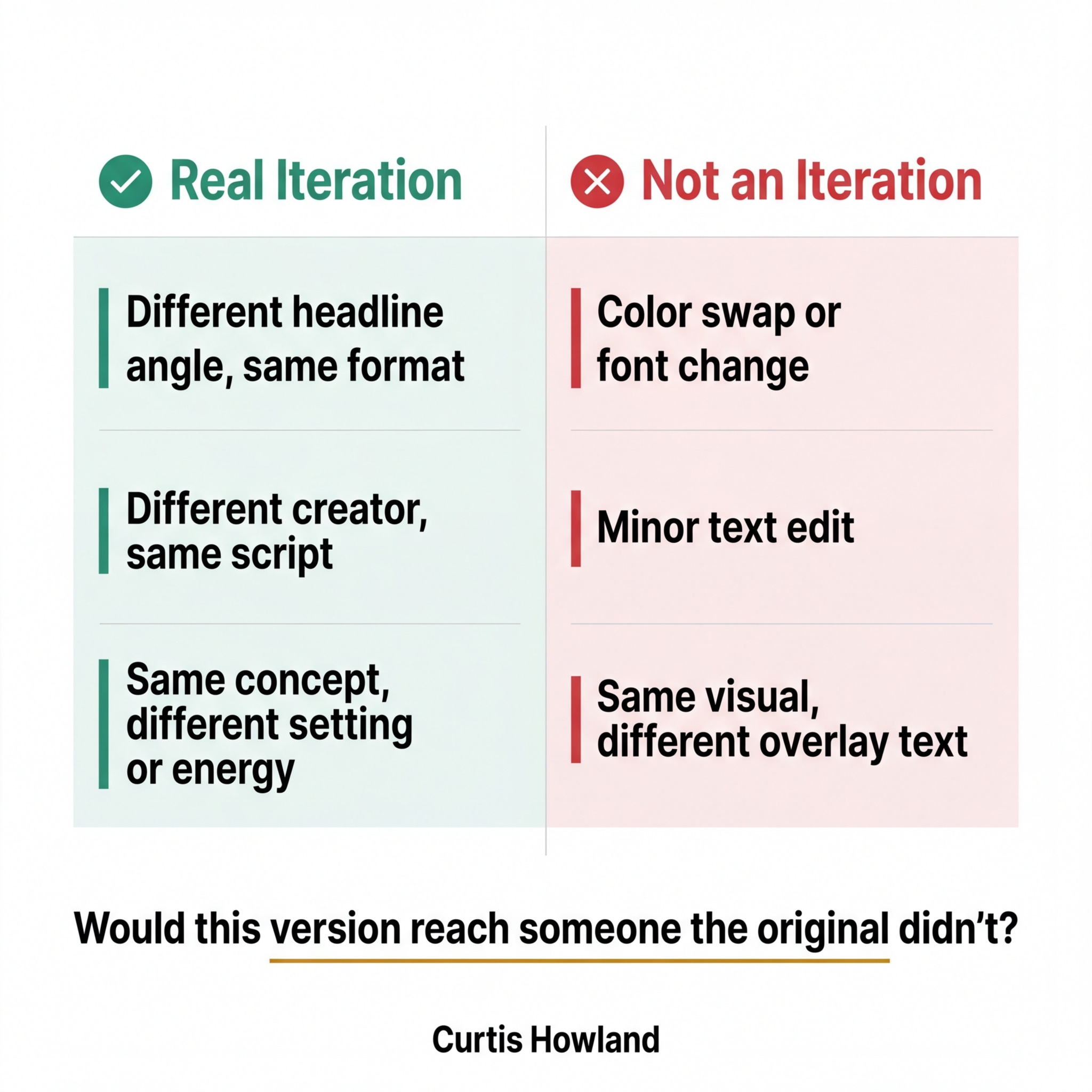
The test I give creative teams: would this version plausibly reach someone the original didn’t? If yes, it’s a real iteration. If no, you’re cluttering your ad account and inflating your “ads launched” count without actually feeding the algorithm anything new.
Three Numbers That Tell You If Your System Is Working
Churn rate. What percentage of last month’s spend is on ads that are no longer performing? I track this monthly. If you’re above 30%, your ads are fatiguing faster than average. Either increase production or diversify your creative mix (more new concepts, fewer iterations of the same three formats).
Ads launched per dollar spent. One new ad per $3K in monthly spend is the benchmark I use. Spending $300K and launching fewer than 100 ads? You’re under-producing. Your CPA will tell you eventually, but by then you’ve already wasted 2-3 weeks of spend at inflated costs.
Hit rate by category. This is the one almost nobody tracks and it’s the most useful. If your iteration hit rate drops below 10%, your “iterations” aren’t different enough. If your new concept hit rate is below 5%, your creative briefs need work. If your big swing hit rate is 0% for three months straight, you might be overthinking it (the best big swings I’ve seen were accidents).
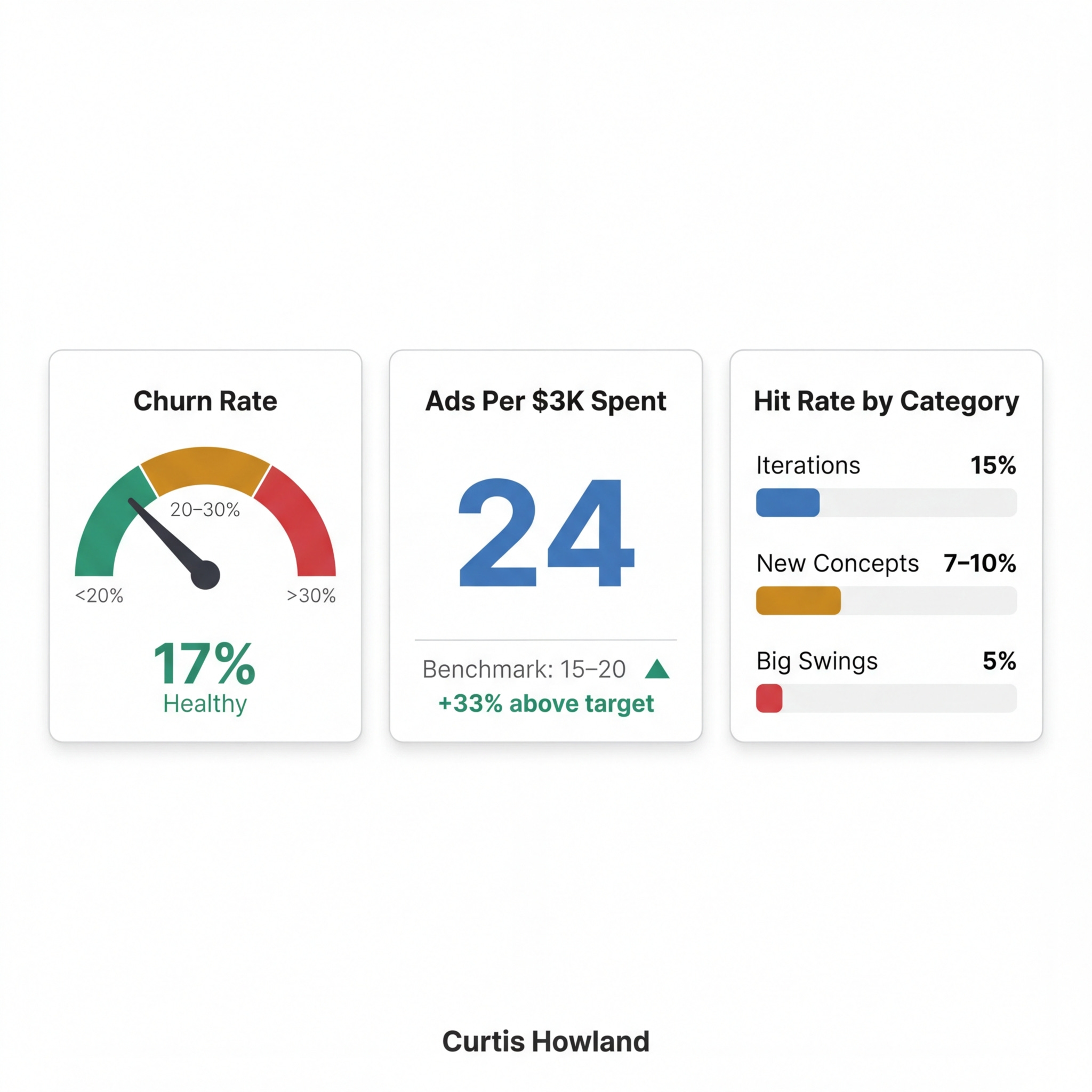
Most brands track individual ad CPA obsessively but have zero visibility into whether their production system is keeping pace with their spend. You know which ads are winning today. Do you know if you’re producing enough to keep winning next month?
Creative Volume Should Lead Spend (Not Follow It)
One more thing. Most brands scale spend first, then try to backfill creative. This is backwards.
If you’re planning to increase spend by 50% next quarter, your creative production needs to ramp 1-2 weeks before the spend increase hits. The algorithm needs fresh ads to explore new audiences. If you scale spend into a stale creative library, you’re just paying more for the same fatigued impressions.
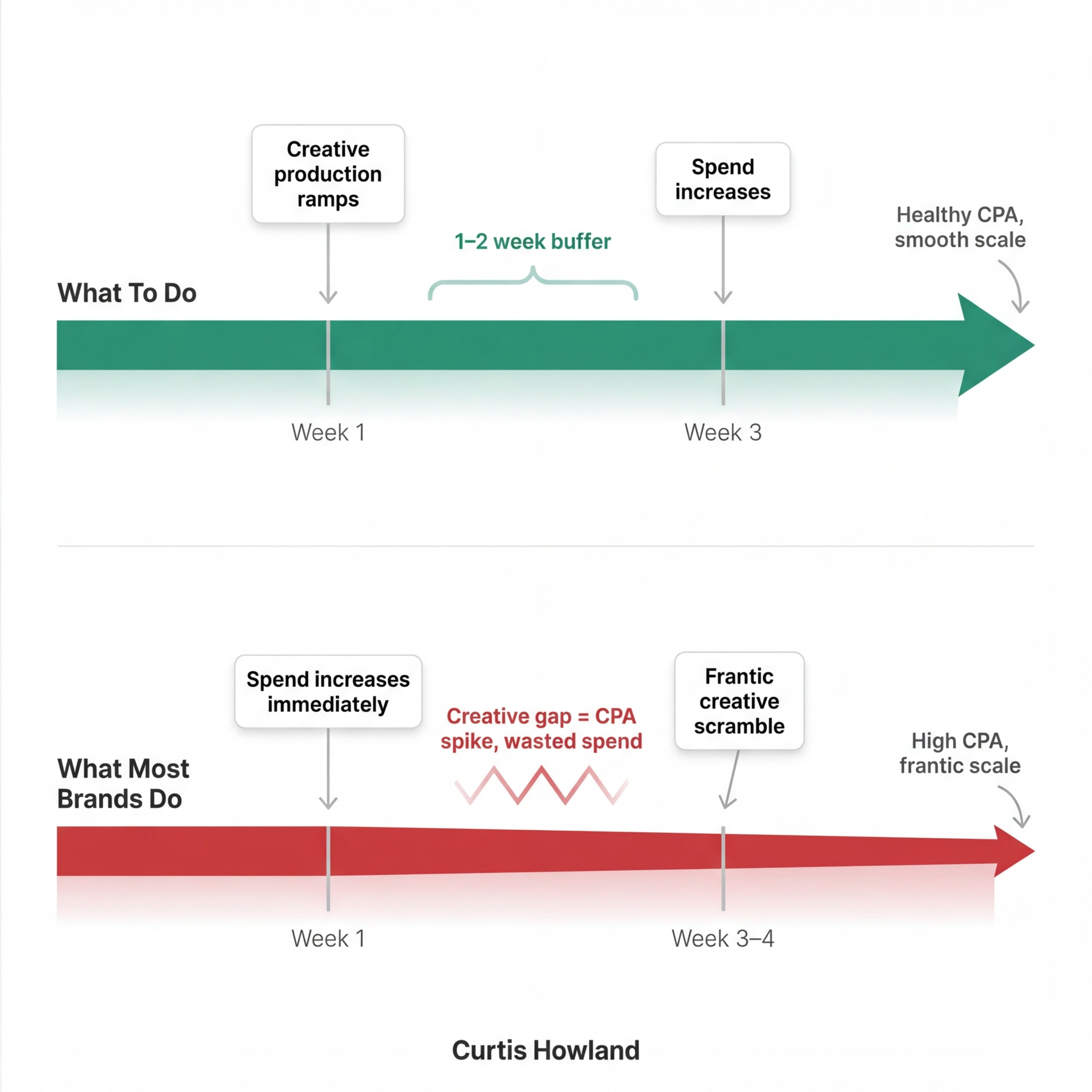
Think of it like inventory. You wouldn’t double your ad budget without enough product in the warehouse. Don’t double it without enough ads in the pipeline.
The Bottom Line
A brand with one incredible ad and no system will always lose to a brand with a solid average and a relentless production pipeline.
Your goal is a system that produces reliably AND takes big swings at the same time.
Know your churn rate. Produce enough to outpace it. Split production across big swings, new concepts, and iterations. And ramp creative before you ramp spend.
None of that is flashy. But it’s the difference between a brand that has a good quarter and a brand that has a good year.
If this was useful, send it to your team.
Such a lovely article