

The offer ads in the same analysis? They closed ~35%
Judge everything on last click and that video is the ad you cut.
Quick definitions:
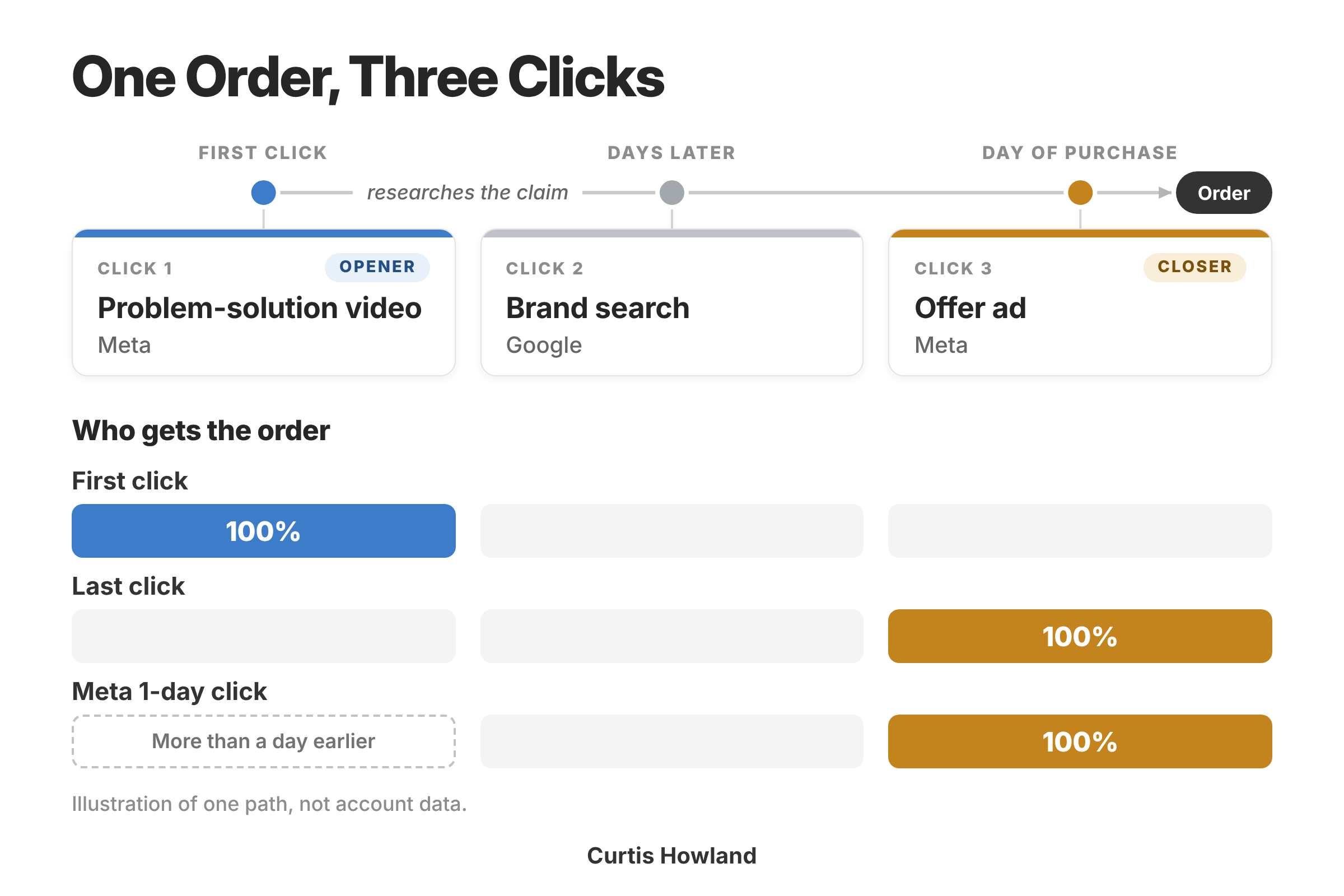
Journey: every tracked click on the way to an order
Opener: the ad that got the first click
Closer: the ad that got the last click
You get this data from your MTA where you can track click paths.
Openers and Closers Are Different Creative
The opener was a spokesperson video. No offer in it.
The closers were offer cuts: gifts/discounts/promos.
Same pattern across our accounts:
Promos drive more last clicks than first clicks
30% of the journeys Meta opened closed somewhere else
The ads that skewed hardest to first click speak to a specific problem people research a lot. I call them research ads.
I’m still parsing this out, but research ads make a claim that’s specific to you. “This is the product if you have XYZ.”
People want to figure out if that’s true. So they go do a bunch of research, then click through Google and convert. First click goes to Meta, last click goes to Google or a promo ad.
The standard Facebook funnel ad is just “great product, here are the selling points, here’s a promo.” And people go buy it.
Promos Look Better on Day One
Your reporting leans toward closers three ways:
Last click gives the whole order to the final ad (If you use a blended model then it probably splits it evenly which might be too much)
Meta’s 1-day and 7-day click windows stop counting before slow buyers show up (Even if you look at a longer time frame, you have to run those ads for a long time for those clicks to get tracked)
Returning customers click closers too, and Meta counts them the same as new customers
Non-promo ads take longer to convert and get fewer last clicks. But they do drive conversions efficiently.
Let’s take an example that I see across a lot of accounts. Here’s the percent of purchases that happen on the first day vs 28 days
Promo ads: 64%
Evergreen ads: 58%
By day 7 the gap is about 3 points
So on day one the promo looks better, even if they perform the same by day 28.
On top of that, you would expect these to have higher off-channel conversions and on-track conversions as well
Don’t optimize out of the slower ads too quickly.
For conversion lag, product matters way more than creative style. Share of first orders landing inside Meta’s 7-day click window:
Whole account: 78%
Two higher-consideration product lines: 72%
The fastest product: 86%
And it gets wider when you go to 28 day ranges.
Two things that don’t change lag which surprised me (for the data I reviewed)
Creator ads. (when holding the above constant)
Middle vs bottom presumptions / I couldn’t predict purely by the hook (for non promo ads)
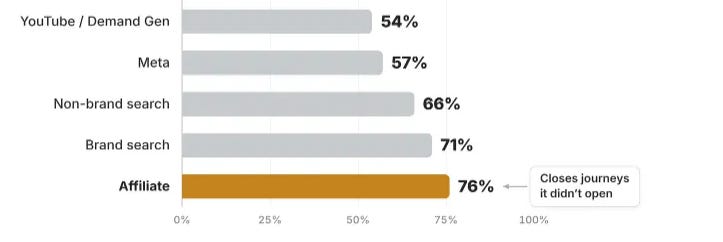
It’s also worth it to look at this analysis across channels. For example, YouTube and Meta might be driving conversions that affiliate closes because your affiliate is mostly promo websites
How to Find Your Openers
Brought to you by Triple Whale
This is where Triple Whale comes in.
Yes, they sponsored this post. Don’t skip this part though. It’s the how-to, and you need an MTA to do it.
Most of our clients at Misfit run on Triple Whale, and we recommend it to any brand that doesn’t have an MTA yet. It’s more than an attribution tool, too. Triple Whale gives us a broader operating view of the business, which is why we use it beyond just this analysis.
First Click is your opener view. Last Click is your closer view. (Triple Whale’s own guide here.)
Pull purchases by ad on First Click. New customers only. (Why that filter matters.)
On the Attribution dashboard, set the attribution model to First Click
Columns button (top right): the Purchases preset shows new and returning customer purchases
Settings menu, then Export CSV. The file breaks out by campaign, ad set and ad
Switch the model to Last Click. Same ads, same dates. Export again.
Divide first-click purchases by last-click purchases for each ad, then compare it to the account’s ratio.
Well above the account ratio = opener
Well below = closer
The video from the top of this post: 68% opened vs 3% closed. About 23 to 1
Check the lag in Ads Manager. Compare attribution settings on the same ads (1-day click, 7-day click, 28-day click), then divide 1-day by 28-day.
Promos convert inside the 1-day window
Slower ads keep adding conversions out to day 28
For anything that looks like an opener, check CPMr (the Ads Manager column is “Cost per 1,000 Accounts Center accounts reached”) and cost per ThruPlay. Low on both = it’s reaching new people cheaply and holding them.
Skip ads with only a handful of purchases.
No MTA yet? Book a Triple Whale demo and run this on your own account.
Thanks to Triple Whale!
How Much Room to Give an Opener
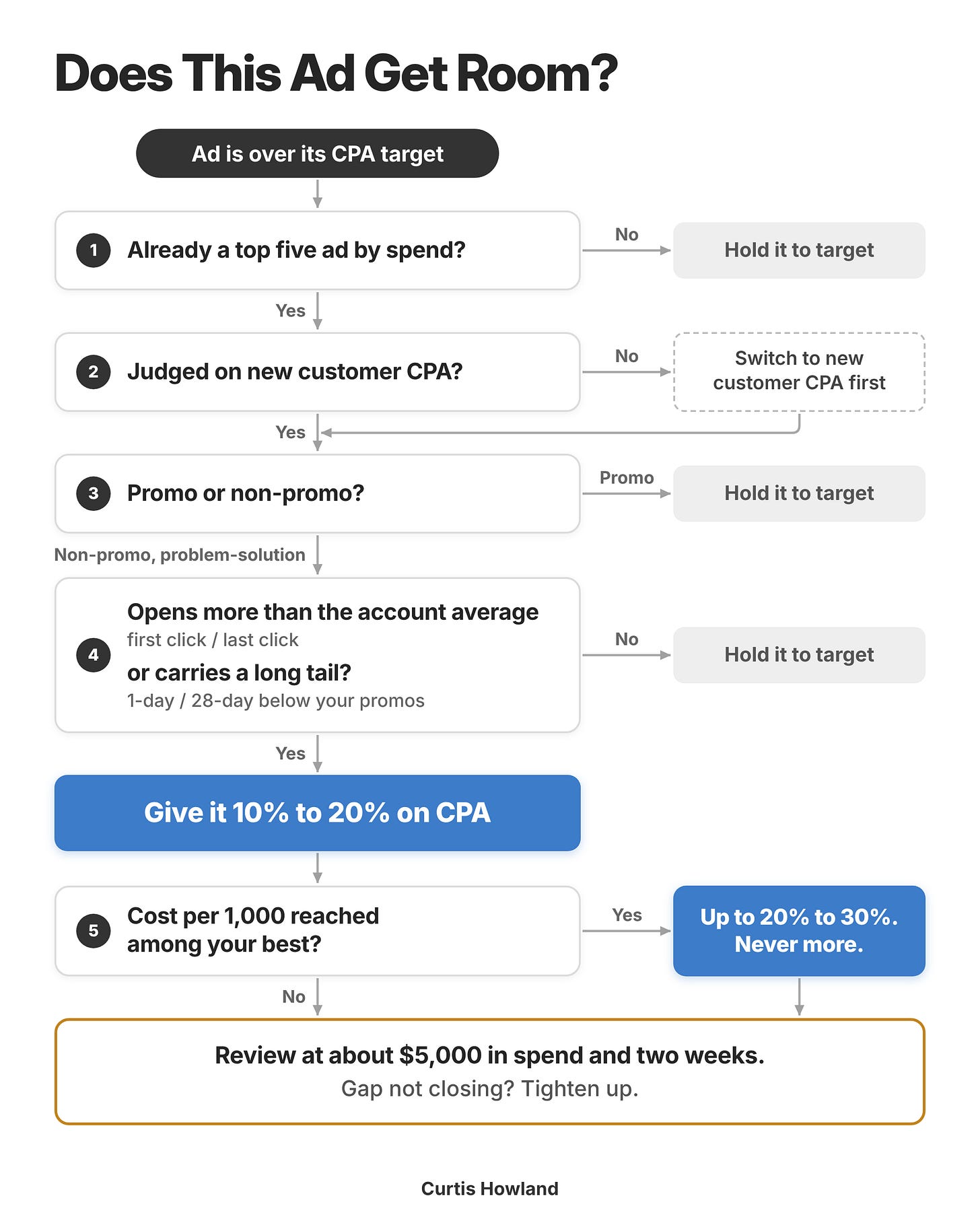
First step: judge the ad on new customer CPA in your MTA, not CPA in Ads Manager.
Then openers get a small bump:
Normal bump: 10% to 20%. If the benchmark is 100, a long-tail, problem-solution opener gets 120
Really low CPMr too: 20% to 30% total. Not more than that
I’m not letting anything run at a 2x here though.
Only do this for your top few ads. If it can’t get into the top five on decent performance, no point in giving it 20% more just to try to get it a little further. (too much noise at this level anyway).
Closers stay at target.
I’m more conservative on promos. Most of their credit shows up on day one
Aim to have their CPA be 20% lower.
Where this stops:
Not every ad that doesn’t convert is secretly doing work. No click signal on any window = not an opener.
Don’t optimize only on first click either. You’ll kill your closers.
Happy buying!
- Curtis
Openers and closers is a far more useful way to talk about it than top and bottom of funnel. The research ad idea rings true: if an ad makes a claim specific enough to be checked, people go and check it, and the credit lands wherever they finish. It's rather like the salesman who does the hard explaining and watches someone else take the order. Glad you put a firm limit on how much room openers get, too.
The day one versus day 28 point is the trap I see most with small business owners running their own Meta ads. They check after a few days, the promo looks like the winner, and they switch off the ad that was actually starting the conversations. For anyone without a multi-touch attribution tool, a rough substitute is asking "how did you first hear about us?" on the enquiry form or the first call, then comparing that with what the ad platform credits. Have you found a minimum run time you'd give an opener before judging it?