

The algorithm isn’t the enemy. But you can’t just let it run wild.
Why You Can’t Just Trust Meta
Meta will optimize toward ads that drive conversions. They’re not a moral agent here. If they make you more money, you spend more money. Simple.
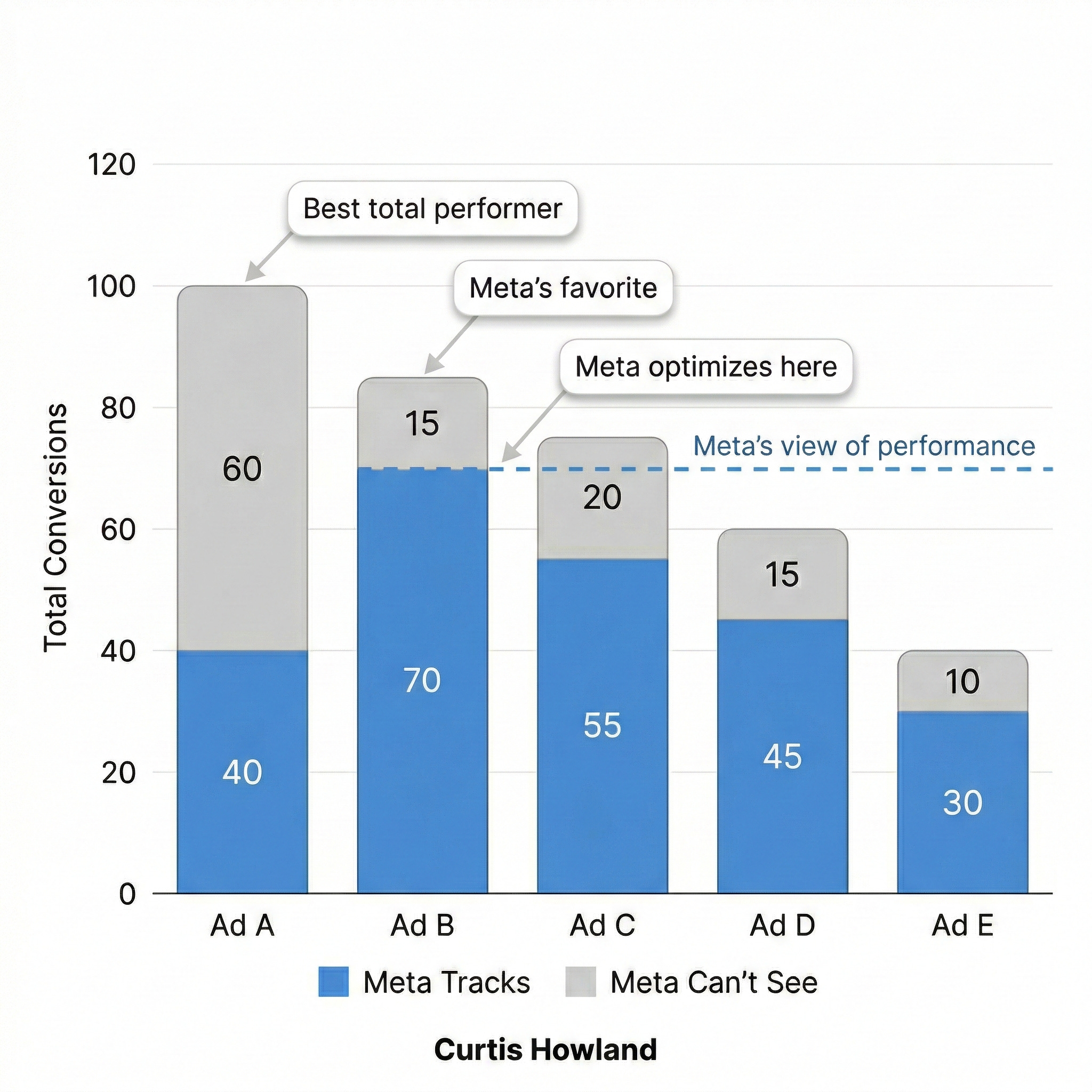
But here’s the problem: Meta can only see what Meta can see. They guess as well but it’s not perfect.
And the other problem? The better they can prove to you they drove those conversions the more likely you are to spend with them. They know this too.
Their in-platform reporting has cookie loss. They’re guessing on a lot of it. Especially top-of-funnel ads where the conversion happens days or weeks later.
Meanwhile, you’re optimizing for business outcomes. Total revenue. Retail lift. Amazon spillover. Rebills. LTV.
These are different things.
Even if Meta was perfect at optimizing the right ads (they normally aren’t) they are still missing data and insights that are crucial to good optimization.
What Meta sees: In-platform conversions, engagement metrics, click-through rates.
What you care about: Total conversions. Including the ones Meta can’t track.
This creates a gap. Meta might kill an ad that’s driving retail purchases they can’t measure. Or scale an ad with great engagement but terrible downstream economics.
The more retail or Amazon presence you have, the bigger this gap gets.
The longer the purchase funnel or consideration the bigger the gap.
The bigger the brand and stronger the awareness, the more careful you have to be here.
If you want to understand this more in-depth, read this article and get more new customers from Facebook to understand how you can adjust your targeting.
How to Actually Get More New Customers from Facebook
If you rely on Facebook’s attribution, they’re going to drive a lot of returning and bottom-of-funnel customers to you ultimately.
Optimizing up the funnel, both in creative and attribution, means that you’re fighting against meta. You need to have more control over your account and more control over your adjustments on a daily basis.
First understand your attribution:
Deep dive here: 8 Types of Attribution Every DTC Brand Should Know (And the 3 I Actually Use)
But in short:
Know your high-level profitability with a blended new customer MER and your nCPA, so you know how profitably you’re acquiring customers at a total level with precision
Figure out a good way to allocate budgets across channels. My suggestion is a mix of a post-purchase survey and MMM
Then, and only then, should you start optimizing on a campaign and ad level basis. For meta, you should absolutely be using a multi-touch attribution tool focused on that new customer row as a metric. You should be watching the difference between total clicks, first and last touch clicks attribution, so you know which ads are driving top-of-funnel versus more bottom-of-funnel conversions
What this means is that you need to actively manage the account.
Meta reported conversion =/= your goal. Total efficient conversions is.
You can’t just set budgets and trust Meta to figure it out. Especially not at scale.
So how do you do it? How do you control what gets the spend?
Three Levers. That’s It.
You have three ways to control spend:
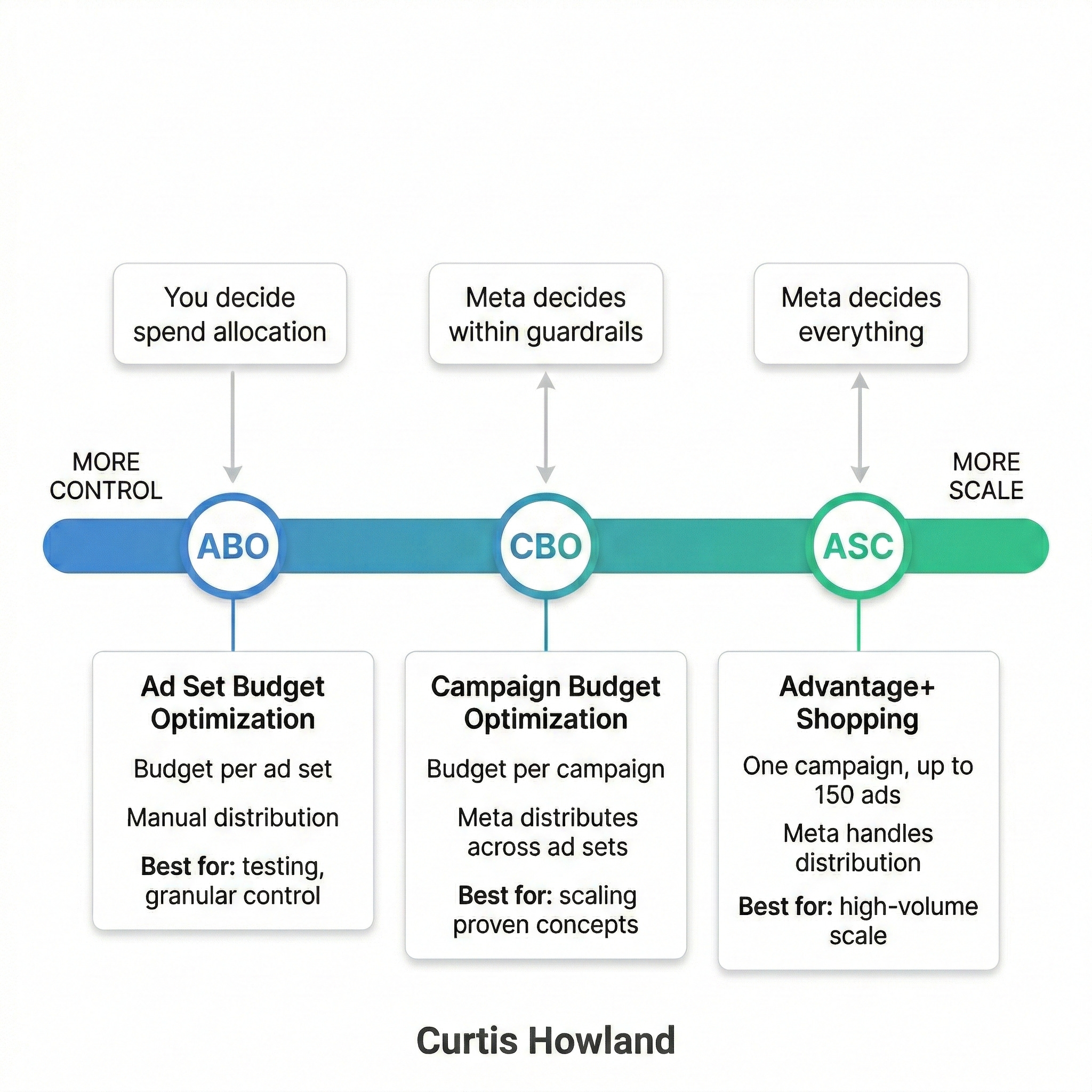
Structure. Where you place an ad determines how much control you have. ABO = more direct control. CBO and ASC = More Meta control.
Budget & Targets. Set at campaign level or ad set level. Cost caps set ceilings.
Status. On or off. Pause underperformers. Duplicate winners.
Everything else is a variation of these three.
P.s. I post weekly, send this to a friend, if you are that friend, you can subscribe here!
Campaign Types
ABO (Ad Set Budget Optimization)
Budget at the ad set level. You decide how much each audience gets.
Best for: testing, granular control, manually scaling winners.
Trade-off: more management.
CBO (Campaign Budget Optimization)
Budget at campaign level. Meta distributes across ad sets.
Best for: scaling proven concepts, less management.
Trade-off: less control over individual ad sets.
ASC (Advantage+ Shopping Campaigns)
One campaign, one ad set, up to 150 ads. Meta handles almost everything.
Best for: scaling at volume with strong creative and good pixel data.
Trade-off: very limited control.
My typical structure:
→ One ABO for testing and scaling top of funnel
→ One ASC per product for additional scale
→ Sometimes a separate campaign for retention with exclusions
*Per product if targets differ
ABO gives control. ASC gives scale. They work together.
Bit of a simplification but it’s a good place to start
When to Cut an Ad
This is where most buyers mess up. They cut too early or let losers run too long.
How do you know when you have enough data?
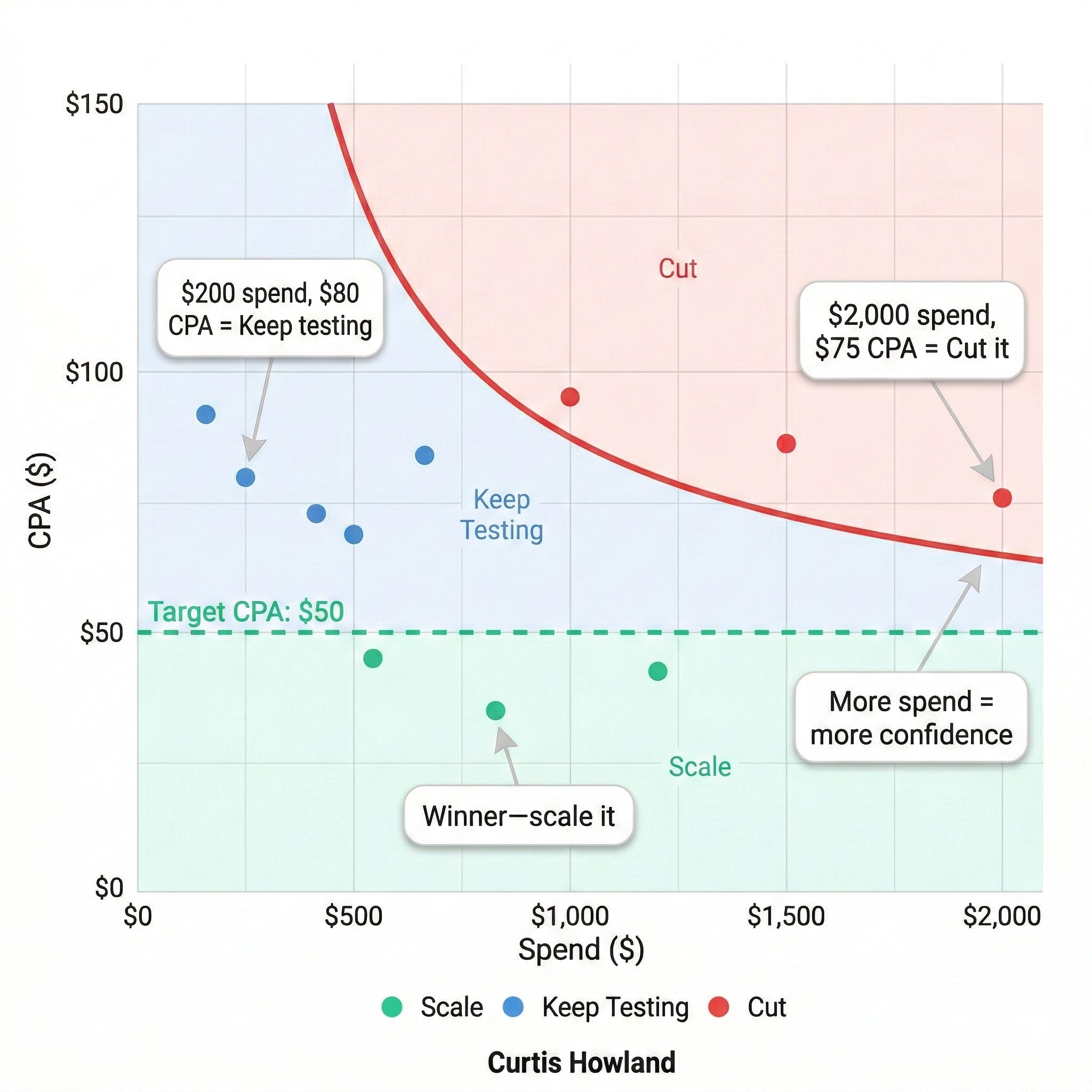
The simple version: An ad with zero conversions at $50 spend might be fine. Zero conversions at $500? Probably a dud.
More spend = more confidence.
The technical version: We use Poisson confidence intervals.
At any spend level, there’s a statistical threshold where you can be X% confident an ad will never hit your target CPA.
I use 90% confidence as my cut line.
( your top ads outperform your target at lower spends, anyways. I find it very rare that this ends up cutting any top performer when using 90% confidence vs the average target)
Set target CPA at $50. Draw a curve based on 90% confidence. Any ad to the right of that curve has enough data. I’m 90% sure it won’t hit target.
Cut it.
Flip side: if an ad is below target CPA but not getting spend, it’s underscaled. Force it.
This gives you a framework. Not just “cut everything above $50 CPA.” It’s nuanced by spend level.
$200 spend, $80 CPA? Keep testing. $2,000 spend, $80 CPA? Cut it.
if you plot all of your ads with spend on the X axis and CPA on the Y axis, your cut Poisson curve is going to look like this red line:
The Workflow
Testing
3-5x CPA target per concept is a decent baseline. Enough to hit statistical significance on the low side (i.e. cut if no conversions)
If its meh performance at that point you may let it run longer (again look at the curves above)
Scaling
Once an ad wins, scale two ways:
Increase budget
Duplicate to new ad sets
Expanding across placements is often safer than pumping budget. If a winner works in 4 out of 5 placements, you have confidence. Scale harder.
Cutting
When an ad crosses the confidence threshold on the upside (inefficient):
Pause it OR reduce budget on its ad set
If it’s in CBO/ASC, pause the specific ad if its the top performer in an adset with no other clear winners then you can pull back.
Sometimes an ad dominates a campaign that has multiple potential winners but performs a little soft (20% above target). You might:
→ Duplicate the campaign
→ Pause the problem ad in the duplicate
→ Lower budget on the original (where that ad is going well)
→ Let the duplicate run with better distribution
More complex. But necessary when one ad monopolizes spend.
You’re using your three levers together to control the output
The Pokemon Thing
I think of ads like Pokemon with power levels competing within adsets. (My co-founder laughed when I said this on a call since I haven’t played Pokémon before. But he confirmed this is accurate.)
Strong ads work across multiple placements. Handle high spend. Don’t fatigue fast.
Weak ads work in narrow conditions. Crumble under pressure.
When moving an ad:
→ How strong is this ad? (How many placements? What spend levels?)
→ How strong is the destination? (Already scaling? Top ad fatiguing?)
A $400/day ad won’t suddenly perform at $1,500/day in a new placement. It doesn’t have the capacity.
But a $1,000/day winner moving to an ad set with a fatiguing top performer? Good swap.
Know your Pokemon’s power level or whatever it is.
Budget Increments
Don’t make massive swings.
20% changes at a time. Looking at change logs from well-run accounts, that’s where the distribution clusters. Few 50%+ moves.
Why? Big changes push ads into relearning. You lose the optimization Meta built up.
Exceptions:
→ Adding to new placement (incremental, not adjustment) → Cutting when data is clear (30-50% OK) → Weekend demand spikes with cost cap handling it
How Often to Check
Accounts spending $150k+/month: twice a day.
Early to catch issues. Later to adjust based on day’s performance.
Not every ad every time.
Consistent ads get tweaked every few days.
Volatile ones might get touched in both sessions.
If you’re making 40-50% adjustments constantly, you’re not checking often enough.
More smaller changes!
Cost Caps
I don’t use them often. My target is scale.
But they have their place.
my biggest concern with cost caps is that people make the incorrect assumption that they can just assume a target based on their unit economics, plug it in a meta, and walk away.
But as we discussed earlier, what Meta reports as your attribution is not the same thing as your total target. They could be over or undercounting.
And some cost caps just don’t like to spend when they can; some cost caps love to spend even when they shouldn’t
As long as you keep an eye on this and are tweaking the budgets and targets to account for those changes, you should be fine
The System
Structure for control. ABO for testing/scaling. ASC for leverage.
Use statistical confidence. Don’t cut on vibes.
Cut losers. Past threshold = pause or budget-cut.
Scale winners. New placements first, then budget.
Know ad strength. Track performance across placements.
Small, frequent moves. 20% adjustments, twice daily.
The algorithm isn’t the enemy. But it’s not your friend either.
Meta’s goals are not your goals.