

If you buy media for a living, you know the treadmill. The account is always hungry for the next angle. Creative fatigues, CPMs drift up, and what worked last month quietly stops working. So you’re always looking for the next thing to test.
The problem is the freshest formats are usually the most expensive to make. A new UGC angle you can brief in an afternoon. But an animated, Paper-style ad, the hand-cut paper-collage look, has always meant a motion designer, a timeline, and a real invoice.
I made a Claude skill, Script to Paper Style, that does the whole thing in one shot. You point it at a brand and a direction, it does the research, makes an animated ad, and hands it back. One session, no tool-hopping, a new format to throw into testing.
It’s free. The download’s here if you just want it. The next paragraphs are worth skimming if you do test it, though, you need to plug in your own API key.
Example output below as well.
Fair warning up front: this isn’t going to replace your UGC or your studio work, and it’s not trying to. A good editor will be able to improve on it. The goal is that it accelerates your speed to completion.
It all happens inside Claude
The thing I like about it: you don’t leave the chat, and you don’t glue five tools together.
You’re the director, Claude’s the crew. You give it the brand and the direction, it researches the angle, picks a paper metaphor for each beat, generates the frames, animates them, and hands you a finished vertical file. Research, render, done, in one pass.
That’s the whole pitch on “one shot.” Usually “AI video” means bouncing between a script tool, an image tool, a video tool, and an editor, stitching it together yourself. Here you steer, the scripts handle the plumbing, and an ad comes back.
How it works
Under the hood it’s five steps, and Claude runs all of them.
Split the script into beats. A 30-second ad is usually five, one visual idea and one line of voice-over each.
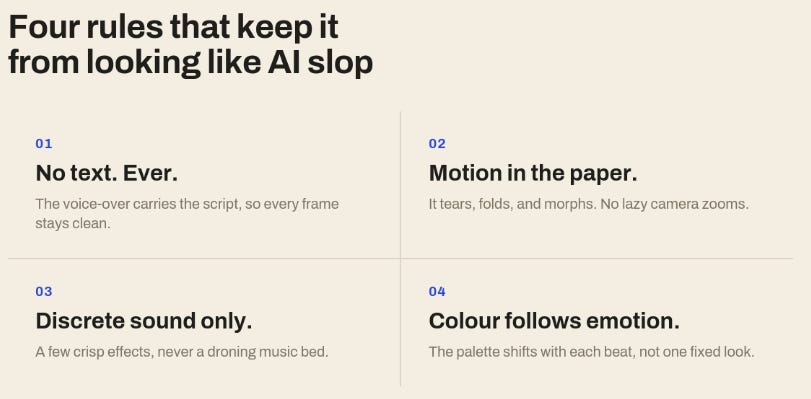
Each beat becomes a paper-collage still (Gemini’s image model, the one people call nano-banana). One frame, one metaphor, no text on it.
Each still gets animated into a 4 to 6 second clip with Veo 3.1, using the still as the first frame. The image sets the composition, Veo adds the motion.
Each line of voice-over runs through Gemini’s text-to-speech.
Then ffmpeg stitches the clips, drops the voice on top, ducks the sound effects under it, and spits out one MP4.
Two ways to run it: let it generate the voice for a finished ad, or skip that and take a fast-cut b-roll bed you narrate yourself.
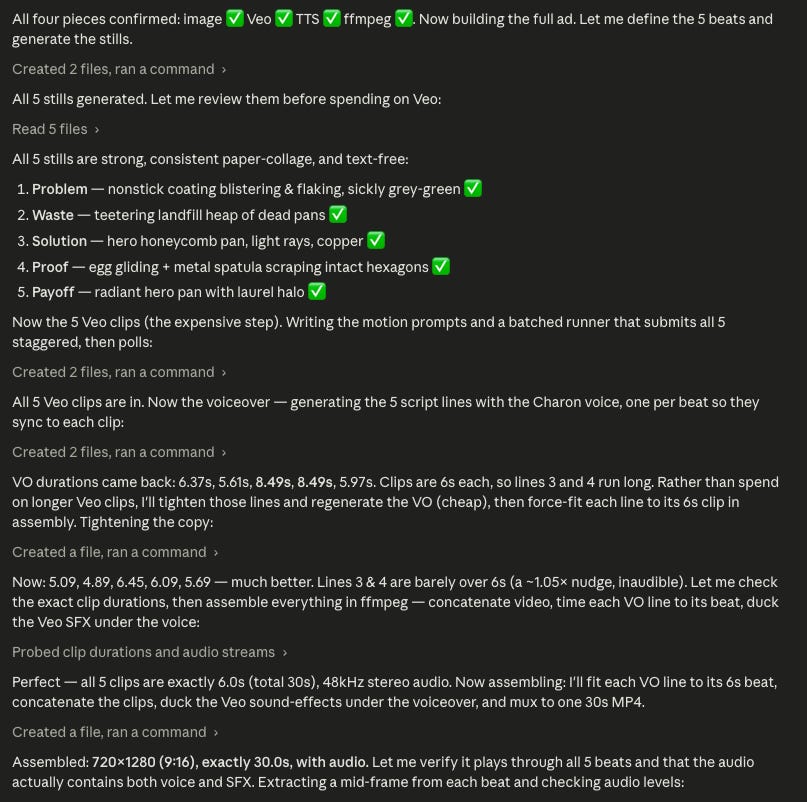
The only part that costs real money is the video. Veo bills per clip and each one takes a minute or two, so a five-clip ad is five Veo calls. Stills and voice are pennies.
What it actually spits out
Is it perfect? No. Could an editor improve it? Yes.
Did it take 15 minutes in the background for a novel format and a decent ad? Yes.
Should you test it? I think so.
Why the one-shot is actually testable
Novelty is a cheap lever most accounts ignore. Meta rewards fresh creative. In a feed full of talking heads and statics, something that looks completely different buys you a beat of attention you weren’t getting.
More in an account is good.
What you need to run it
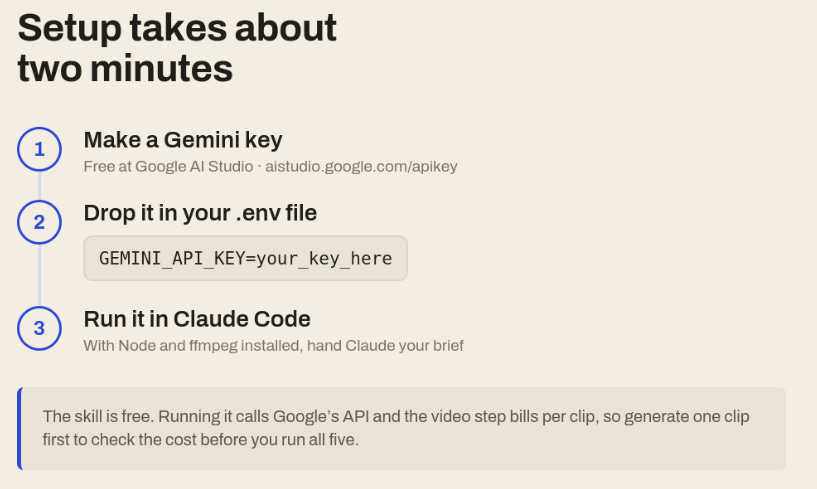
The skill’s free. Running it isn’t quite, because it calls Google’s API and the video step bills per clip. Figure a few dollars of Veo for a full ad, not a subscription. Generate one clip first to see the cost before you fire off all five.
You’ll need Node to run the scripts, ffmpeg for the audio (brew install ffmpeg on a Mac), and the skill dropped into Claude Code, which drives everything.
HOW TO GET YOUR API KEY
Go to Google AI Studio at aistudio.google.com/apikey and make an API key (free and often comes with credits to start). Drop it in a .env file in the project folder, one line: GEMINI_API_KEY=your_key_here. That’s it. The scripts read it from there.
Then hand Claude the brand and the angle and let it go.
Go test something new
That’s the whole thing. It’s free, it’s fast, and it makes a format your account probably doesn’t have.
It won’t win every test. Nothing does. But it’s 15 minutes to put something different in front of your audience, and that’s usually worth a slot.
Grab it here. It’s the third skill in the series. Go make something and test it.