

Step 1. Open Meta Ads Manager
Step 2. Head over to your campaigns
Step 3. Click change log (Clock icon top right)
Step 4. Copy Last 90 days to a Sheet
Step 5. Only pull strategy-related changes (Ignore status changes).
Then create these 4 simple charts:
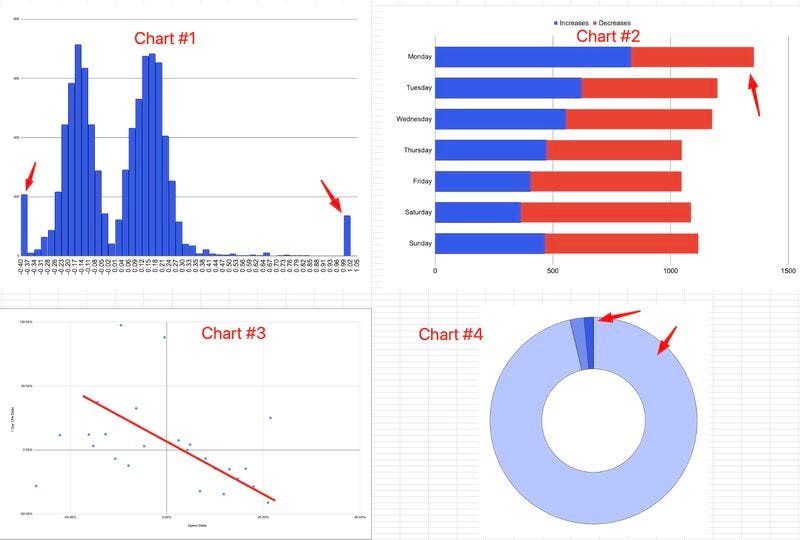
🔴 Chart 1: +/- budget change histogram
Map out the count of positive and negative changes and categorize them in 3% buckets
Three red flags you may see
1. Always the same change, “10%”, no matter what the data shows
2. Rarely making changes (you want consistent small optimizations)
3. Often making big changes 50%+/-
The example below is what you want. It shows an even number of ups and downs, which are dynamic based on performance, and rare large changes.
🔴 Chart 2: Changes by day
Red flags: Making 90% of changes on the same day of the week.
This normally means you are not getting regular attention on the account.
Ads don’t need changes every day, but its a rare day that an entire account would go a full day without benefiting from a tweak, let alone that same day every week.
We often see the Mon/Thurs pattern or the Tues/Friday adjustment patterns leaving money on the table.
If you are spending 250k+/mo, check change times as well (how many times per day).
🔴 Chart 3: Predictive power
So they make changes regularly, but is it working?
Map out the changes vs the CPA the next day. Do they predict whether an ad is decaying or improving accurately on average?
If so, you will see a downward trend in this chart. Ads with increasing day/day show on average slightly lower CPA.
A flat trend is OK here, but make sure they are not positively correlated (in which case you are blowing out your ads and killing potential).
🔴 Chart 4: Who’s making changes:
Is it 3 people?
Is it an AI bot?
Is it an Automation?
Know what you are paying for.
If the person media buying on your account changes every other day, how can they become familiar with the nuances of your specific account?
🟢 What makes a good media buyer?
1. They make nuanced changes based on the data
2. They make changes when the ads are ready (not when they feel like it)
3. They make careful and regular small changes, and they see how the ads respond
4. They are in the ad account, and they know what’s going on inside of it.
It always surprises me that people use metrics to track creative teams and other employees, but media buyers are tracked by a single performance metric.
In theory, that’s great (I’m a performance marketer after all), you SHOULD hold them accountable to performance.
You wouldn’t judge a sales team on closed sales without knowing other metrics...
You’d also track calls made, meeting frequency, pipeline hygiene, and follow-up cadence. When revenue drops, you need to know if it’s market conditions or if they’ve stopped prospecting.
Same with media buyers:
Performance metrics tell you what happened, but process metrics tell you why.
—-
Hope this was helpful.
Curtis from Misfit Marketing
https://misfitmarketing.co/