

I’ve managed over $150M in Meta ad spend across DTC brands. In that time, exactly four ads have crossed $1M in lifetime spend on a single creative.
Not $1M across a campaign. Not $1M across an account. One ad. One creative. Seven figures.
When I tell people this, they usually ask what the ads looked like. What was the hook? What was the offer? What audience were they targeting?
Those are the wrong questions.
The right question is: what made those ads structurally different from the thousands that died after $10K in spend?
That’s what this article is about. Not hacks. The actual mechanics of why certain ads can absorb massive budgets without fatiguing, and why most creative strategies are architecturally incapable of producing one.
Here are the 5 steps.
Step 1: Be Different From Yourself
Most brands think they’re testing creative. But in reality they’re producing variations on their own ads and others ads.
High probability of success but limited ceiling on potential. Nobody breaks records doing the same thing everyone else does.
Most “new ideas” look like small tweaks. New hook on the same script. Different thumbnail on the same video. Swapped the CTA from “Shop Now” to “Learn More.” This used to work but its less and less effective today.
In late 2024, Meta rolled out a system called Andromeda. It’s a complete overhaul of how ads get selected for delivery. The old system let you flood an ad set with similar creatives and hope the algorithm picked a winner.
What this means in practice: you can upload 50 ad variations, and Meta might treat them as 4 or 5 actual ads. The rest are redundant. They don’t get separate auction eligibility. They don’t reach separate audiences. They compete against each other for the same impressions.
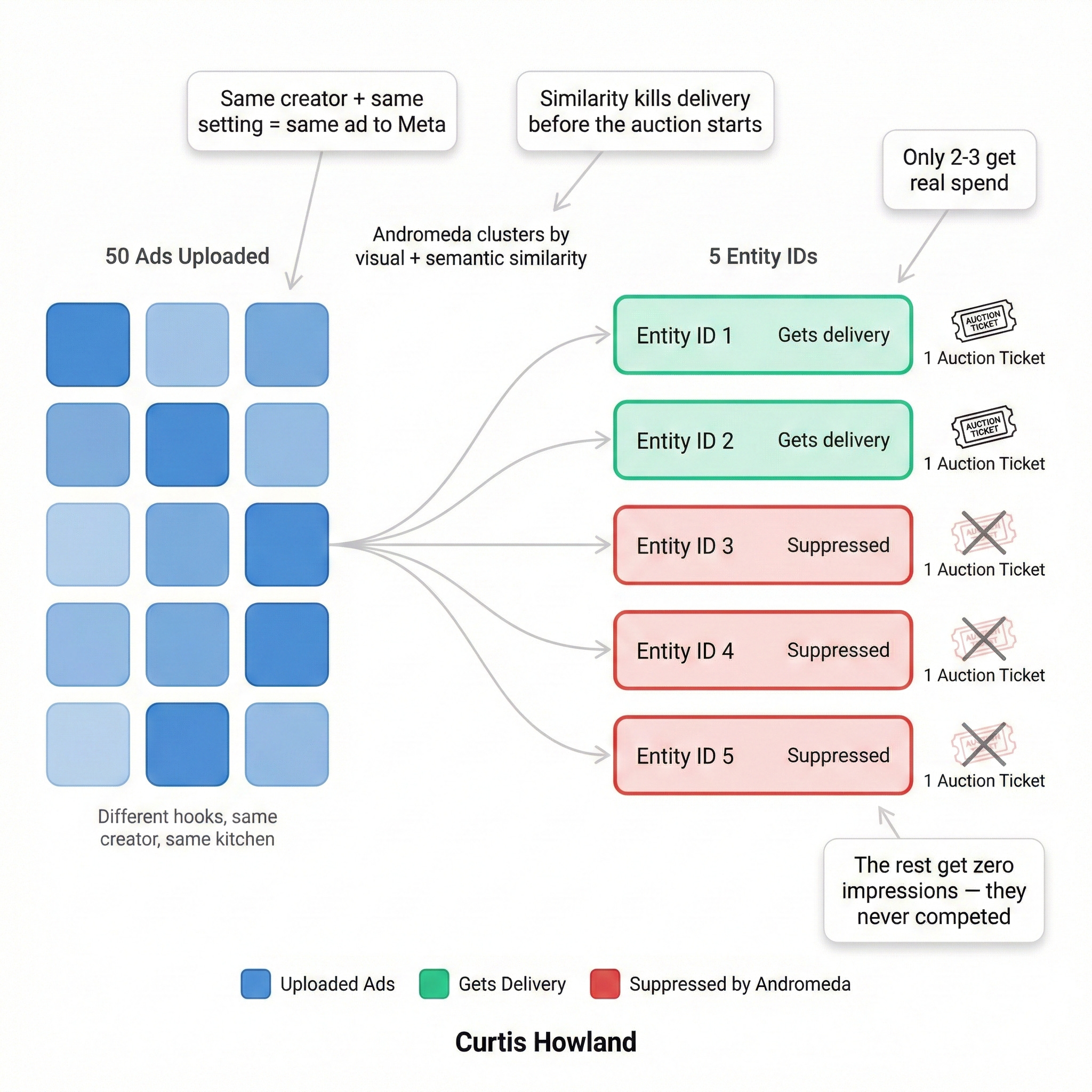
The goal is efficiency, Meta is telling you that variety is IMPORTANT. (Believe me, they aren’t against you spending money, if they reject your bids its because they think you’ll spend more on the new model).
So play by their game…
Meta hasn’t published an official similarity threshold, but the grouping is aggressive and will likely keep increasing. I’ve seen ads with different scripts, different hooks, and different offers get clustered because they featured the same creator in the same setting.
On the flip side, changing just one major dimension (swapping in a new creator, or shifting from video to static) is usually enough to generate a new Entity ID.
Step 1 is the foundation of the entire framework because a $1M ad is a structurally distinct ad. It occupies its own node in Andromeda’s retrieval tree, which means it gets its own audience discovery path, its own auction eligibility, and its own learning trajectory.
To build creative that Andromeda treats as genuinely distinct, you need to vary across at least three of these four dimensions simultaneously:
Format (video vs. static vs. carousel vs. podcast clip)
Creator (different person on camera)
Environment (different physical setting)
Benefit angle (different value proposition entirely)
Changing one isn’t enough. Same creator in a new location with the same script? Probably still clustered. Or at least in the same family tree. New creator in the same location with a different script? Maybe distinct, maybe not. New creator, new location, new format, different benefit? Now you’re charting a new path.
Most brands hit their ceiling right here. Producing genuinely diverse creative is expensive, slow, and operationally complex. You need multiple creators, multiple locations, multiple formats, multiple scripts. It’s not a creative problem. It’s a production infrastructure problem.
And that’s exactly why it’s a moat.
Andromeda wants you to produce at least somewhat different ads.
Million-dollar ads take this to an extreme.
Step 2: Be Different From Everyone Else
Step 1 is about being different from your own ads. Step 2 is about being different from every other advertiser in the auction.
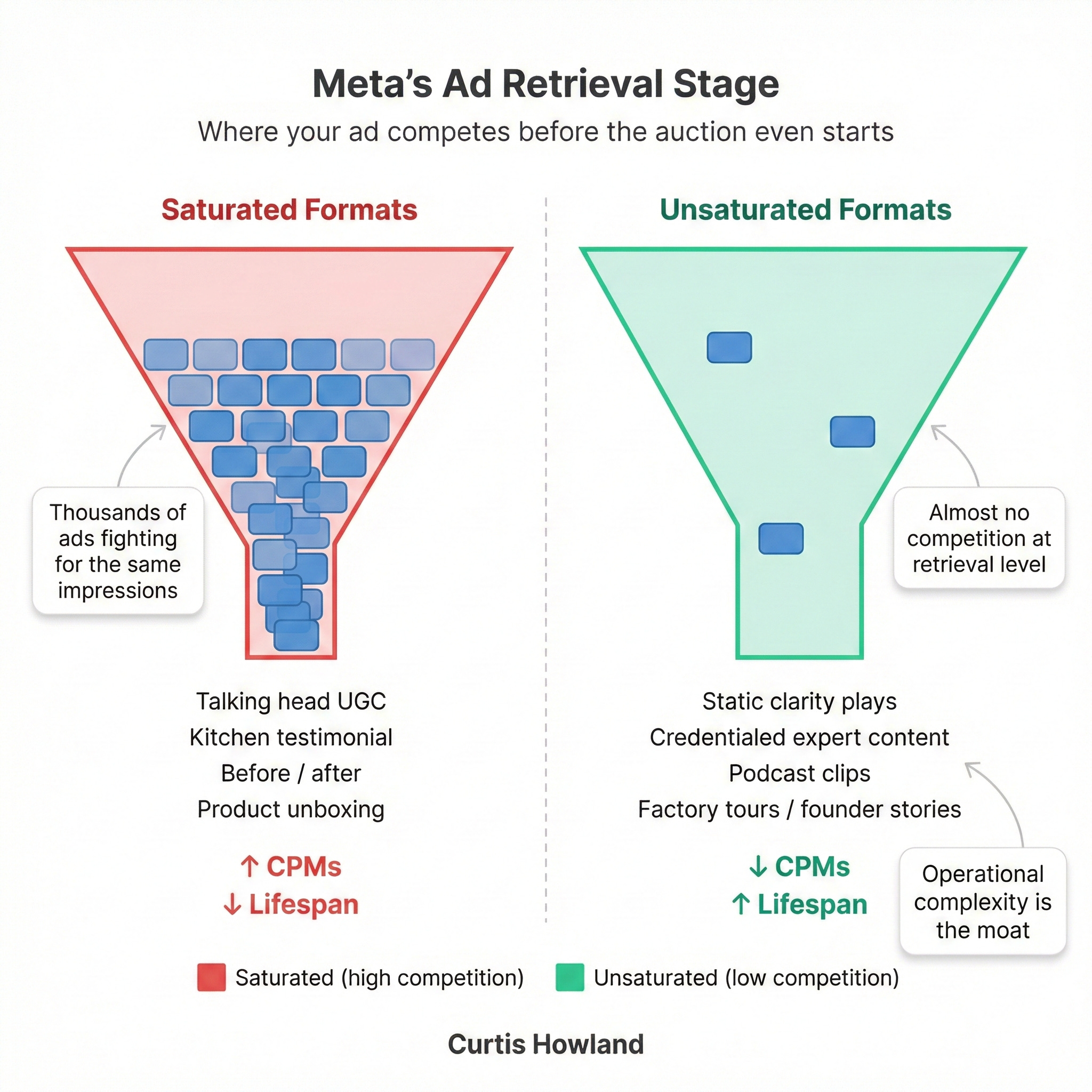
Think about what the average DTC brand’s ad looks like right now. A creator, usually a woman in her 20s or 30s, talking to camera in her apartment or kitchen. “I’ve been using [product] for three weeks and here’s what happened.” Maybe there’s a before/after. Maybe there’s a green screen. The script hits the same beats: problem, discovery, skepticism, result, CTA.
This format works. It’s proven. It converts. And that’s exactly the problem.
When thousands of advertisers are running the same format, the auction gets saturated at the format level. Meta’s retrieval system isn’t only comparing your ads to your other ads. It’s comparing them to every ad in its inventory. If your creative looks structurally similar to thousands of other ads, you’re competing in the most crowded lane of the auction.
Again, Meta is doing this because humans do this. They are telling you something.
The $1M ad doesn’t look like other ads. Not because it’s trying to be quirky, but because it’s occupying a format that few competitors can replicate.
One of the highest-spending ads I’ve ever managed was a static image. Not a video. Not a carousel. A single static image for a brand that spent over $2M in lifetime ad spend.
It worked because the visual was genuinely unique to this brand. Nobody else in the category could make the same claim. And the creative communicated that USP with a clarity and simplicity that video couldn’t match. In a sea of 60-second UGC videos, a well-designed static image was the pattern interrupt. Andromeda had no similar ads to cluster it with because no competitor was running anything like it.
They couldn’t and nobody could copy it. It was this brands unique offer.
Another high-spend ad featured a doctor who partnered with the brand. But it wasn’t a stiff, scripted endorsement. This doctor had a genuinely entertaining and fun way of explaining why he chose to work with the brand (musical). The combination of real medical credibility and an unexpected personality made it feel like content, not an ad.
It occupied its own lane in the auction because very few competitors could replicate a credentialed expert who was also naturally engaging on camera.
This is counterintuitive. We’ve been trained to think that “better” creative means better research. Best practices. Top formats. If we could see our competitors #1 ad we would copy that.
Sometimes the most scalable creative is the one that looks nothing like what everyone else is running.
The framework I use to think about this is what I call the Innovation Spectrum:
Small iterations (new hook, new copy, new thumbnail on existing concept): ~20% hit rate, impacts current month performance. Low risk, low ceiling.
Medium swings (same script/concept, new creator or new setting): ~15% hit rate, impacts current and next month. Moderate risk, moderate ceiling.
Big swings (entirely new format like a podcast ad, street interview, rap video, or documentary-style piece): ~5-10% hit rate, but when they hit, they impact 2-3 months out and have the highest spend ceiling.
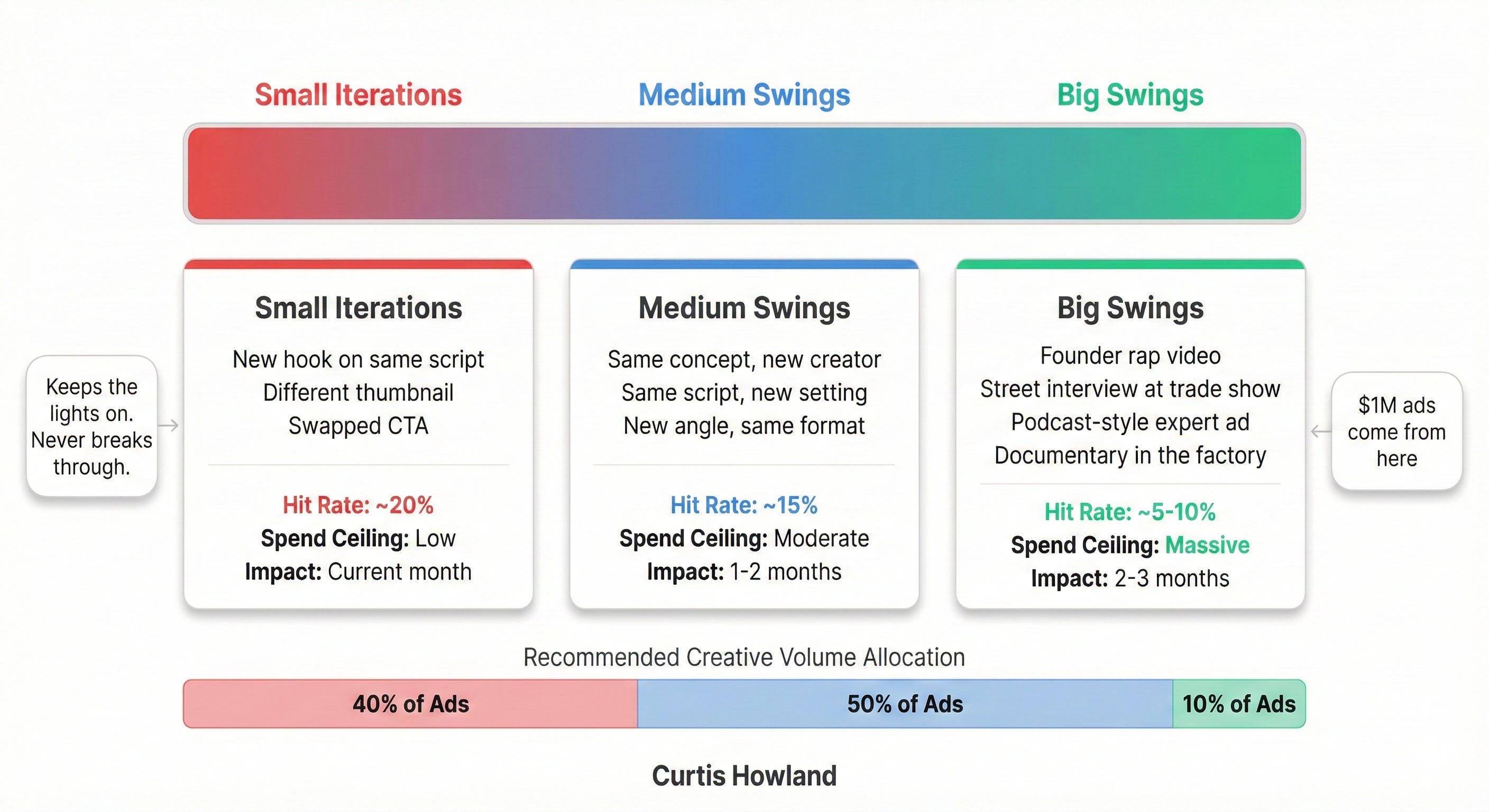
Most brands spend 80% of their creative budget on small iterations and 20% on medium swings. They never make big swings because the hit rate looks bad. This is a mistake.
The expected value of the right side of the spectrum is dramatically higher, even accounting for the lower hit rate.
Your creative pipeline should allocate roughly 40% to small iterations (they keep the lights on), 50% to medium swings, and 10% to genuine big swings. The big swings are where $1M ads come from.
Big ads take more budget so you may need to allocate 20-25% if you think about it on a cost basis but aim for 10% of ads to be big swings
(This article is about those 10% of ads - don’t neglect either side of the system).
The difficulty of producing these formats is the moat. Anyone can brief a UGC creator to do a talking-head video. Very few brands can produce a founder rap video, a street interview at a trade show, a podcast-style ad with a credentialed expert, or a documentary shot inside their manufacturing facility. The operational complexity is the barrier to entry, and it’s what keeps these formats from getting saturated in the auction.
Step 3: Make It Entertaining
Nielsen research says 56% of a campaign’s sales ROI on the ad itself.
Not targeting. Not bidding. Not audience selection.
The ad itself is the majority of the equation.
Meta’s also says 56% of all campaign outcomes are attributable to creative quality. And their auction system is designed to reward it.
When an ad generates high engagement (likes, comments, shares, saves, long watch times), Meta interprets that as a signal that the ad is valuable content. The algorithm responds by reducing your CPMs. You’re getting an algorithmic subsidy: more impressions per dollar than a competitor with the same budget but less engaging creative.
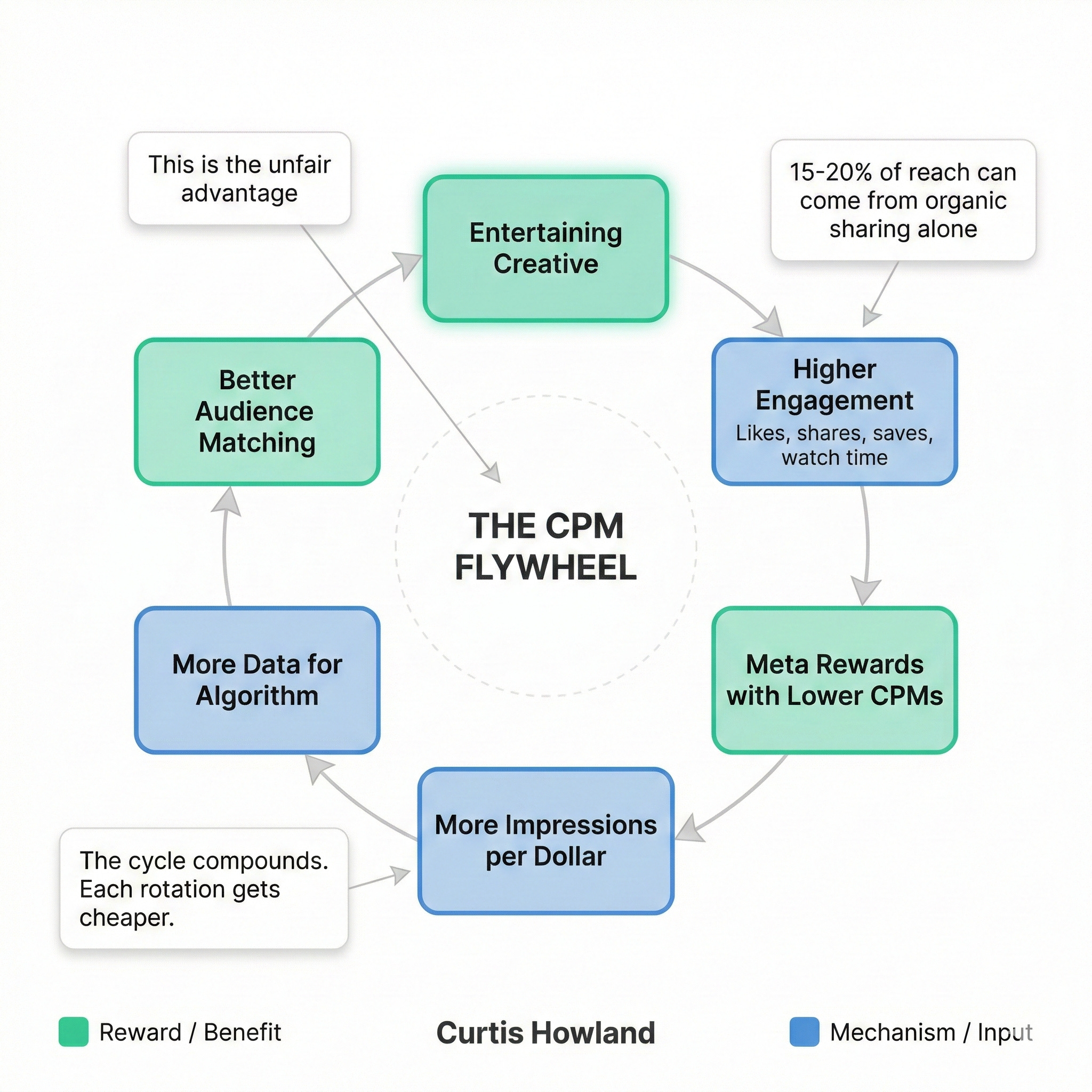
This is an unfair advantage. Here’s how it works mechanically:
Your ad gets served to an initial audience.
If engagement is high (strong hook rate, high hold rate, shares, saves, comments), Meta’s quality scoring improves your ad’s ranking.
Higher quality ranking means you win more auctions at lower CPMs.
Lower CPMs mean your budget stretches further, reaching more people.
More reach means more data, which helps the algorithm find even better audience pockets.
The cycle compounds.
The benchmarks to target: a 30-40% hook rate (percentage of impressions that become 3-second video views) and a 25%+ hold rate (percentage of 3-second viewers who watch to 15 seconds). Ads that hit these thresholds consistently outperform because Meta’s algorithm gives them preferential delivery.
But most people miss the second-order effect: engagement reduces your cost CPMs and generates free impressions. When someone shares your ad, tags a friend in the comments, or saves it to watch later, those are impressions you didn’t pay for. The functional CPM (what you actually pay per person who sees the ad) drops even further than what Ads Manager reports.
I’ve seen ads where 15-20% of total reach came from organic sharing. On a $1M spend ad, that’s $150-200K worth of free distribution.
The formats that generate this kind of engagement share common traits:
Pattern interrupt in the first 3 seconds. Not a logo. Not a product shot. Something that makes a scroller’s thumb stop because it’s unexpected, unusual, or visually striking. The first 3 seconds are the highest-leverage creative decision you’ll make.
Genuine entertainment value. The ad has to work as content AND as a sales vehicle. Would someone watch this even if it weren’t an ad? If the answer is no, you’re leaving the CPM subsidy on the table.
Credibility through novelty. Founders in unusual (but relevant) settings (manufacturing floor, trade show booth, Whole Foods demo). Credentialed experts (dermatologists, nutritionists) in authentic environments (podcast studios, clinics). These signals build trust while also creating visual distinctness.
A mediocre script delivered in an unusual, entertaining format will outperform a perfect script delivered in a standard talking-head setup.
The format determines whether someone stops scrolling.
The creator determines whether they trust the message.
What you’re selling only matters if you’ve earned the first two.
One more thing about entertainment: it creates re-watchability. Formats like rap ads, dramatic reveals, and genuinely funny street interviews have inherent replay value. People will watch them multiple times voluntarily. The frequency number in Ads Manager overstates actual fatigue for these ads. A 4.0 frequency on an entertaining ad is not the same as a 4.0 on a talking-head testimonial. The creative is absorbing repeat exposure without the usual performance decay, which is part of why it can sustain massive spend.
Step 4: Widen Your TAM
This is the step that separates the $100K ad from the $1M ad. It’s also the one that’s hardest to explain, so I’m going to use a framework from a 1960s copywriter named Eugene Schwartz that maps perfectly to how Meta’s algorithm works today.
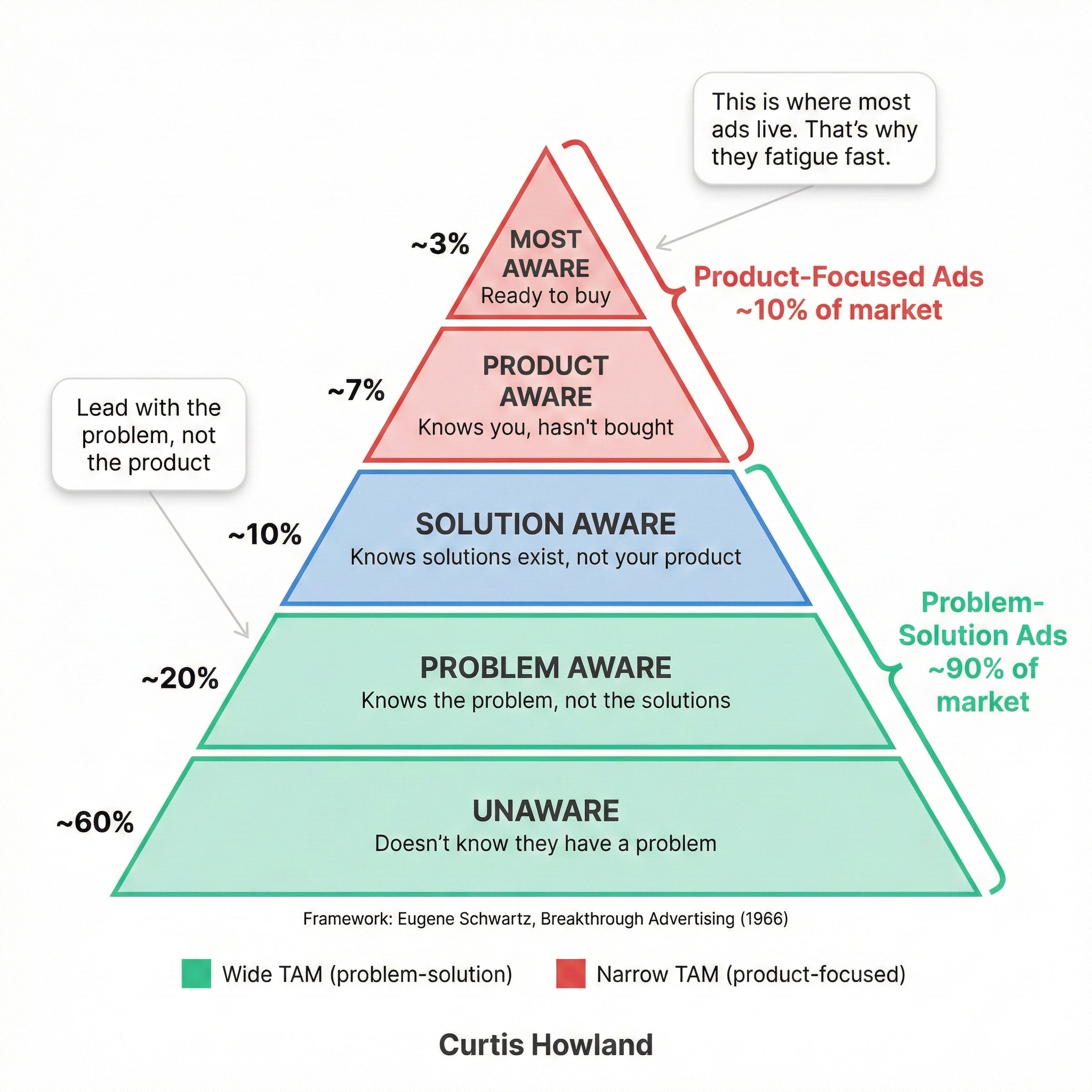
Schwartz identified five stages of customer awareness:
Unaware (doesn’t know they have a problem; ~60% of your potential market)
Problem Aware (knows the problem, doesn’t know solutions exist; ~20%)
Solution Aware (knows solutions exist, doesn’t know your product; ~10%)
Product Aware (knows your product, hasn’t bought yet; ~7%)
Most Aware (knows your product, ready to buy; ~3%)
So why does this matter for ad scalability on Meta?
When you run a product-focused ad (”Here’s our starter kit, here’s what’s in the box, here’s the price, use code SAVE20”), you’re talking to stages 4 and 5. These people already know you exist. That’s maybe 10% of your potential market. Meta can show that ad to the people who’ve visited your site, engaged with your content, or look like your existing customers. But that audience is much smaller.
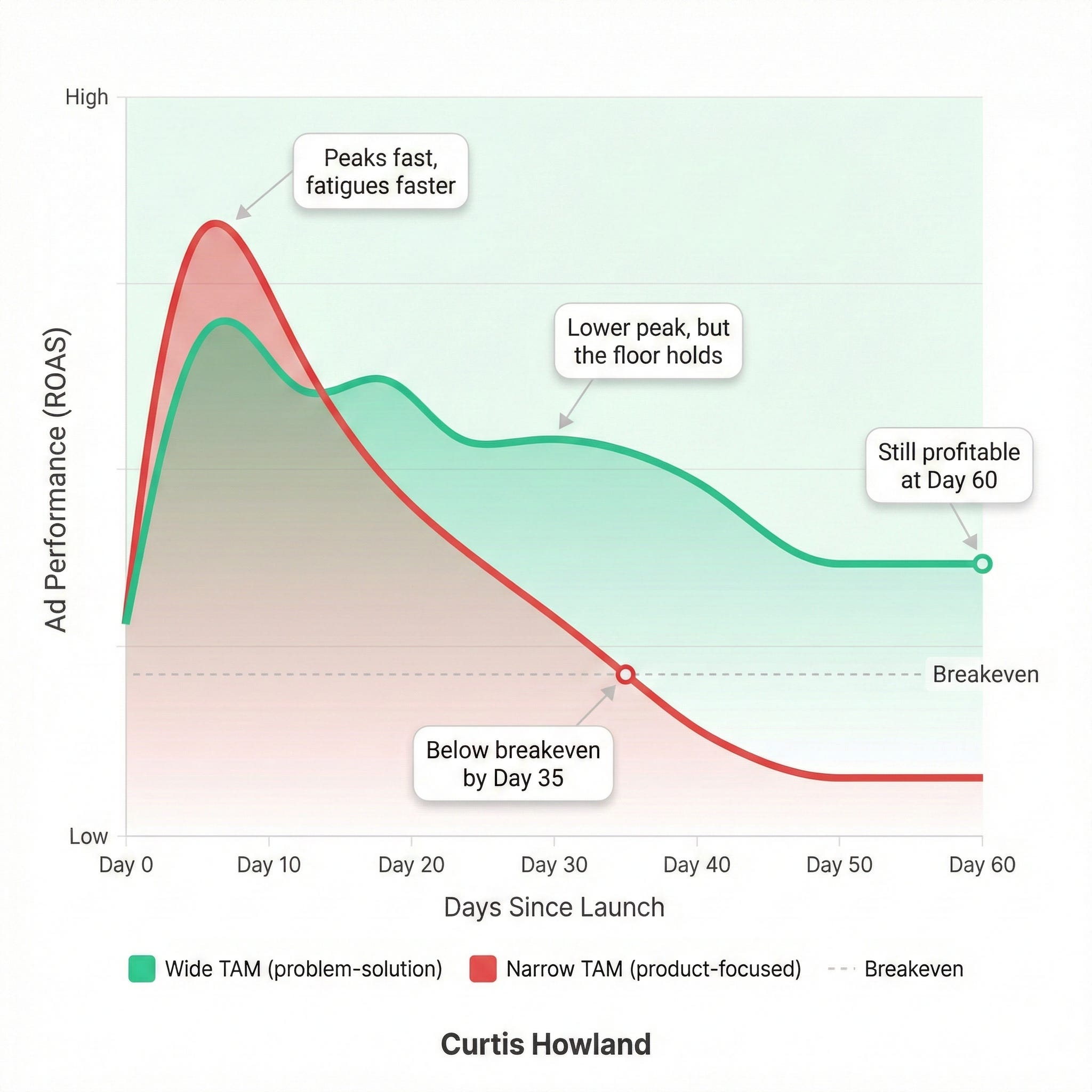
At high spend levels, you burn through it fast. Frequency climbs. Fatigue sets in. The ad dies.
When you run a problem-solution ad (”Do you sweat through everything? Here’s why, and here’s what finally worked for me”), you’re talking to stages 1 through 3. People who don’t even know they have a problem. People who know the problem but haven’t looked for solutions. People who are looking for solutions but haven’t found you yet.
That’s 80%+ of your potential market.
On Meta, larger addressable audience means:
More room for the algorithm to find cheap pockets of inventory
Lower frequency buildup (more unique people to show the ad to)
Slower fatigue (fewer repeat impressions per person)
Longer creative lifespan
More total spend before you need to replace the ad
This is the structural reason why problem-solution ads have higher spend ceilings than product-focused ads. It’s not that they convert better per impression (they often don’t). It’s that they can absorb dramatically more budget before fatiguing, because the audience they address is 8-10x larger.
The $1M ads I’ve managed all shared this trait. They led with the problem, not the product. The product was the resolution, not the hook. Meta could serve them to a massive audience of people who didn’t know the brand existed, and because the creative was entertaining (Step 3) and structurally unique (Steps 1 and 2), it maintained performance across millions of impressions.
Creatives normally fatigue in 35-40 days. The TAM-widening approach extends this natural lifespan even further, because you’re reaching new people instead of re-showing to the same audience.
One important nuance: widening your TAM doesn’t mean making your message vague. It means moving up the awareness ladder. Instead of “Here’s our product,” you’re saying “Here’s a problem you might have.” The specificity stays. You’re still talking about a real, concrete problem. You’re just addressing it at a stage where the audience is much, much larger.
Step 5: Over-Scale Intentionally
If you’ve done Steps 1-4 right, you’ll have an ad that’s structurally distinct, competitively unique, entertaining enough to earn an algorithmic CPM subsidy, and addressing a wide enough audience to sustain high spend. The final step is to spend more on it than your attribution model tells you to.
This is the hardest step because it requires ignoring data that feels definitive.
Last-click attribution systematically undervalues top-of-funnel ads. A highly entertaining, wide-TAM ad is doing its best work at the top of the funnel: building awareness, creating brand recall, generating positive associations. The conversion often happens later, on a different ad. Maybe a retargeting ad. Maybe a Google search. Maybe a direct visit.
Last-click gives zero credit to the ad that created the awareness. But without that awareness, the retargeting ad never would have converted. The search never would have happened.
I recommend over-scaling your best top-of-funnel ads by 20-30% beyond what last-click ROAS suggests is profitable. If your target ROAS is 2.5x and your $1M ad candidate is running at 2.0x, don’t kill it. That 2.0x is almost certainly understating its true contribution.
These high-entertainment, wide-TAM ads create a halo effect across your entire account. They’re doing two jobs at once:
Direct conversions (what last-click measures): some percentage of people who see the ad buy immediately.
Awareness building (what last-click misses): a much larger percentage of people who see the ad don’t buy right away, but they now know your brand, recognize your product, and have a positive association. When they encounter your retargeting ad, your email, or your product on a shelf, they’re far more likely to convert.
The halo effect means your retargeting CPA drops, your branded search volume increases, your email open rates improve, and your overall blended ROAS lifts. Even though the top-of-funnel ad itself looks mediocre on a click basis.
Ideally, you validate this with incrementality testing. Tools like Haus let you run geo-lift tests that measure the true incremental impact of over-scaling a specific ad. Not just the direct conversions it drives, but the lift it creates across every other channel. When you run these tests, you almost always find that the true ROAS of a high-performing TOF ad is 30-50% higher than what last-click reports.
Without that testing infrastructure, a 20-30% over-scale is a reasonable starting point for ads that meet these criteria:
High engagement metrics (hook rate 35%+, hold rate 25%+)
Strong CPM efficiency (below account average)
Wide TAM targeting (problem-solution messaging, not product-focused)
Structurally unique format (not easily replicated by competitors)
Starts off with a strong ROAS and scales well
If the ad checks all five boxes, lean into it harder than your attribution model says to. The ad is doing more work than it gets credit for.
The $1M Ad Formula
A $1M ad isn’t one thing. It’s five things working simultaneously:
Structurally distinct from your own creative library. Occupies its own Entity ID in Meta’s Andromeda system, with a unique combination of format, creator, environment, and benefit angle.
Competitively unique in the auction. Uses a format that few competitors replicate, reducing retrieval-level competition and earning its own lane in the auction.
Entertaining enough to earn an algorithmic subsidy. Generates high engagement that Meta rewards with lower CPMs, plus organic sharing that creates free impressions.
Addressing a wide TAM. Leads with the problem, not the product, targeting the 80% of the market that’s unaware or problem-aware rather than the 10% that’s already product-aware.
Over-scaled beyond what last-click suggests. Intentionally funded 20-30% above attribution-based targets because the awareness halo effect lifts every other channel in the account.
The reason most brands never build a $1M ad isn’t lack of talent. It’s that these five requirements are each independently difficult, and they need to work together. The creative production infrastructure required to consistently produce structurally diverse, competitively unique, genuinely entertaining content is beyond what most in-house teams or agencies are set up to deliver.
That’s the moat.
Difficulty is the moat.
The brands that figure out how to systematize this (not as a one-time stroke of creative genius, but as a repeatable production process) are the ones that build $1M ads. Not once. Repeatedly.
And in a world where Meta’s algorithm increasingly rewards creative diversity over targeting sophistication, this isn’t a nice-to-have. It’s the entire game.
You got my attention, been diving into your contents recently. Nice work man!