

Brands set up campaigns for conversions, exclude past customers, and wonder why 50% of their attributed sales still come from people who bought before.
Meta’s algorithm doesn’t care if someone bought from you yesterday. It cares about showing your ad to whoever is most likely to convert today.
They know you are just looking at ROAS, but spending on Meta to get past customer to return is a waste of money. Just send more emails.
Getting new customers reliably and profitably is how you scale a business.
Here’s how to fix it.
Facebook Optimizes for Easy Wins
Had a call with a founder spending millions on Meta.
Solid numbers. Good product. Strong reviews.
But they can’t scale their DTC site.
Acquisition on Meta wasn’t profitable.
His question: “Should we run awareness campaigns to reach new people?”
My answer: No. That’s not the problem.
The problem is that even with exclusion lists, Meta is showing your ads to:
Past customers who remember your brand
People who visited your site last week
Anyone who’s already in-market for your product
Because those people convert at 3-5x the rate of cold traffic.
Meta’s job is to hit your ROAS target.
Your job is to make sure that ROAS target pushes toward new customers, not just toward the easiest sale.
Stop Asking for Awareness. Start Measuring New vs Returning.
You can’t manage what you don’t measure.
If you’re looking at blended ROAS, you have no idea how efficient your new customer acquisition actually is.
Here are 3 preparation steps, then how to change your creative strategy to drive more new customers:
1. Install a Multi-Touch Attribution Tool
Triple Whale, Northbeam, Rockerbox - pick one. I’ve used them all, pick your poison.
These tools tag every purchase as new or returning, then attribute it back to the ad that drove it.
This allows you to see the difference between:
Which ads drive 80% new customers at $3.5 ROAS ($2.8 NC ROAS)
Which ads drive 50% new customers at $4.0 ROAS ($2.0 NC ROAS)
The second group looks better in Meta’s dashboard. The first group is what you need to optimize for.
Teach Meta to find new customers not returning.
2. Add a Post-Purchase Survey
On Shopify, add a survey that asks: “Where did you FIRST hear about us?”
Options: Facebook, Instagram, Google Search, TikTok, Friend/Referral, Amazon, Other (Put in anything you spend money on while keeping it less thna 10 answers).
(Randomize setting = on)
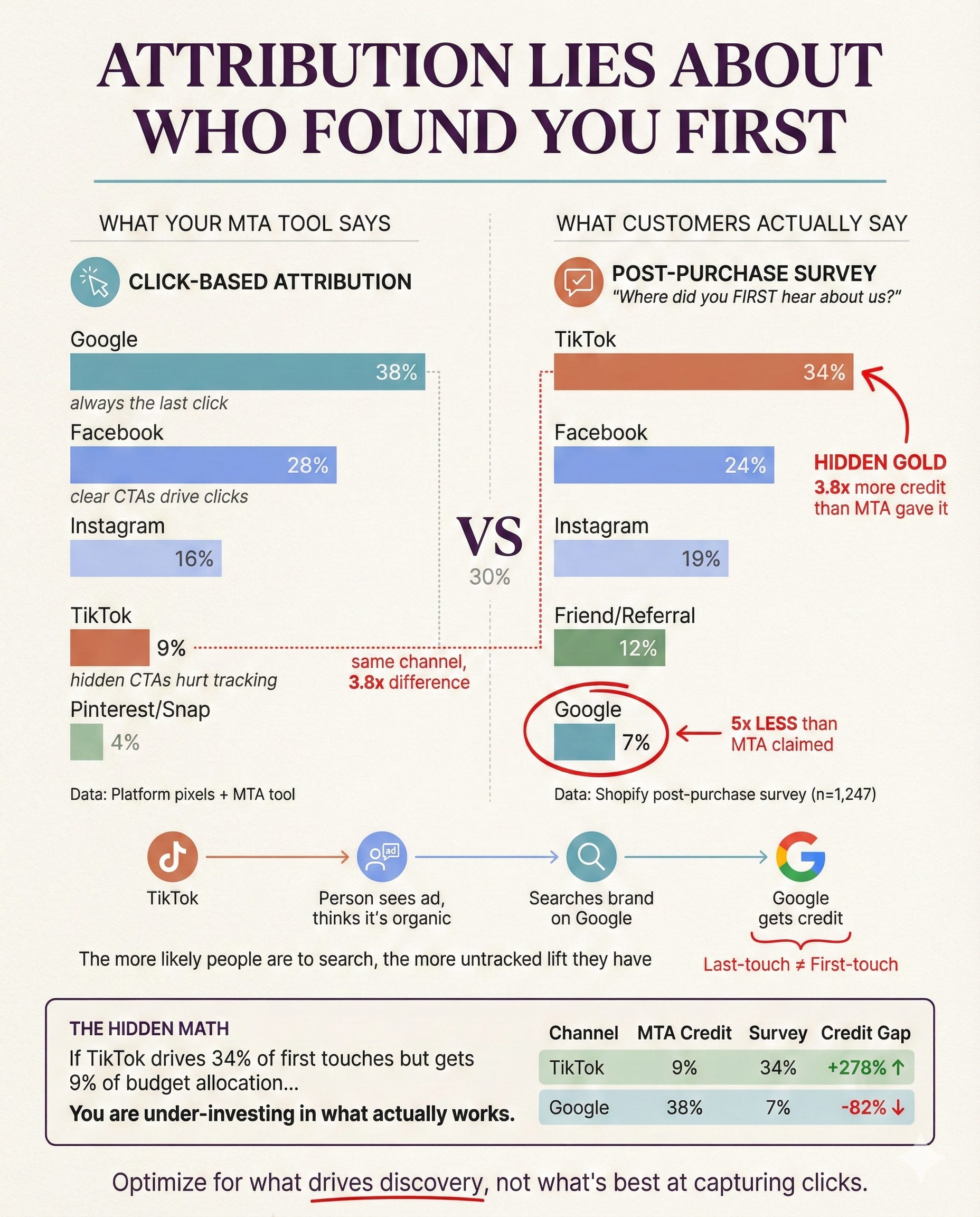
This gives you channel-level data that your attribution tools miss.
On a click basis (platform OR your MTA tool)
Google crushes / its always a last click
Facebook does well (the CTA is clear and people know how to click through)
TikTok is OK (The CTA is sometimes hidden / people may think the ad is organic and search)
Pinterest/Snapchat barely work
Your multi-touch tool will favor Google, then Facebook, then everything else.
The more likely people are to search the more untracked lift they have. You need to optimize for what is actually driving performance, not what is best at getting people to click.
But if your post-purchase survey shows TikTok driving more first touches than your attribution tool suggests, that’s top-of-funnel traffic you’re under-investing in.
And its not just TOF fluff impressions, you now know its driving conversions too.
3. Set Up Exclusion Campaigns Correctly
Create an audience of all past purchasers. Exclude them from your prospecting campaigns.
You’ll still get 20-30% returning customers because Facebook’s exclusions aren’t perfect. But it forces the algorithm to work harder to find new people.
Then use your attribution data to double down on the ads that drive efficient new customer acquisition within that prospecting campaign.
Keep this updated with a an automatic connection if you can (your CRM purchasers list and shopify past purchasers)
Your Creative Strategy Determines Your Audience
Don’t miss this part.
You don’t need awareness campaigns. You need top-of-funnel creative in your conversion campaigns.
There’s a difference between:
Middle funnel creative:
Shows your product
Highlights features/benefits
Assumes some brand awareness
Leads with logo or brand name
Top funnel creative:
Starts with a problem
Explains why you’re the solution
Builds credibility from zero
Brand reveal comes after the hook
If your first frame shows your logo before it shows the problem you solve, you’re signaling to Meta: “Show this to people who already know us.”
If your first frame shows the problem before your brand, you’re saying: “Show this to anyone with this problem.”
Same conversion campaign. Different audience signals.
I wrote a full post about that here:

This only works if you have steps 1-3 rolling, otherwise the ads will look like poor performers, you won’t scale them, your creative team will think they lost and you learn from the wrong ads
Efficient New Customer Acquisition:
time to implement:
Step 1: Measure New vs Returning
Set up attribution + post-purchase survey
Step 2: Audit Your Creative
What % of your ads lead with the problem vs the product?
What % of your first frames show your logo before your selling point?
Which ads drive the highest % of new customers?
Step 3: Optimize for New Customer ROAS
In your attribution tool, look for:
New customers only
ROAS > your target (even if slightly lower than returning customer ROAS)
Ads with spend >$500 (enough data to matter)
These are your scalers. Push budget here.
Step 4: Train Your Creative Team
Show your team which ads get the most spend. Show them which concepts drive new customers efficiently.
They’ll start iterating on those themes instead of guessing.
Step 5: Adjust Channel Budget Based on First Touch Data
If your post-purchase survey shows Pinterest driving more first touches than your multi-touch tool suggests, shift budget there.
If Google looks great in your attribution tool but your survey shows it’s mostly last-click traffic from people who found you on Facebook first, don’t over-invest there.
What This Actually Looks Like in Practice
Let’s say you’re spending $250K/month on Meta right now.
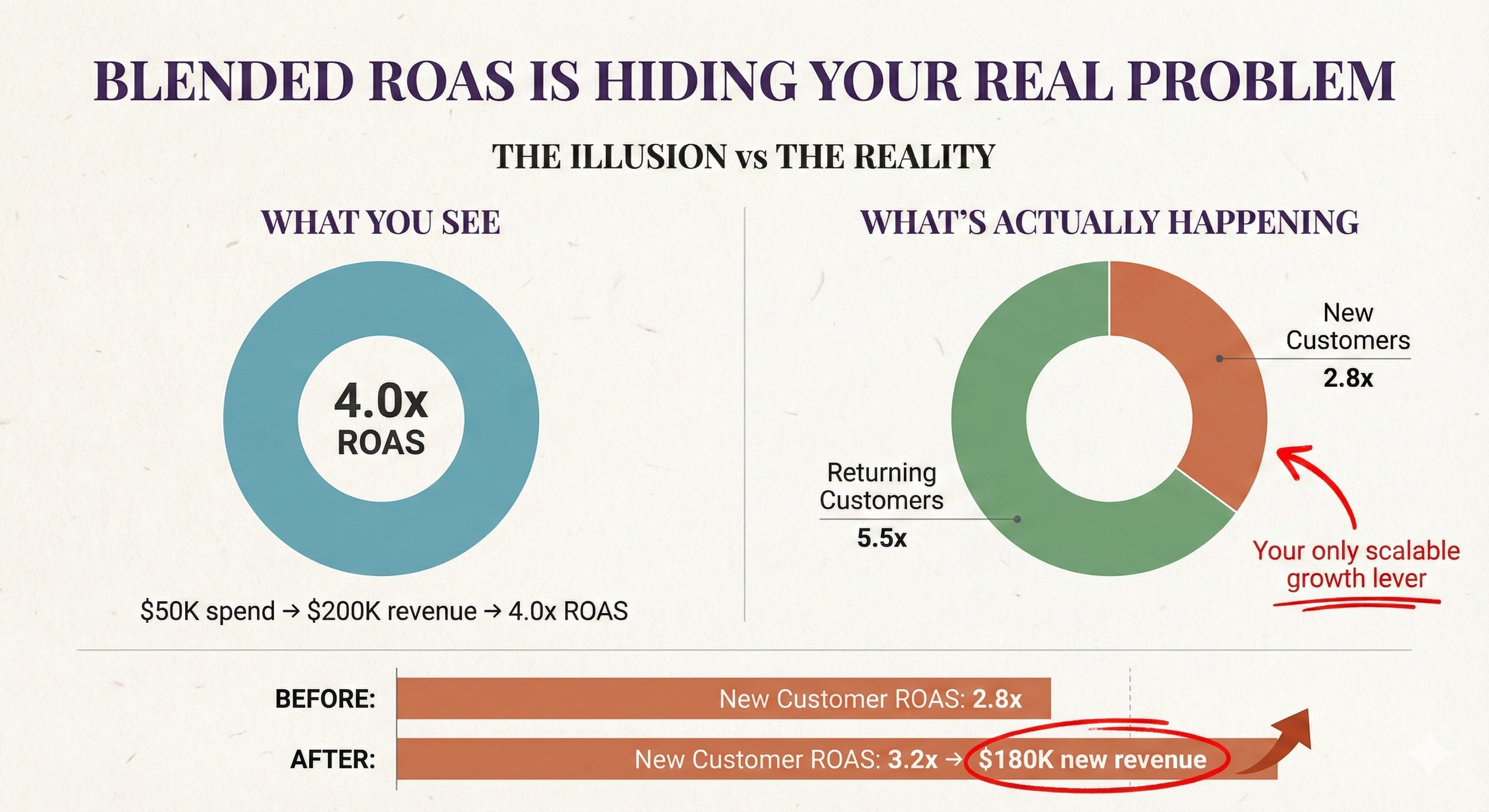
Blended ROAS: 4.0x Total sales: $1M/month
Feels good, right?
Now you install Triple Whale and see:
50% of sales are returning customers
New customer ROAS: 2.8x
Returning customer ROAS: 5.5x
That 5.5x feels good, but how many of those would return anyway?
It's not scalable anyway (limited to total customers) and confuses the algorithm too.
Suddenly, your $250K spend is only partially going towards generating new customer revenue at 2.8 ROAS.
Depending on your margins, you may be just treading water.
So you:
Audit your creative. 80% of your ads lead with your logo and product shots.
Launch 10 new ads that start with the problem, explain your solution, then reveal your brand.
Push budget toward the ads that drive >70% new customers at 3.2+ ROAS.
Use post-purchase surveys to see that most new customers actually discovered you on TikTok, even though Facebook gets last-click attribution.
Six weeks later:
New customer ROAS: 3.2x
New customer revenue: $560k/month
You can finally scale without hitting a ceiling
Much better position to be in.
You can scale into this without performance dropping off a cliff.
You are growing your business, not just extracting from past customers.
Quick reminder…
Unless you are near $100k/day on Meta
Don’t run awareness campaigns.
Don’t buy impressions.
Don’t optimize for engagement.
Stay focused on conversions. But measure the right thing.
Train Meta to find new customers who convert, not returning customers who were going to buy anyway.
Facebook knows who’s going to purchase. If you ask for Cheap impressions? You'll get cheap impressions. Don’t kid yourself into thinking Meta is going to give away purchasers in disguise.
Your job is to show it ads that convert cold traffic, not just warm.
That’s how you scale.
Want to try this out?
This week: Install Triple Whale or Northbeam (or equivalent attribution tool)
Add a post-purchase survey to your checkout (Where did you FIRST hear about us). Have questions randomize + add in an “other” category.
Audit your creative: What % leads with a problem vs a product shot? (Aim for 70% of the prior)
Compare new customer ROAS across your ad concepts
Push budget toward the ads driving efficient new customer acquisition
Questions/Critiques/Ideas? I’d love to hear them! Drop em below!
Very interesting article. I run a fashion brand and our best performing ads are statics. What would you suggest in this case? You can still hook people with a problem, or some sort of higher messaging that defines an audience, but the product / brand is still front and center...