

I keep hearing the same argument.
“You can’t turn off that ad. Facebook is sequencing the creative. What if that ad is a critical first touch?”
This has become the new meta-argument (pun intended) in performance marketing. It shows up in Slack groups, on LinkedIn, in pitch decks.
And I get why. Meta has rebuilt how ads get delivered from the ground up, and sequencing is a core part of it.
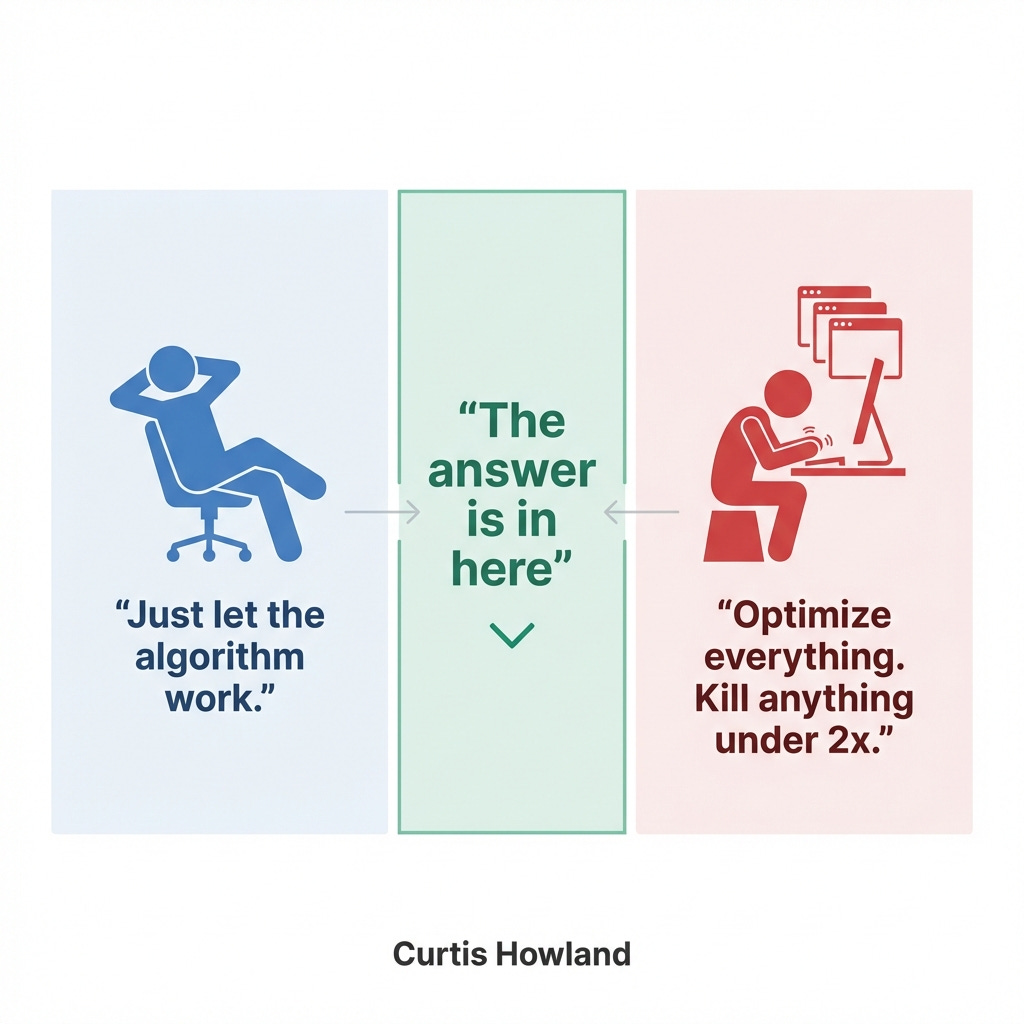
But the conclusion people draw, that you should just upload creative and let the machine handle everything, is getting stretched past what the data supports.
It permits lazy media buying. Turn “What if” into “Here is what the data shows” and keep improving.
The answer isn’t the opposite extreme either, day-trading your ad account with wild swings and killing anything that doesn’t hit ROAS targets in a 48 hour period. Or managing every ad at exactly the same CPA with no nuance.
I’ve reviewed roughly half a billion dollars in Meta spend over my career, most of it post-Andromeda. The answer lives in the middle. But where in the middle depends on your business, your spend level, and even what phase your campaign is in.
One thing I want to be upfront about: I don’t claim to know exactly how Meta’s algorithm works internally. Nobody outside of Meta does (Not sure if they do internally either).
What I can tell you is where the big ideas break down logically when you compare them against what I see in real accounts every day.
What Meta Actually Built
Three systems are working together now. The engineering behind them is worth understanding because it’s the foundation of the whole debate.
Andromeda is the retrieval engine. When an impression opportunity comes up, Andromeda narrows tens of millions of ads down to a few thousand candidates. It uses “Entity IDs,” which are clusters of semantically similar ads. If you upload 50 variations that are all minor tweaks of the same concept, Andromeda might treat them as a single entity.
GEM (Generative Ads Recommendation Model) launched in mid-2025. GEM is trained at a scale comparable to large language models. It predicts which ad, and which sequence of ads, will drive the best result for each user. It works across Facebook, Instagram, and Messenger at the same time. Previously, each placement had its own optimization model. GEM bridges those silos.
Meta reported that GEM drove a 5% increase in conversions on Instagram and 3% on Facebook Feed. For context, in standard creative testing, individual ads routinely outperform each other by 100-200%. So the sequencing system is a real improvement, but it’s not the magnitude of difference that some people imply.
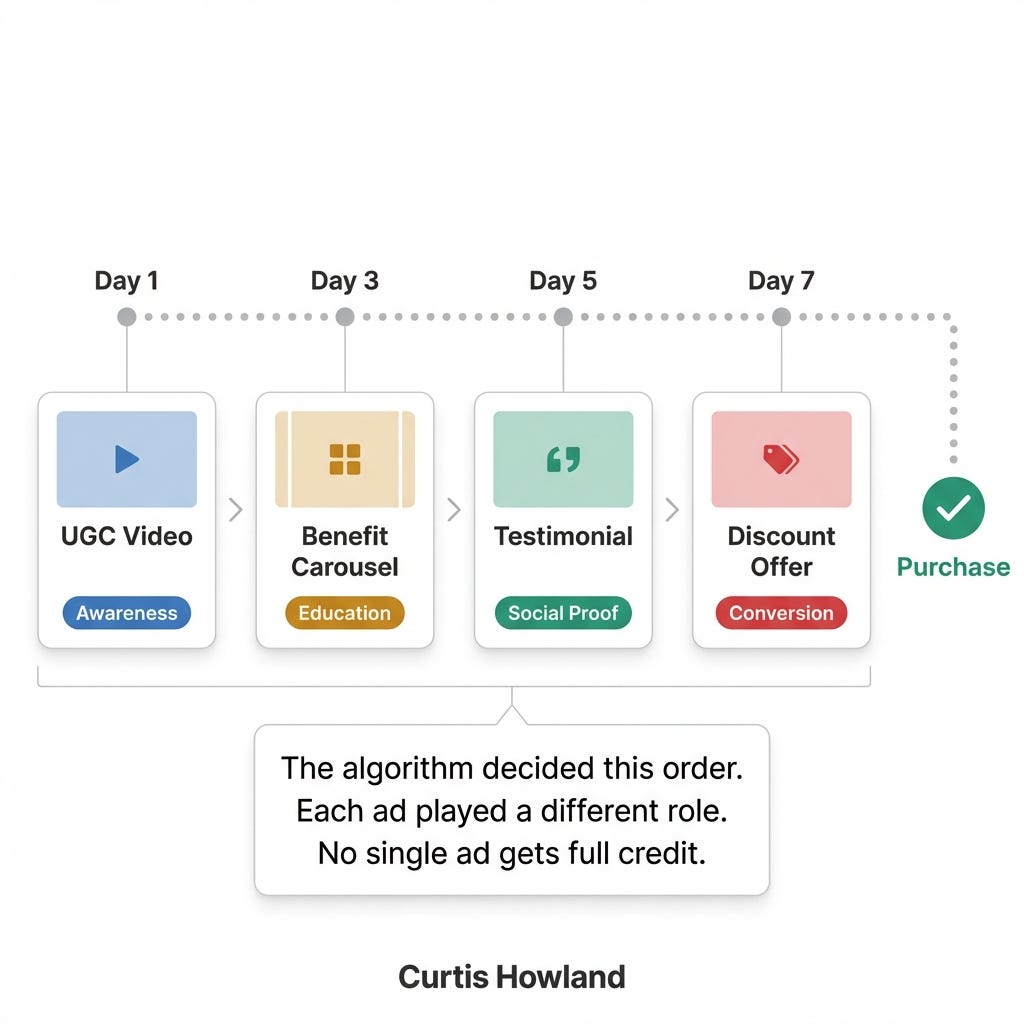
Sequence Learning is the underlying paradigm shift. Meta’s engineering team published a detailed breakdown of this in late 2024. The old system used aggregated features: “ads a user clicked in the last N days.” The new system uses event-based features that preserve the order and timing of every interaction. It doesn’t just know what a user engaged with. It knows when, in what order, and what happened next.
Meta’s system now understands conversion paths as sequences, not just individual touchpoints.
So yes. Sequencing is real. The algorithm is deciding what order to show your ads in. Some ads are first-touch awareness drivers. Some convert on the fifth impression.
That’s the part everyone agrees on. And logically it makes sense from an awareness to conversion perspective:
The Case for Letting the Machine Work
The “trust the algorithm” camp has stronger arguments than most media buyers want to admit.
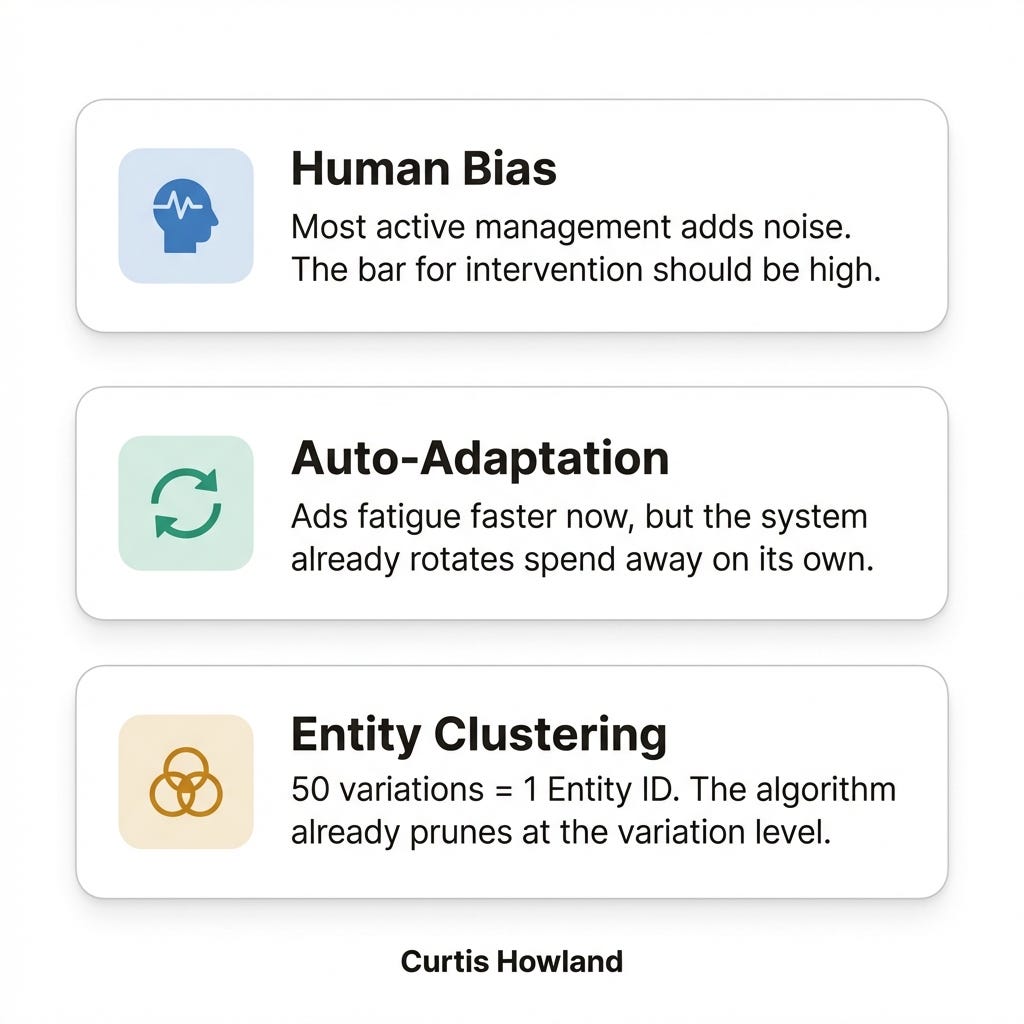
Start with the human bias problem. Most media buyers introduce more noise than signal. They kill ads based on 3-day windows. They anchor on whatever metric they checked that morning. They make gut calls that feel decisive but are statistically meaningless at the spend levels they’re working with. The algorithm is processing millions of signals per impression.
The argument isn’t really “do nothing.” It’s “most people’s version of active management is destructive, so the bar for intervention should be very high.” And that’s a fair point.
I’ve audited accounts where the media buyer was resetting learning phases weekly during their “Friday media buying spring”, never giving any ad enough data to prove itself.
Or worse, three people taking turns making changes at different levels of the account week after week with no shared framework. So much disruption.
Then there’s the adaptation speed. GEM saturates optimal audiences faster than the old system, so individual ads have shorter lifespans. But the system is already rotating spend away from fatigued creative on its own. If the algorithm is already cycling through your ads, your manual pruning might just be adding turbulence.
And the Entity ID clustering is real. Andromeda groups similar ads together. If your 50 hook variations all land in a single Entity ID, the media buyer spending an hour deciding which hook to kill is doing work the algorithm already handles.
Here’s the thing I’ll say directly: as of April 2026, Meta is a solid B+ media buyer for a clear product. If you sell a single SKU supplement with an obvious audience, Meta’s system will do a respectable job on its own with zero intervention on a bunch of ads in an ASC. If you’re not willing to be disciplined and data-driven about your account management, you’re probably better off letting Meta run it than doing it badly yourself.
Know your limits. For simple accounts (similar products by margin profile, clear ICP), a bad media buyer is worse than no media buyer in 2026. If the difference between a B+ and an A is millions in profit because of LTV gaps, margin complexity, or channel mix, that gap is worth paying for. But you have to earn that distinction with real work, not just button-pushing.
When I say “media buyer” I’m including financial strategy, creative insights, inventory awareness, and cross-channel thinking. If your definition of media buying is changing budgets based on interface data, that stopped working in 2024.
Where the Logic Breaks Down
So if sequencing is real, why am I not fully in Camp 1?
Because when I push on the specific claims people make, the logic falls apart.
The argument goes like this: “This ad had a terrible ROAS, but when we turned it off the entire account fell apart.”
I hear this same claim on Twitter, Slack groups, calls. But when I push on it, the answer is almost always “not my account, someone told me they saw it happen.”
If you’ve seen this firsthand with data to back it up, I’d love to talk. Seriously. DM me.
Think about what that claim is actually saying.
This ad is so important to the conversion path that the entire account depends on it. It’s the key first impression. It sets up every downstream conversion.
And it can’t generate a trackable click. On any attribution window. Not 1-day. Not 7-day. Not 28-day. Not first-click, not last-click, not multi-touch. Its all view through impact.
Important enough to affect the whole account. Not enough to tap “shop now” to learn more.
We aren’t arguing about impression campaigns here. This ad has a “Shop Now” CTA. It’s designed to drive action. And nobody who sees it takes any measurable action.
But it’s secretly the most important ad in the account.
So influential the account depends on it. So uninfluential nobody clicks on it.
That’s where the logic breaks for me.
And we’re not talking about a soft performer here. The ROAS is bad enough that you wouldn’t just pull back spend. You’d pause it entirely according to the quote I hear.
Could an ad contribute to awareness in a way that’s hard to measure directly?
Absolutely.
That’s real and I’ve seen it. But the version of this argument that gets used in practice, the version where a high-spend, high-CPA ad with declining engagement and zero click signal across every attribution window is actually a secret hero, that doesn’t hold up.
Now, a high-scaling ad that leads with a problem, speaks to non-aware customers, and has a slightly softer ROAS than your bottom-funnel converters? But most conversions are first click at a higher ratio than normal? That’s a different story. Keep it running even with that lower performance, we know there is some cookie loss. That ad is doing top-of-funnel work inside a conversion campaign, and it’s probably driving new customer acquisition that your last-click model undervalues. (I wrote a full breakdown of how to think about this with creative here.)
I also think most of the people repeating this narrative haven’t observed it in their own accounts. They heard it on a Reel or in a Slack group, and now it’s conventional wisdom.
It also happens to be a very convenient argument if you’re a media buyer who doesn’t want to be evaluated. “Just let Meta do its thing” is a nice way to avoid accountability.
Here’s what I tell my team instead. If you want to argue an ad is doing sequencing work, back it up with three things:
The creative logically speaks to awareness. It leads with a problem, not a product. It’s designed to reach people who don’t know your brand yet. If it looks like every other conversion ad in the account, it’s not a first-touch driver.
The first-click attribution signal is there. It should show a high ratio of first-click conversions relative to last-click. That’s the signal that people are discovering you through this ad, even if they convert later through something else.
The relative performance is reasonable. A softer ROAS than your bottom-funnel ads? Fine. A 0.3x vs 2.0x with declining engagement after 30 days and $3k in spend? That’s not a sequencing play. That’s a bad ad. Cut it.
The Algorithm’s Real Blind Spots
The real case for active management doesn’t rest on sequencing being fake. It rests on three gaps the algorithm can’t close on its own.
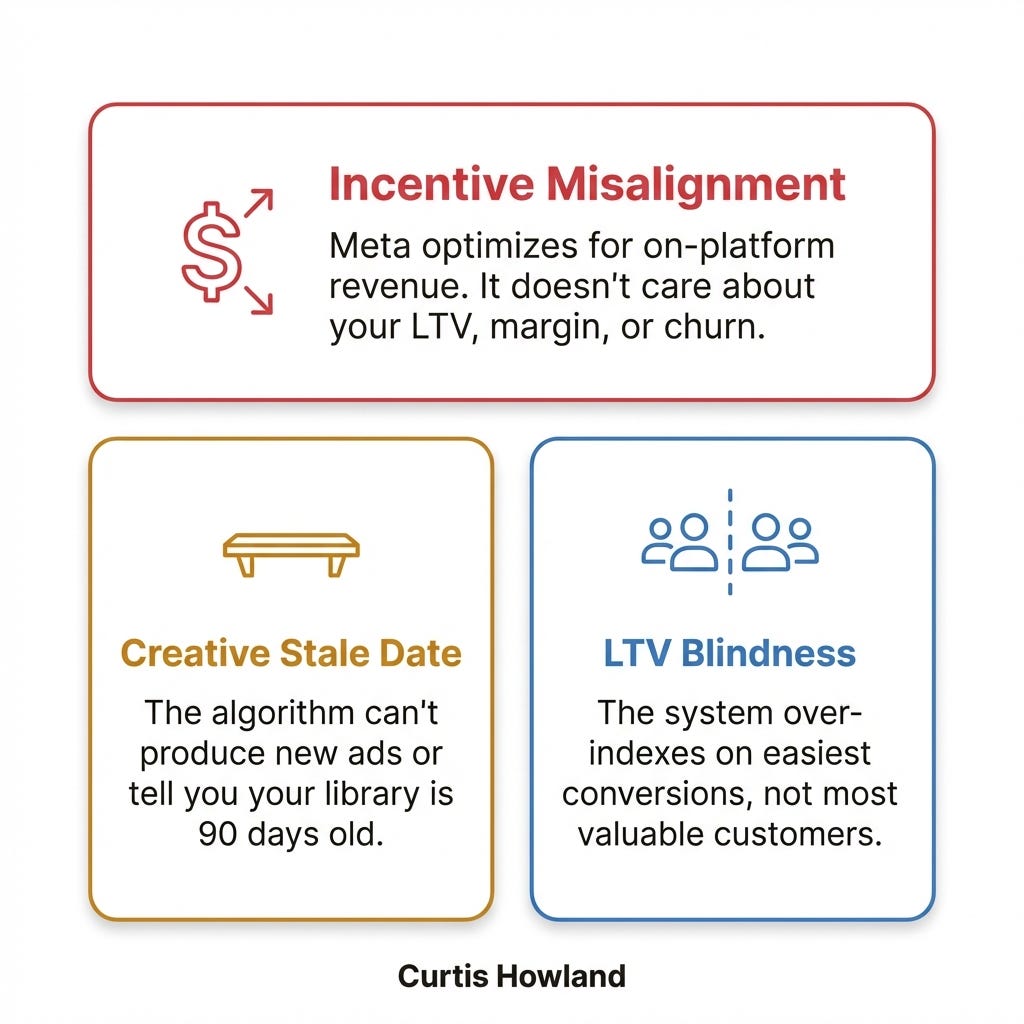
Meta’s goals are not your goals. Meta optimizes for high on-platform revenue per minute. They know giving you customers profitably is a piece of that but its not a 1:1 tie. Meta doesn’t care about your margin or whether one product creates a better customer experience than another except if it makes you spend more. It doesn’t know if one ad drives heavier retail or Amazon lift than another. If a discount-heavy ad converts at high volume but attracts customers who churn after one order, Meta’s system sees that as a win. If you aren’t tracking it and see that as a reason to spend more on Meta they will accept it. You shouldn’t. That gap is where human judgment matters most. The algorithm is working with incredible data, but it doesn’t have your margin model, your LTV curves, or your retail sell-through numbers. You do.
The algorithm can’t fix that your creative library is dying. It can only sequence what you give it. It can’t produce new ads. It can’t flag that the same three ads have been carrying the account for 90 days. The brands I see fail with the “let the algorithm work” approach aren’t failing because the system is bad. They’re failing because nobody is feeding it fresh creative, nobody is watching spend concentration, and nobody noticed the library went stale.
Meta is trying to fix this with their “AI ad tax” (pushing AI-generated ads without your permission, or with it if you turned it on I guess). If those AI ads are outperforming your creative, that’s a clear sign your library needs more diversity. Have you seen them? You can do better…
LTV segmentation requires human intervention. If different products or customer personas have meaningfully different contribution margins and lifetime values, and you’re optimizing for conversions, the algorithm will over-index on the easiest-to-convert customers. A subscription brand where one product line retains at 2x the rate of another has a massive LTV gap that Meta doesn’t account for. Active management, combined with MTA and predicted LTV data, is the only way to steer toward your best customers.
Meta is working on this (LTV optimization betas are rolling out, results are mixed so far) but for most accounts in 2026, this gap is still yours to manage.
The Creative Graveyard
I want to name the real danger that the sequencing argument correctly identifies, because it’s not wrong about everything.
I was on a call recently with a brand making 1000+ creatives per month. Their CMO said something that stuck with me. They have a “graveyard of creative that was probably working extremely hard for us, but was turned off because of reactivity to what we were defining as success.”
She was defining success as efficient direct-response conversion. But some of those killed ads had really high click-through rates, strong engagement, broad reach. They were doing awareness work. They were the first touch in a sequence. And they got killed because their direct ROAS didn’t clear the bar.
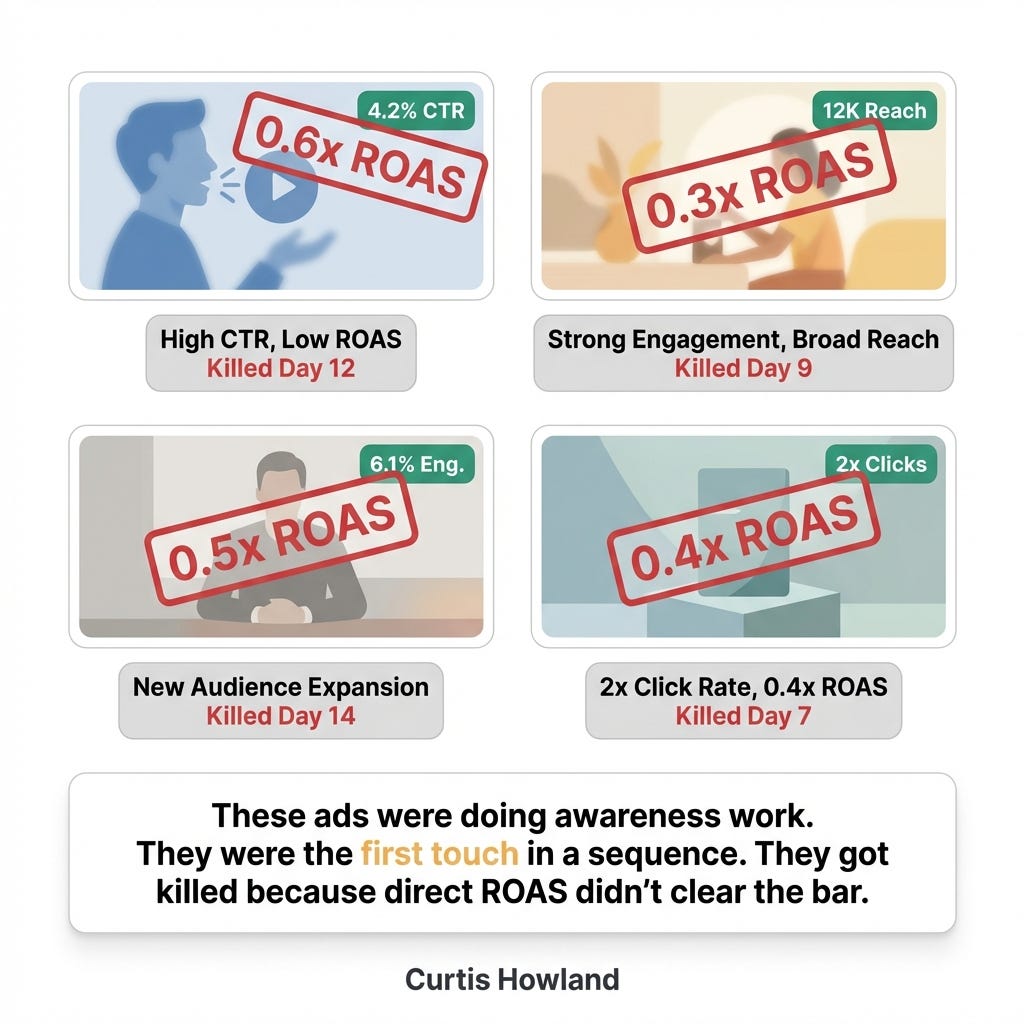
This is real and I’ve seen it at multiple brands. When you evaluate every ad by the same last-click metric, you systematically kill your top-of-funnel creative. And by top-of-funnel creative, I don’t mean awareness campaigns or impression-optimized fluff. I mean conversion-optimized ads that lead with a problem instead of your brand. Ads that can convert a customer who’s never heard of you. Those are the ones that get killed first, because they look weak on last-click ROAS even though they’re doing the hardest work in the account.
The inverse is also true: optimize only on first-click and you kill your bottom-funnel closers.
No single attribution model is perfect. Looking at multiple windows and understanding trends within individual ads over time is what separates a good media buyer from a dashboard watcher.
Over time, if you over-optimize to a single model, your ad library gets narrower. With last click, all your surviving ads are bottom-funnel converters. You lose the ability to reach new people. Growth stalls.
The fix isn’t “never turn anything off.” The fix is better evaluation criteria. And if you’re only looking at one attribution window (last click or 7-day click) before you decide to turn something off, you’re not giving yourself enough data points to make the call.
The Complexity Spectrum: Where Should You Sit?
I thought about cutting this section since its a side note but its really important…
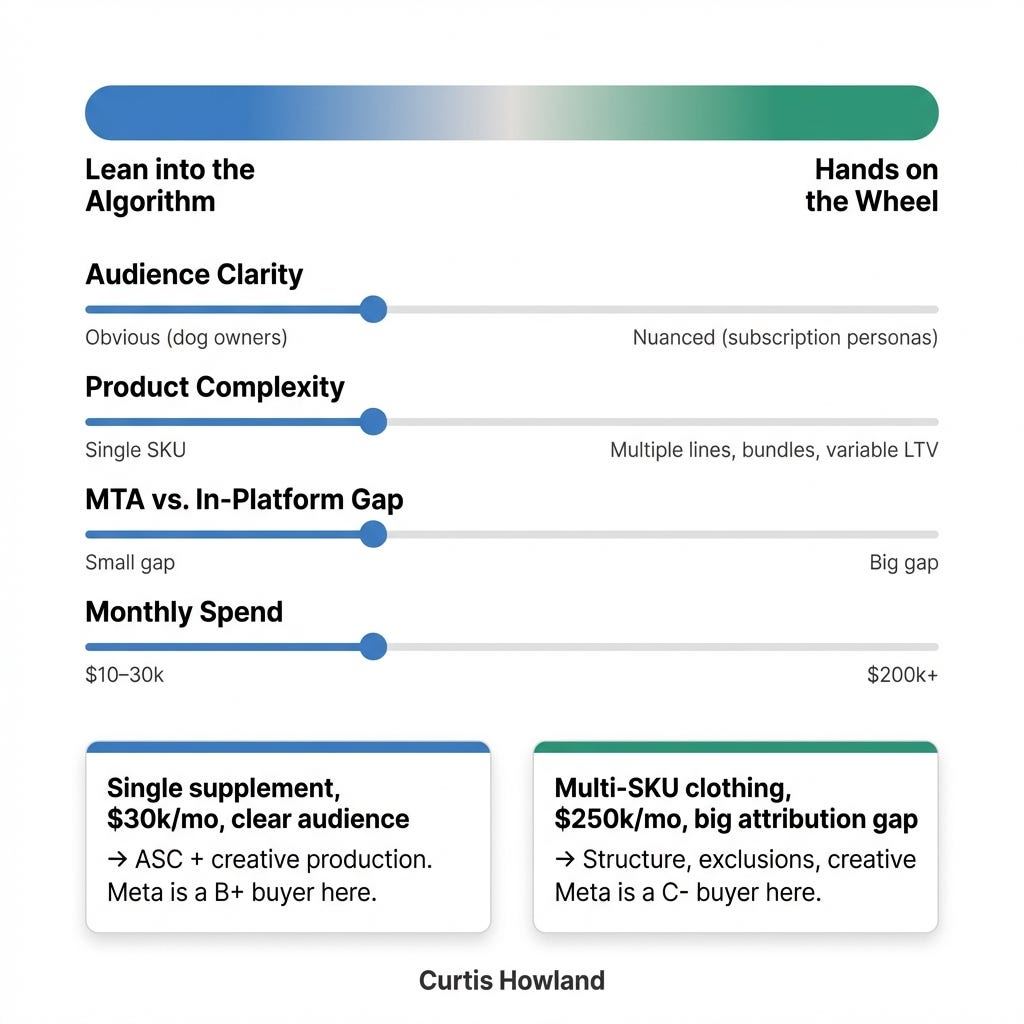
Not every brand needs the same level of active management. Where you should sit on the spectrum depends on four variables.
Variable 1: How obvious is your audience to Meta?
If you sell dog products, Meta knows who has a dog. The signal is clean. The algorithm finds your people with minimal guidance.
If you sell something more nuanced, like specialty food for different age ranges with different medical needs, Meta’s signal is muddier.
Meta knows a lot about each person, but depth of knowledge doesn’t equal relevance of knowledge. It might know someone’s browsing patterns down to the minute, but it doesn’t know they just started a specific diet or that their kid aged out of your product line.
The clearer your audience signal, the more you can lean into the algorithm.
Variable 2: How complex is your product?
Single SKU supplement with one clear benefit? Pretty simple. The algorithm can figure out who responds to what.
Multiple product lines, different selling points per product, different customer personas, bundles versus subscriptions? Now you need creative that maps to each segment, and you need to watch whether the algorithm is matching the right message to the right person.
Simplest test: if a single ASC campaign does 90% of what your structured account does, your product is probably simple enough to let Meta do all the work. If you see meaningful performance differences by structuring different ad sets for different product lines, that complexity is real and worth managing carefully.
To be clear: managing your account does not mean turning off Advantage+ and going back to manual audience targeting. That’s not 2026. It means using the algorithm’s strengths (broad delivery, creative matching) while layering in structure at the ad set level so you can control budget allocation, test new concepts cleanly, and scale winners intentionally.
Variable 3: How different is your MTA from in-platform reporting?
If your multi-touch attribution (Northbeam, Triple Whale, whatever you use) tells roughly the same story as Meta’s in-platform numbers, you can trust the algorithm’s optimization decisions more.
But if MTA shows dramatically different performance from what Meta reports, the algorithm is optimizing for something that doesn’t align with your actual business outcomes. That gap is where human judgment adds the most value.
(Side note: If you’re spending $200k+/mo and don’t have MTA yet, it’s probably the highest-ROI investment you can make right now. We use Triple Whale across most accounts. Northbeam is solid too.)
Variable 4: How much are you spending?
At $10-20k per month, the cost of a bad decision (killing an ad too early, restarting learning phases) is high relative to your total budget. A lighter touch makes sense.
At $200k+ per month, you have enough data to make confident decisions quickly. And the cost of not managing is huge. Every day a bad ad runs at that level, it’s burning real money. Higher spend = more reason for active management.
The punchline: A single supplement brand spending $30k per month should probably run ASC and put its energy into creative production. Meta is a B+ buyer for that kind of account, and a B+ might be 90% of performance. A complex subscription brand spending $500k per month with 100s of creatives across different personas, different LTVs, big gaps between MTA and in-platform, and nuanced customer segments needs real hands on the wheel.
Most DTC brands fall somewhere in between.
The Practical Framework
Regardless of where you fall on the spectrum, these basics apply.
The three checks.
I don’t care what account structure you use. ABO, CBO, ASC, a hybrid, whatever. As long as three things are happening:
Your ads get tested effectively. New creative gets enough spend to prove itself. If you’re regularly finding that ads you paused early turn out to be winners when retested, you have a testing structure problem.
Your ads get cut effectively. Underperformers with enough data behind them get turned off. Budget stops being wasted.
Your top performers get scaled effectively. The top 1% of your ads drives something like half your revenue. Are those ads getting maximized? Are you building iterations around them?
If all three are working, the account is healthy. If any one is broken, performance suffers regardless of how sophisticated your sequencing theory is.
Think about what you’re removing, not just that you’re removing.
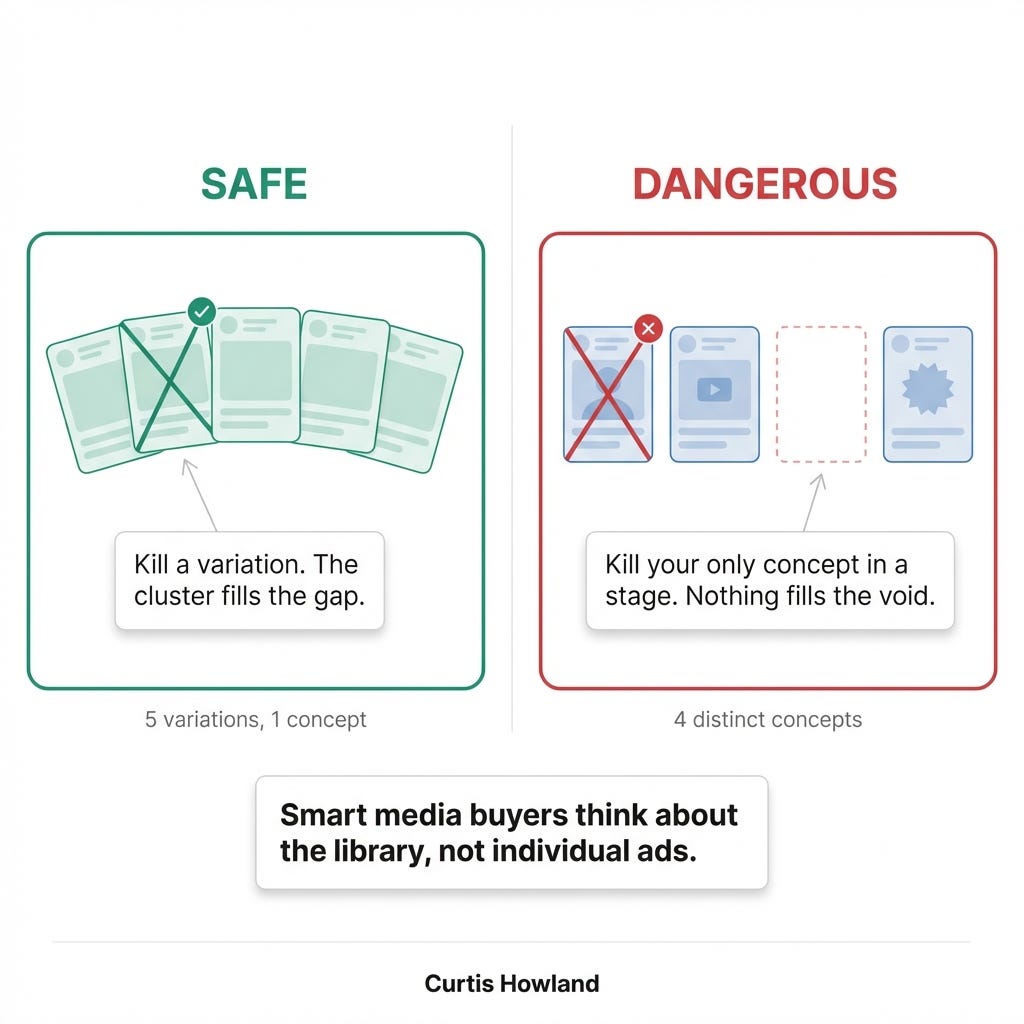
The risk isn’t removing an ad. It’s removing an entire concept or an entire stage of the funnel.
Turning off the worst-performing hook variation of a UGC concept? Totally fine. The algorithm has other variations in that entity cluster.
Turning off your only problem-first creative (the kind that reaches non-aware customers inside a conversion campaign) because its last-click ROAS is low? That might actually hurt the account. You created a gap in the ecosystem.
Feed the algorithm variety.
Sequencing means Meta is trying to show users the right ad at the right moment. If all your ads say the same thing in the same way, the algorithm can’t sequence anything meaningful.
Build for conceptual diversity: different formats, different messages, different angles, different funnel stages. Not 50 hook swaps on the same video.
One concept per $10k in monthly spend is my baseline for production volume, with 3 variations per concept. If you’re scaling quickly or burning through creative fast, produce more.
The Bottom Line
The sequencing infrastructure is real. Meta built a system that orchestrates multi-ad conversion paths.
But the debate has collapsed into two extremes that are both wrong.
“Never touch anything” ignores incentive misalignment, creative production gaps, and LTV segmentation. “Optimize everything by last-click ROAS” fills the graveyard with problem-first creative that was doing the hardest work in the account: reaching people who’d never heard of you and converting them inside a conversion campaign. Kill enough of those and your audience contracts, your new customer rate drops, and growth stalls.
And the most popular version of the sequencing argument, that a high-CPA ad with zero click signal is secretly the most important ad in your account, just doesn’t hold up when you think about it.
The right answer depends on your complexity, your spend level, and your campaign phase.
The algorithm decides the order. You decide the options.
And the quality of those options still matters more than anything else.
Great article, Curtis.This is a situation I often find myself in. The heuristic you provided is really helpful! One question - where do you think the sequencing of ads mainly happens? I'd like to think it is within the ad set level but do you think it can happen within the campaign or account level?