

I’ve managed north of $150M in Meta spend over the last six years. Almost none of my job is SEO. So when brands started asking me about AEO last year, my honest answer was that I didn’t have a strong opinion and I wasn’t going to fake one.
What changed my mind wasn’t a thought-leadership post. It was pulling GA4 for a few accounts and realizing the number I was looking at was way off.
Here’s the situation most brands are in. You open analytics, find the AI traffic, see something like 1% of sessions, and file it under “watch later.” Reasonable. Except that number is missing a ton.
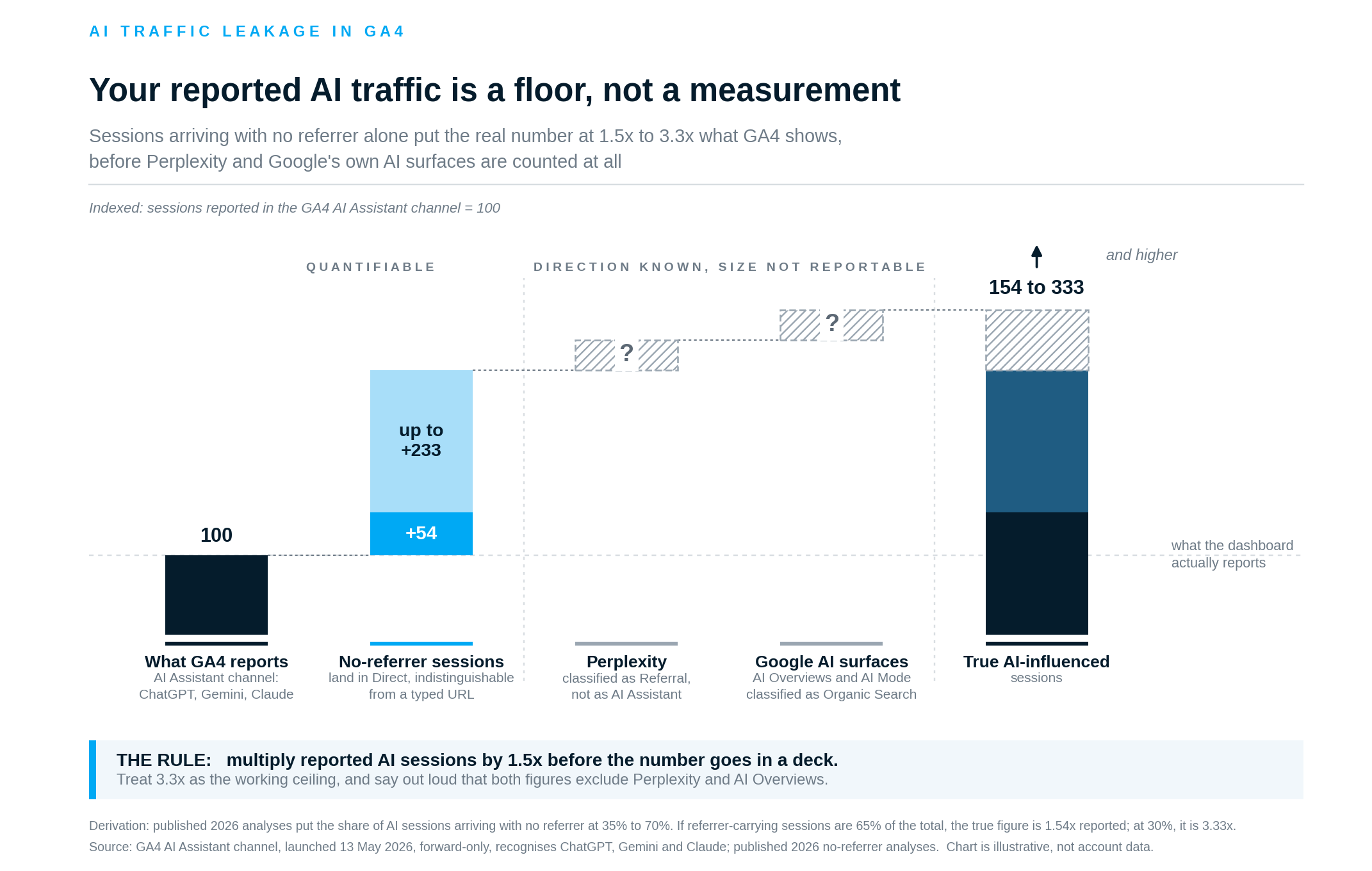
Adobe’s Q1 2026 analysis, covering over a trillion visits to U.S. retail sites, found that in March 2026, AI traffic converted 42% better than non-AI traffic. Shopify, working from its own commerce data, reported in May 2026 that AI-referred sessions convert nearly 50% higher than organic search on product detail pages, and that AI beat organic in 23 of 25 merchant categories.
Both of those are vendor-stated numbers, so hold them loosely. But two independent datasets pointing the same direction is worth more than one flattering screenshot.
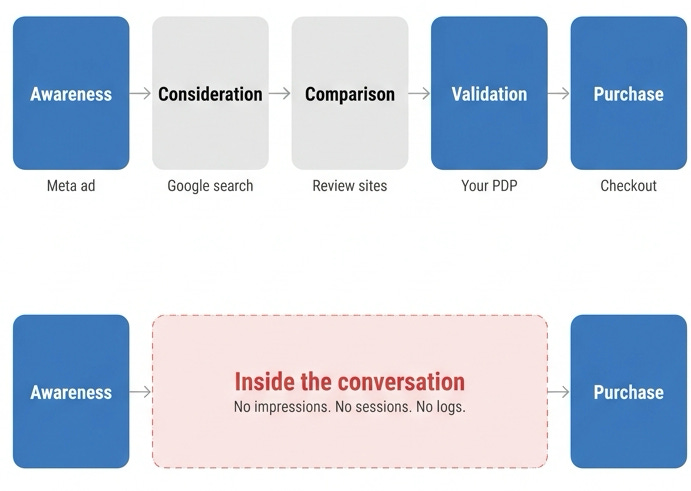
The mechanism is simple: by the time someone clicks through from an assistant’s answer, the comparison shopping already happened inside the conversation. They arrive as a finalist, not as a browser.
So I asked Lorea Lastiri to build the actual playbook, because she does this for a living and I don’t. Lorea runs Lastiri Digital, has been doing SEO content work for over 12 years, and spends her days on async SEO audits, demand-capture strategy and AEO for ecommerce and growth-stage brands.
What follows is her list. I’ve added my notes where a move overlaps with something I see on the paid side. This isn’t paid. I just think it’s a fascinating topic, and I appreciate her sharing these details and wanted to pass them along! (Graphic additions are mine)
Part 1: Do This Before You Buy Anything
Most brands are getting pitched an “AI optimization” retainer before anyone has checked whether the engines can read the site. That’s backwards.
1. Map the buying decisions, not a vanity list of prompts
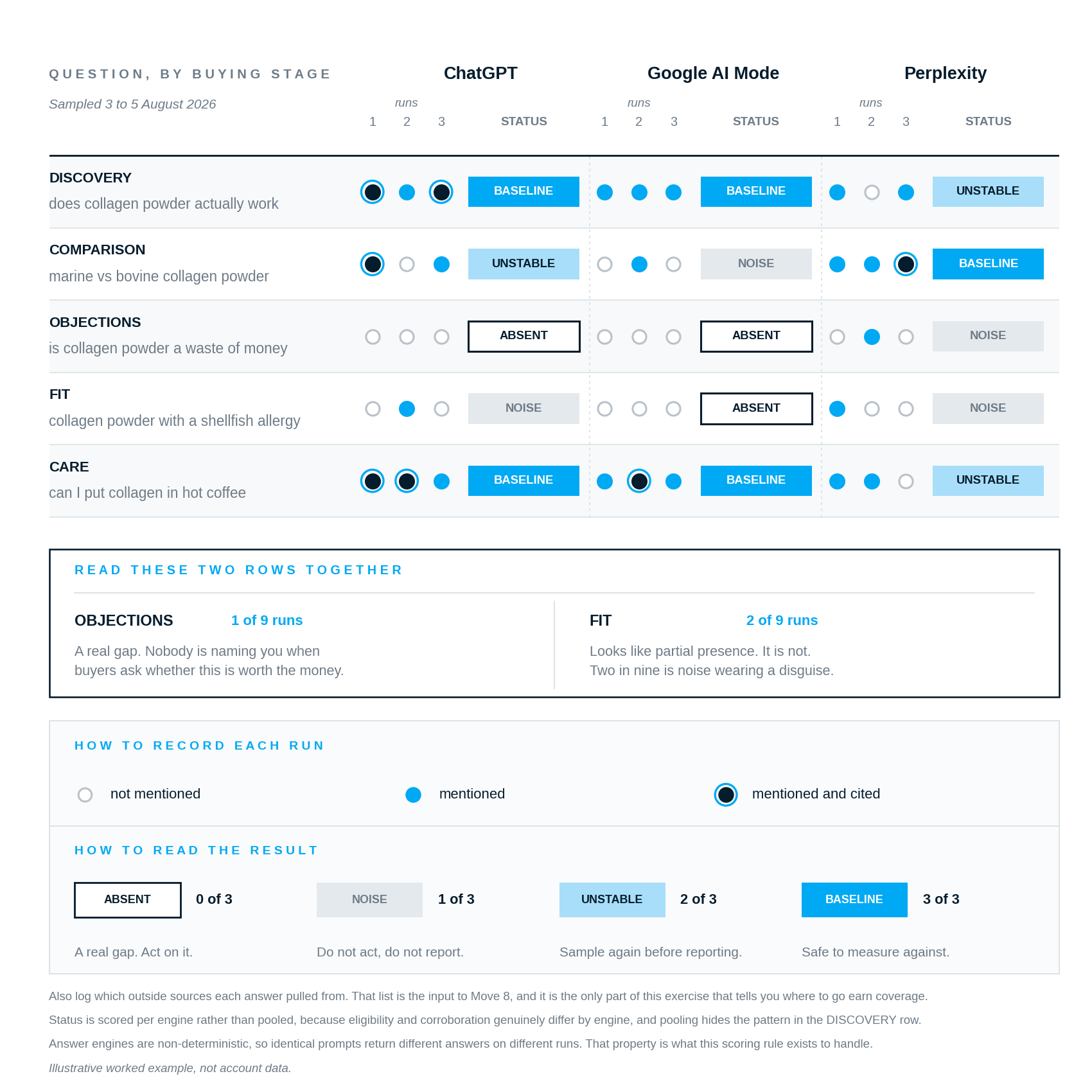
Build a fixed set of 20 to 30 questions from support tickets, reviews, site search and post-purchase surveys. Cover discovery, comparison, objections, fit and care.
Then sample each engine more than once and record four things: the answer, whether you were mentioned, whether you were cited, and which sources it pulled from.
A single run is not a baseline. These systems are non-deterministic, and one query on one day tells you nothing you can defend in a meeting.
Curtis note: this is the same discipline as reading creative test results. One day of data on a new concept is noise. You need repeated sampling before you call anything.
2. Fix eligibility
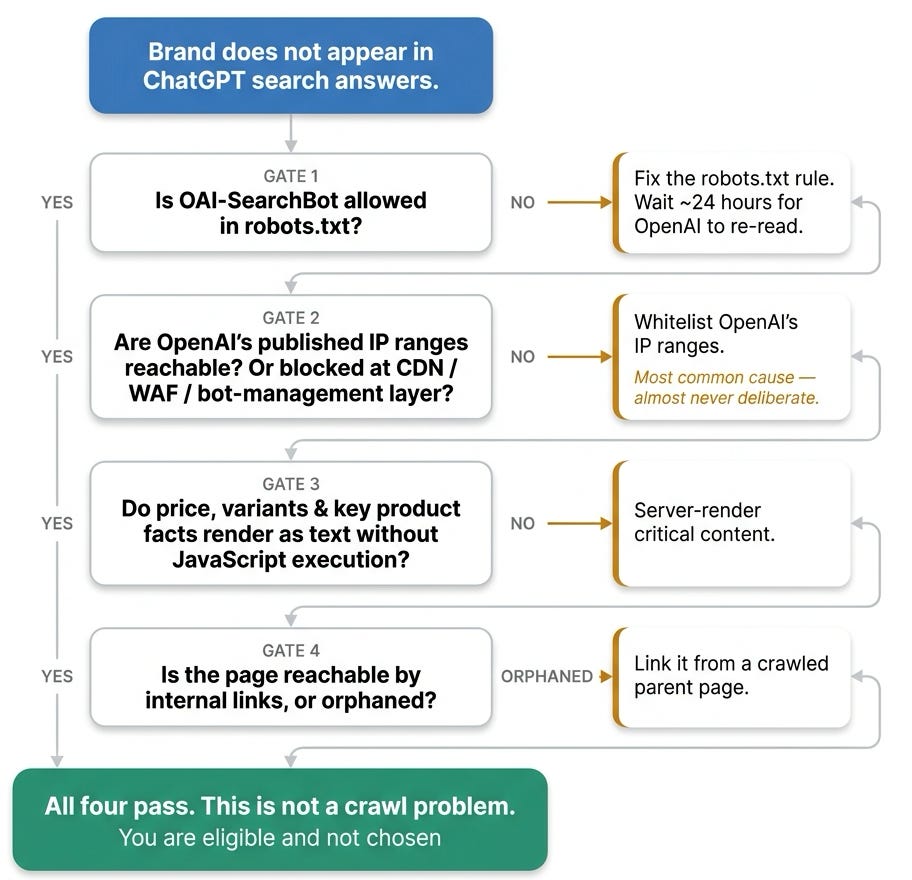
For Google, a page still needs to be indexed and eligible to show with a snippet. For ChatGPT search, the crawler that matters is OAI-SearchBot.
That last one trips up more brands than it should, because OpenAI runs three separate agents with three separate jobs. GPTBot handles training. OAI-SearchBot handles search inclusion. ChatGPT-User handles user-triggered fetches, and OpenAI’s own documentation says robots.txt rules may not apply to it since a person initiated the action.
Most sites that are invisible didn’t block anything on purpose. They have a broad WAF rule, a CDN bot filter, or a wildcard disallow that catches everything before it reaches the content. Robots.txt changes take roughly 24 hours to register on OpenAI’s side.
Check robots rules, CDN blocks, internal links, JavaScript rendering, and whether your key product facts exist as text on the page.
3. Turn the catalog into a product truth layer
Put price, availability, variants, materials, dimensions, compatibility, shipping and returns in visible HTML. Then keep Product and Offer markup plus your Merchant Center feed consistent with what’s on the page.
Schema supports product understanding. It’s not a magic AEO switch, and Google’s structured data policy is explicit that markup has to be a true representation of visible page content. Mark up a price a logged-out visitor can’t see and you’re risking rich result eligibility, not gaining an edge.
Curtis note: if you’ve ever had a Meta catalog throw disapprovals because the feed and the PDP disagreed on price, you already understand this problem. Same fix, wider blast radius.
Part 2: Give the Engine Something Worth Citing
Eligibility gets you considered. Give it something to actually name.
4. Publish the facts only your operating data can supply
Mine return reasons, support questions, product tests, sizing failures, durability findings and usage constraints. That’s material a competitor cannot rewrite from the same public sources.
Generic advice gets summarized without crediting anyone. First-hand evidence gives the engine a reason to link back, because there’s nowhere else to get it.
Curtis note: this is the single most underused asset in DTC. Brands are sitting on post-purchase survey data and return reason codes that would make really useful content. Use it for AEO, but also creative.
5. Build for the follow-up questions hiding inside the first question
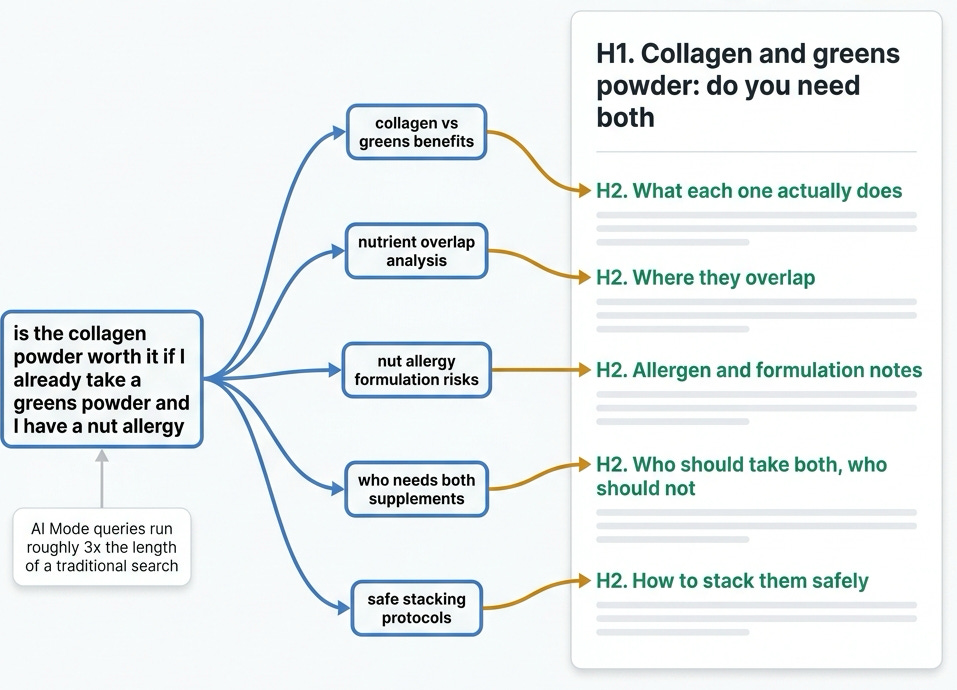
Google’s AI features fan one query into several related searches running at the same time. Google published data in March 2026 showing AI Mode queries average three times the length of a traditional search, and at I/O in May 2026 said AI Mode had passed a billion monthly users.
So a strong decision page covers the main answer, the trade-offs, the edge cases, the comparisons and the next step in one navigable asset.
What you should not do is spin every wording variation into its own thin page. That’s maintenance debt at best, and it can cross into Google’s scaled content abuse territory at worst.
6. Write the comparison page your legal team will still like
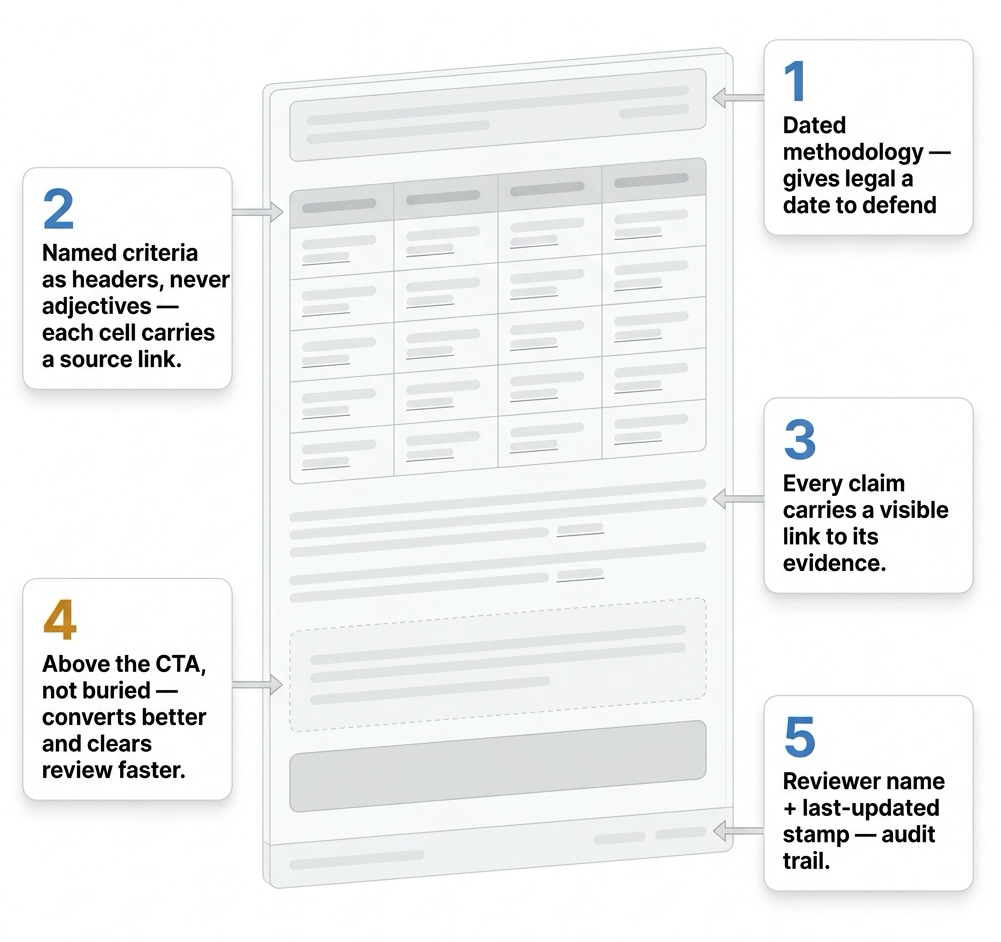
Own “X vs Y”, “best for [use case]” and alternative queries. Do it with a dated methodology, named criteria, evidence links, and a clear account of who should not buy your product.
Admitting where a competitor wins makes the page more useful to a buyer and more defensible to your counsel than a disguised sales page.
Part 3: Make the Mention Actually Worth Something
A citation that lands on the wrong page is a vanity metric with extra steps.
7. Make product and brand identity boringly consistent
Use the same brand, model, variant and category names across PDPs, Merchant Center, retailer listings, organization profiles and press materials.
When you rename or reformulate a product, preserve the aliases. Otherwise an answer engine treats your old reviews, your new retail listing and your current SKU as three unrelated things, and you lose the accumulated trust of all three.
Bots and people see things differently.
8. Earn corroboration where buyers already ask for help
Reviews, retailer pages, expert roundups, videos and real forum discussions supply independent context your own site can’t.
Start with the outside sources already showing up in your baseline prompts from move one. Fix the wrong facts there first. Then earn coverage there.
Spraying synthetic mentions or blasting generic PR is cargo cult behavior. You’re copying the shape of what works without the substance underneath.
9. Make every citation land on a decision-ready page
A mention isn’t a business result if the cited page can’t confirm the claim, show the right variant, or move the shopper toward buying.
Deep-link your evidence to the relevant PDP, comparison or guide. Keep stock and policy details current. Give the visitor an obvious next step.
Curtis note: this is just landing page discipline, and it’s the same reason a great ad pointed at a generic homepage underperforms a mediocre ad pointed at the right page. Different traffic, same idea.
Part 4: Run It as an Experiment, Not a Religion
10. Measure it honestly, including the parts you can’t see
Track three things: Google generative AI visibility in Search Console, identifiable AI referrals and conversions in analytics, and repeated mention and citation rates for your fixed question set by engine.
Curtis note: Post-purchase survey as well!!
Judge changes against a dated before-and-after sample. Keep SEO, merchandising and conversion metrics in the same scorecard so you can see what a change cost you elsewhere.
This post was co-written with Lorea Lastiri of Lastiri Digital. Lorea has spent 12+ years in SEO and content, and runs async SEO audits, demand-capture strategy and AEO for ecommerce and growth-stage brands. The ten moves are hers. The paid media commentary (and any errors) are mine.
You can find Lorea and her partner program here: https://lorealastiri.com/partners/
Sources
Adobe Digital Insights Q1 2026 AI traffic report: https://business.adobe.com/blog/ai-traffic-surge-retail-sites-not-machine-readable
Shopify AI-referred session performance, May 2026: https://www.shopify.com/enterprise/blog/ai-search-insights
Google Search Console generative AI performance reports, June 3 2026: https://ppc.land/google-finally-gives-search-console-its-own-generative-ai-visibility-reports/
Search Console generative AI report limitations and history start date: https://www.tryhikoo.com/en/blog/guides/search-console-ai-overviews-impressions/
GA4 AI Assistant channel launch and coverage gaps: https://www.digitalapplied.com/blog/ga4-ai-assistant-channel-2026-measure-ai-traffic-playbook
Share of AI sessions arriving without a referrer: https://www.madx.digital/learn/ga4-launches-ai-assistant-channel
OpenAI crawler documentation overview: https://developers.openai.com/api/docs/bots
OpenAI crawler documentation changes, December 2025: https://ppc.land/openai-revises-chatgpt-crawler-documentation-with-significant-policy-changes/
Google general structured data guidelines: https://developers.google.com/search/docs/appearance/structured-data/sd-policies
AI Mode query length and query fan-out: https://keywordseverywhere.com/news/google-ai-mode/