

March was tough for some Ecom brands, and for others it was a time to scale 50%
Everyone is doing different things.
Everyone’s success looks very different.
Across millions in spend and billions in revenue here is what im seeing working as I talk to different brands.
What’s Working Right Now
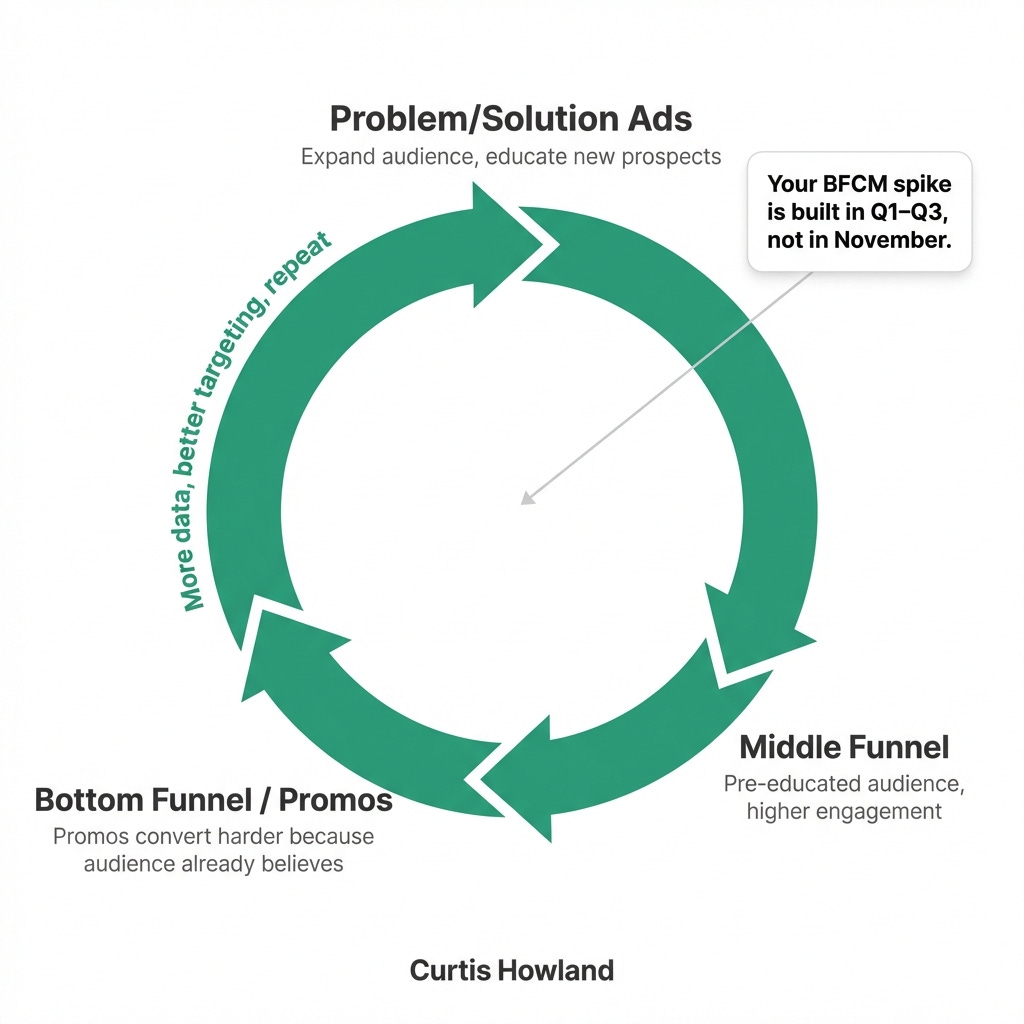
Problem/solution ads as a full-funnel play.
The brands scaling hardest on Meta right now are not running promo-first creative.
They’re running problem/solution video ads. A real pain point. A credible voice (founder, doctor, real customer). A complete story.
These ads pull new people into the funnel AND drive direct conversions. One brand I work with saw their Black Friday performance jump 100% year over year, not because of better promos. Because we spent Q1 through Q3 building the top of funnel with problem-first creative. By November, the audience was pre-educated. The promos just had to close. Better performance through the whole year but very clear when BF came around.
Here’s what I see across accounts: When you scale ads to high budgets at strong performance AND those ads speak to a problem, the long term performance and sustainability of that growth is better.
When we come into an account and it’s heavy on promo language (percent off, free gift, limited time), the first move is almost always pushing toward problem/solution, video format, high-density information ads. That’s what expands the audience. That’s what builds long-term scale.
Offers bundles and promos have their place, but their place isn’t everywhere.
Long-form ads are having a moment.
This might be the most counterintuitive thing we’re seeing right now.
We’re testing 2-minute, 3-minute, 5-minute, and even 14-minute ads across multiple accounts. And they’re working.
One account has a 14-minute ad that’s one of their top spenders at strong efficiency. It’s basically a mashup. One strong 90-second ad stitched together with several other creator clips. All over the place from a production standpoint. Crushing it from a performance standpoint.
A separate brand has a 4-minute video walking through the full story and usage of the product. No script. It does have a fun eye catching before/after hook (thats still important). But they are authentically walking through their story. Average watch time was nearly 40 seconds. The comment section was people sharing their own story and commenting back about it.
A few friends have mentioned the same thing in their ad accounts. Long form ads hitting well (all kinds of formats)
It makes sense from one level: if someone watches 2+ minutes of your content, Meta has an incredibly strong signal about who that person is and what they want. You’re pre-qualifying buyers before they ever hit your landing page.
The completion rate doesn’t need to be high. Even 1-2% watching to the end at scale means you’re building a deep pool of highly educated prospects.
The 30% hook rate threshold still applies. You need qualified attention at the top. But once you have it, keeping people engaged for minutes (not seconds) is a massive signal advantage.
Whitelisted pages are still outperforming.
For brands with AOVs above $80-100, running ads from whitelisted pages instead of your brand page is one of the biggest performance levers I’m seeing right now.
The simplest version: find a credible expert (doctor, practitioner, creator with real domain authority) and run your ads from their page as a partnership ad.
The credibility transfer is real. People trust a doctor talking about a health product more than a brand page saying the same thing. And Meta’s algorithm picks up on it too. The engagement signals are stronger because the content feels more native coming from a person than from a brand.
If you’re in health, wellness, beauty, or any category where trust matters, whitelisting should be a core part of your creative mix. Not a nice-to-have. A core part.
The $3K/creative production benchmark.
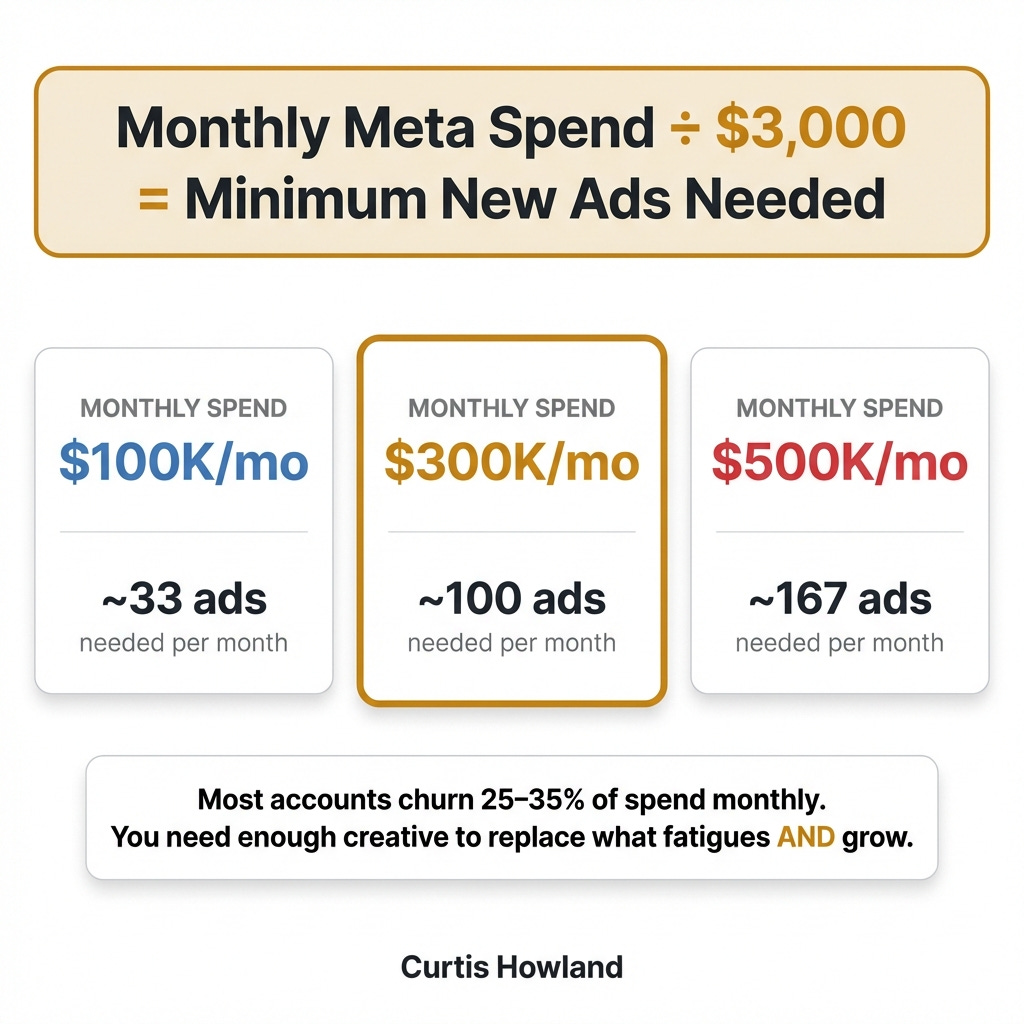
Across our accounts, the math keeps coming back to one number: you need roughly 1 new ad for every $3,000 in monthly Meta spend.
At $100K/month, that’s ~33 new ads. At $300K, it’s ~100.
This accounts for creative fatigue (most accounts churn 25-35% of their spend monthly), hit rates (10-15% of ads become real winners), and the need to keep testing.
But here’s the thing most brands don’t talk about.
The volume trap is real.
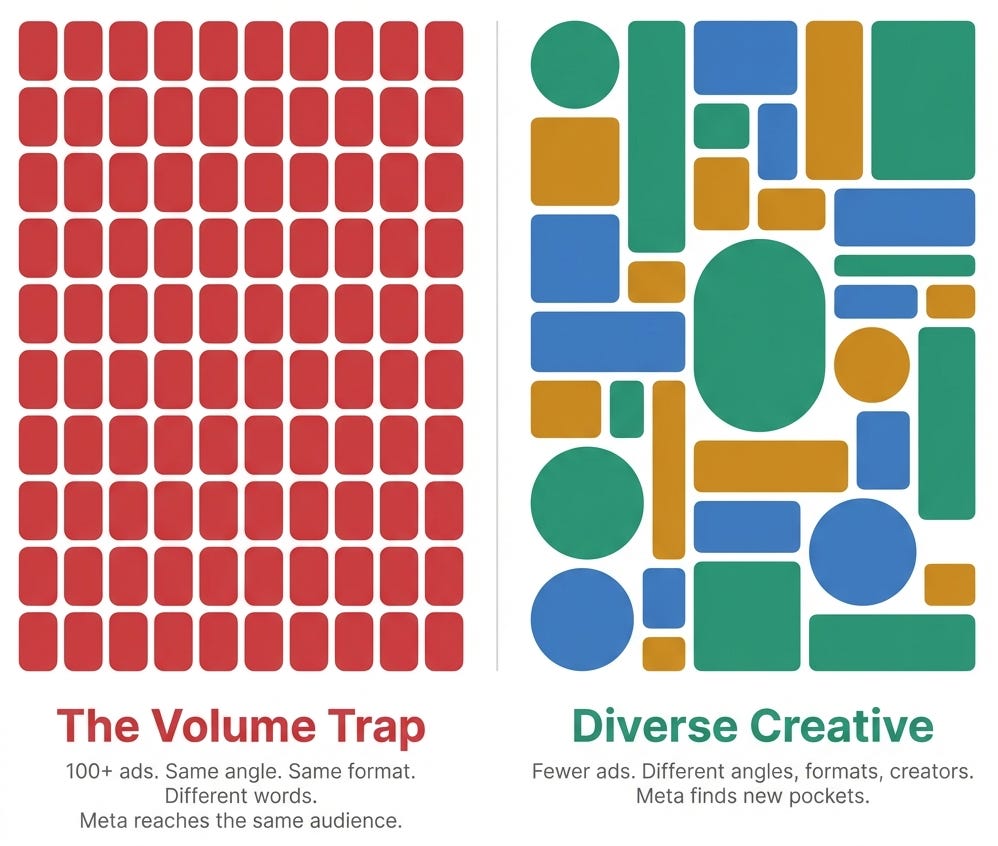
I had three separate conversations this month with brands producing 100+ ads per month who couldn’t scale.
The problem wasn’t volume. The problem was that all 100 ads looked the same.
Different copy. Different creators. Different hooks. But the same core angle, the same format, the same visual feel. Meta is reaching the same pocket of audience over and over because the creative isn’t actually diverse.
One founder put it perfectly: “Even when the messaging is entirely different, when you look at the ad account, it all looks exactly the same.”
The fix is not more ads. It’s more different ads. Map your creative on a grid (selling point x format x creator type) and look for the empty squares. That’s where your next winner is hiding, not in another variation of your current best angle.
I’ve seen a single ad spend $800K+ at strong efficiency. It was unique and new. That one ad is worth more than 200 variations of the same concept.
What We’re Testing
Novel format “big swing” creative.
We’re allocating roughly 10% of creative production to “big swings.” Engaging, native-feeling formats that still incorporate real selling points.
Speed challenges. Street interviews. Game-show style comparisons. Science experiments. Founder content.
One brand did a game show style version of their product, made it into a challenge to apply the skin care product quickly. Casual phone shoot. Became one of their best-performing concepts. The format was engaging enough to hook, but the USP (ease of installation) was baked into the concept.
Other big swings that have crushed it: a founder talking to himself in two chairs about a product problem. A song about a product’s core benefit. A skincare vs child race filmed on a phone.
All engaging. All selling.
The hit rate is lower than workhorse creative. Some of them flop HARD. But the ceiling is much higher. When one hits, it can change the trajectory of an entire account.
The important thing: don’t go high production. The best big swings are phone-shot. Authentic. People associate polished video with ads and scroll past. High production works in specific contexts (podcast interviews, product demos in a warehouse, events where cameras make sense). Everywhere else, phone wins.
AI animated statics.
This one is early but worth watching.
We’re taking top-performing static images and running them through AI video tools (Veo, Gemini) to animate them. The AI adds subtle movement, background elements, and atmosphere.
For some accounts, this has become a significant chunk of account spend in just three months. Every week we launch new ones by animating the best performers.
Download the static, convert it, send to the AI tool with specific direction prompts, output a video. Not 100% perfect, and you need to filter out a lot but you get some really interesting content.
Twitter is full of the AI-generated “clay” style ads and seeing them scale to $50K/day in spend on launch. This space is moving fast.
Subscription-only landing pages.
Most brands default to showing both one-time and subscription options. If your subscription take rate is already above 50%, consider removing the one-time option entirely.
The math changes too. Your LTV goes up dramatically when everyone is on subscription. That means your allowable CAC goes up. That means you can spend more on Meta. That means you scale faster.
It’s not right for every brand. But if you’re already converting more than half your customers to subscription, the one-time option is probably just adding friction.
Retail support via Meta (three approaches).
For brands with retail distribution, we use three distinct strategies:
Conversion overflow. Keep everything conversion-optimized. When a top-of-funnel ad performs well, retail sees a pickup naturally. No special targeting needed.
Banner hijacking. Take your top DR ads and add “Now at [Retailer]” banners. Still conversion-optimized. But millions of impressions build retail awareness for free on top of ads already working.
Geo-targeted reach. Impression campaigns targeted to high-income households around specific retail locations. Best for major launches.
Most brands should start with #1. Layer in #2 when you have a clear retail story. Save #3 for big launch moments.
Top Tests You Should Be Running
1. Long-form video (2-5 minutes). Take your best short ad concept and expand it. Don’t pad. Add depth: more proof points, more story, more education. If you’re feeling bold, go longer. The 12-minute ceiling is real.
2. AI animated statics. Take your top 5 performing static images. Run them through Veo or Gemini. Launch them as video ads. Total time investment: an hour. Potential upside: a whole new format that scales.
3. Static ads with non-promo headlines. If your top statics are discount-driven, test the same visual with a selling-point headline instead. If it performs at parity, it’s better for the business because it doesn’t train the algorithm for deal-seekers.
4. Creative matrix gap analysis. Map your last 90 days on a grid: selling points on one axis, formats on the other. Find the empty squares. Fill one gap per week. This is how you escape the volume trap.
5. Post-purchase survey budget reallocation. Compare implied CAC by channel (spend / survey-attributed customers). If Meta’s implied CAC is 2-4x lower than Google non-brand, shift 20% of Google non-brand to Meta and watch overall CAC for 30 days.
6. One whitelisted expert ad. Find one credible voice (doctor, specialist, creator with domain authority) and run their content from their page. Even one strong whitelisted ad can shift your entire account’s efficiency.
7. One big swing. Block 2 hours this week for one creative concept that’s genuinely different from anything in your account. A challenge, an experiment, a format you’ve never tried. The worst case is you learn something. The best case is a million-dollar ad.
If this was useful, send it to your team or share on LinkedIn with your favorite graphic and tag me! Best compliment you can give!