

1. Chase Dimond: brand voice is the only moat AI can’t cross
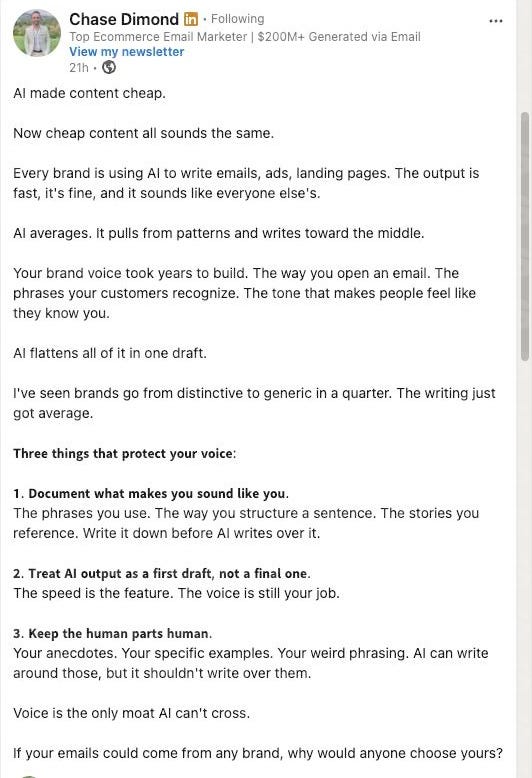
Chase’s line: AI made content cheap, and now all the cheap content sounds the same.
His take is that brand voice is the one thing AI can’t copy at scale, because it comes from a point of view, not a prompt. He lays out three ways to protect it.
Read the full post on LinkedIn →
2. Marissa Rodriguez: evaluation is the new bottleneck, not execution
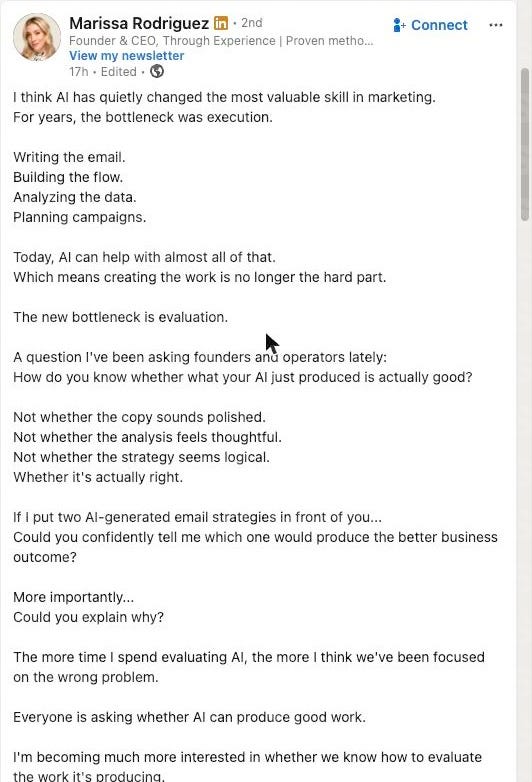
Chase says protect the voice. Marissa pushes on the harder question: can you even tell which AI output is right?
Anyone can generate ten versions of an ad in a minute. The rare skill now is knowing which one is actually good, and being able to explain why.
The strategists worth the most aren’t the fastest at making things. They’re the ones with taste sharp enough to evaluate what will work.
Read the full post on LinkedIn →
3. Marissa Rodriguez: stop asking what AI saves you, ask what you’d attempt if it were easy
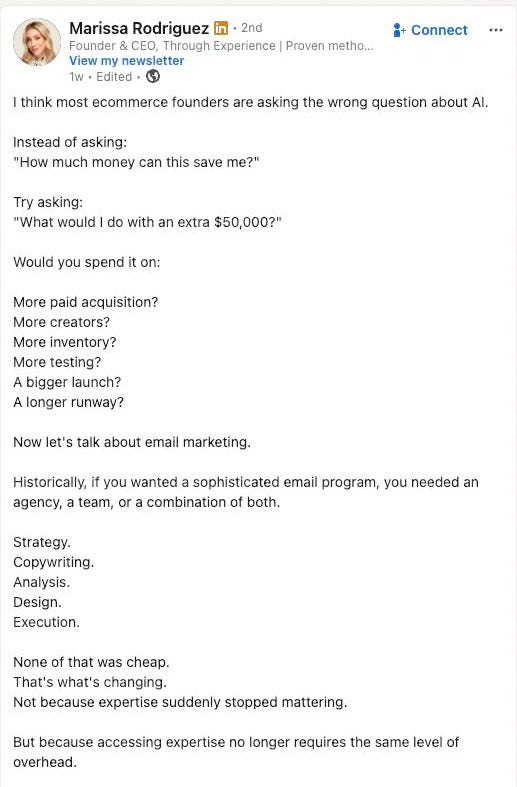
Most founders ask how much AI can save them. Marissa’s better question: what would you attempt if this were easy?
The savings question keeps you doing the same work for less. The other one opens up work you used to write off as too expensive to bother with.
Not everything you do should be automated / but plenty of things you want to do no can be…
Read the full post on LinkedIn →
4. Michael Kaminsky (Recast): your geo tool is an error tradeoff in disguise
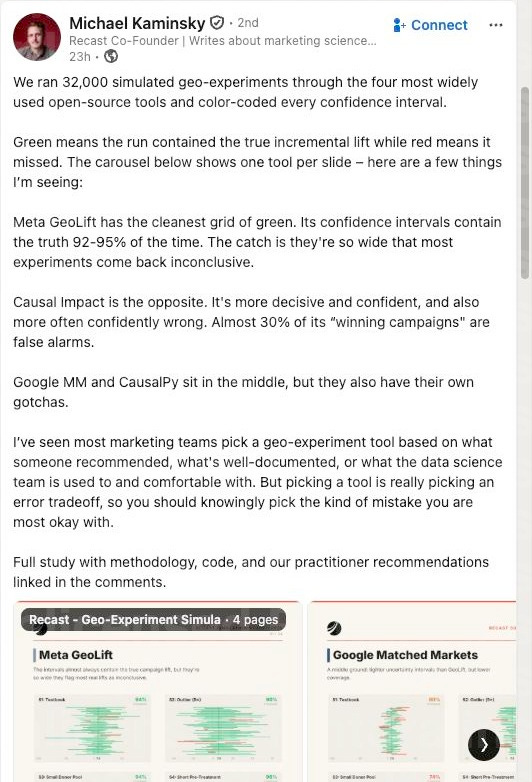
Michael ran 32,000 simulated geo-experiments through the four main open-source tools, then color-coded which results actually contained the true lift.
I’ll let the post speak for itself. I keep thinking about this one...
Read the full post on LinkedIn →
5. Zach Sherrod (Northbeam): the bucket that lies to you
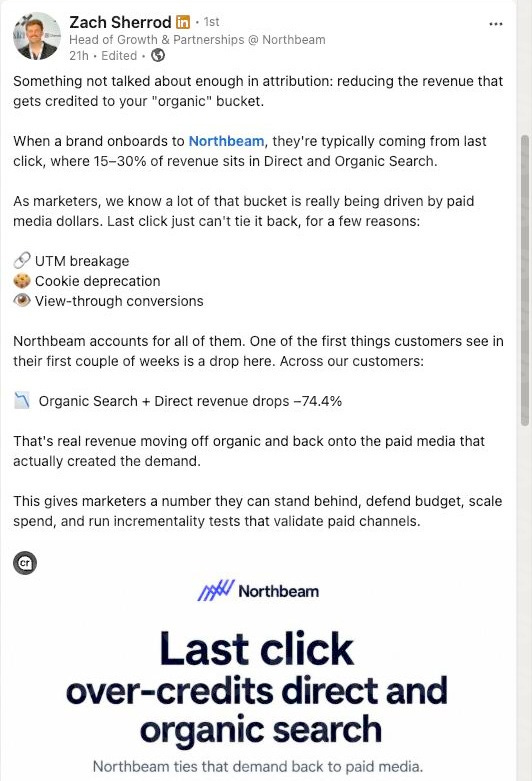
Straight from Northbeam: when you move off last-click, your “Organic + Direct” bucket drops by around 74 percent. Not because organic vanished. Because paid was driving most of it the whole time, and last-click kept handing the credit to the wrong line.
Read the full post on LinkedIn →
6. Charlie de Thibault: a chunk of your budget isn’t underperforming, it’s doing nothing
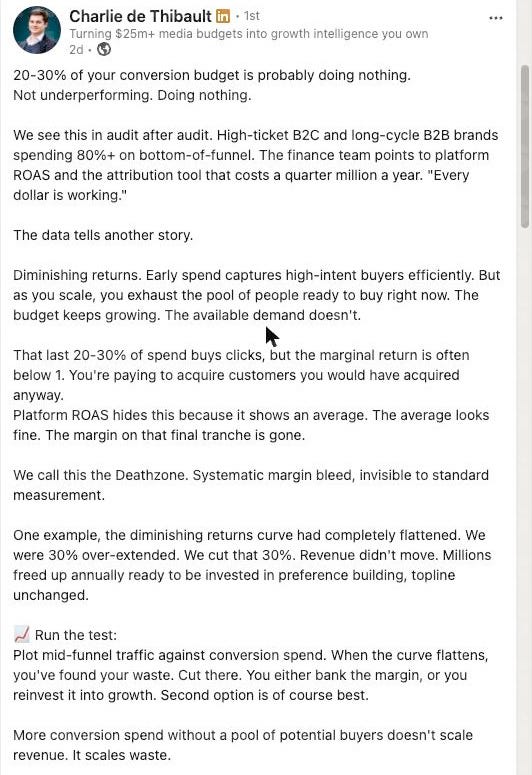
Charlie’s claim: 20 to 30 percent of your conversion budget probably isn’t underperforming. It’s marginally a profit loser.
Great post on a simple way to think about marginal impact.
Read the full post on LinkedIn →
7. Charlie de Thibault: pushing attributed ROI up every year quietly kills growth
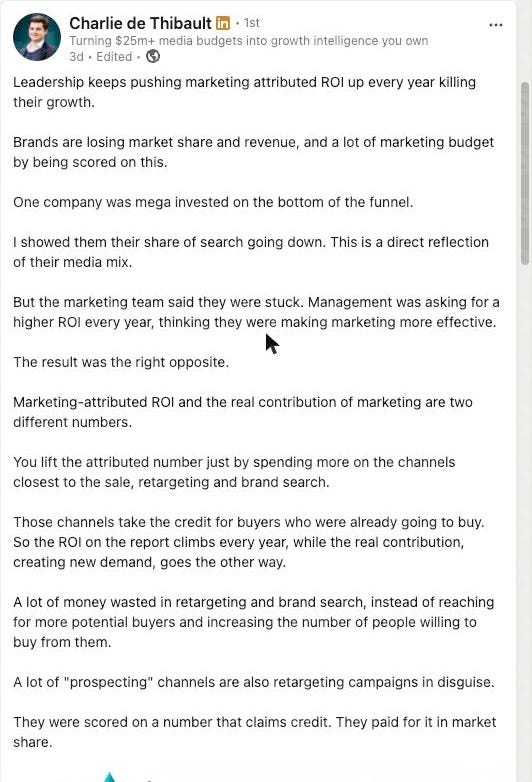
When leadership demands marketing-attributed ROI climb every single year, you eventually starve the spend that was feeding everything else.
Combined with above, know your target, measure well, and then stick to them.
Read the full post on LinkedIn →
8. Taylor Holiday (CTC): the creative quality barbell
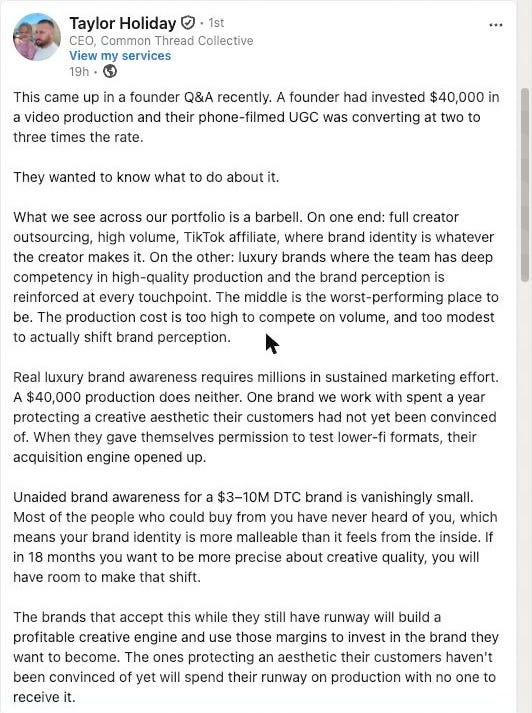
Taylor framed creative quality as a barbell. On one end, a $40k produced video. On the other, something filmed on a phone. The $40k video lost to the phone footage.
His point: for a $3 to $10M DTC brand, the middle is the worst place to live. Polished enough to be expensive, not raw enough to feel real, and it loses on both counts.
I really agree with this one.
Read the full post on LinkedIn →
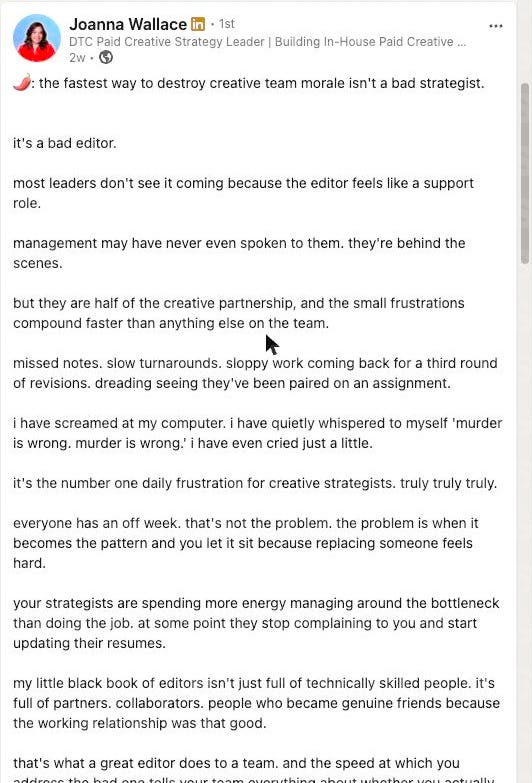
9. Joanna Wallace: a bad editor wrecks a creative team faster than a bad strategist
Joanna’s contrarian one. The fastest way to destroy creative team morale isn’t a bad strategist. It’s a bad editor.
A weak strategist points the team at the wrong target. A bad editor kills good work, rewards safe work, and teaches everyone to stop taking swings. One is a wrong direction. The other rots the engine.
If evaluation is the real skill, then the person doing the evaluating is the highest-leverage seat on the team, and the easiest one to get wrong.
Read the full post on LinkedIn →
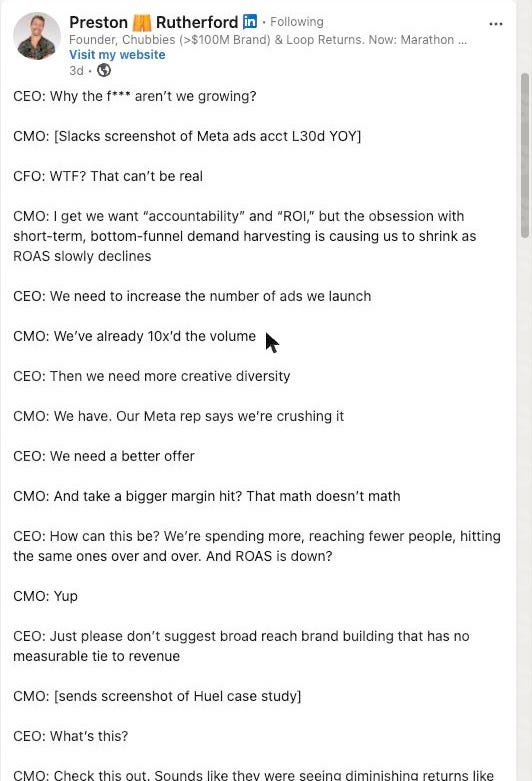
10. Preston Rutherford (Chubbies): marginal CAC, not blended CAC
Preston wrote a CEO and CMO dialogue that teaches the difference between marginal and blended CAC - super fun read and again a really clear way of describing the concept.
Read the full post on LinkedIn →
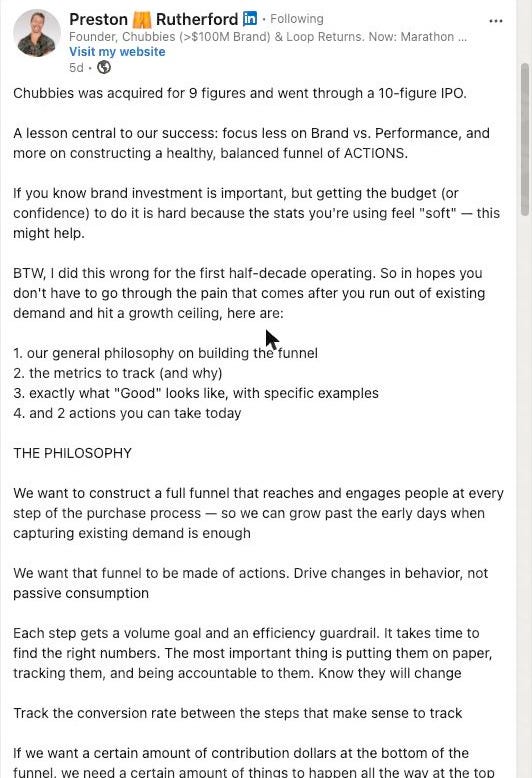
11. Preston Rutherford (Chubbies): Brand vs. Performance is the wrong fight
From the lesson of Chubbies’ nine-figure acquisition. The argument everyone has, Brand versus Performance, is mostly a distraction. The real driver sits underneath both.
As someone who is heavy performance focused I really like learning from Preston.
Read the full post on LinkedIn →
The team and the customer
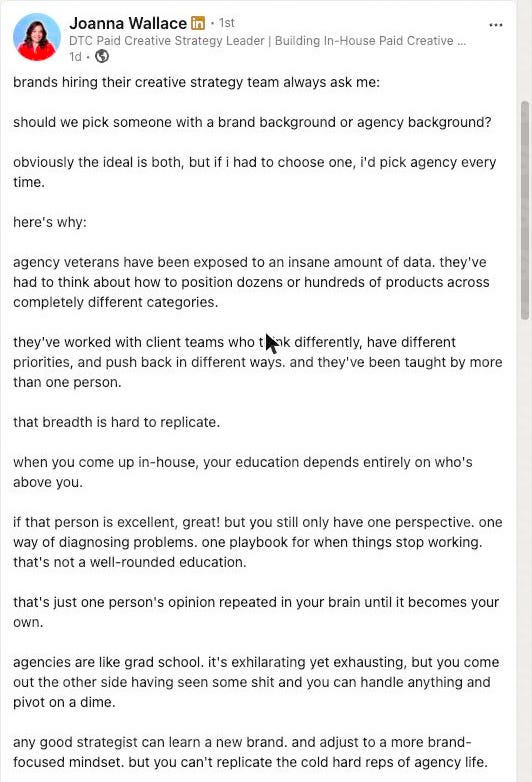
12. Joanna Wallace: hire creative strategists with agency reps
Joanna makes the case for hiring creative strategists with an agency background over a brand background, every time. Her logic: agency reps are grad school. You see fifty brands, fifty problems, fifty failures, in the time a brand-side hire sees one.
I’m biased, I’ve done both. But the breadth point is real. Just make sure it's not an agency with 40 accounts on each person.
Read the full post on LinkedIn →
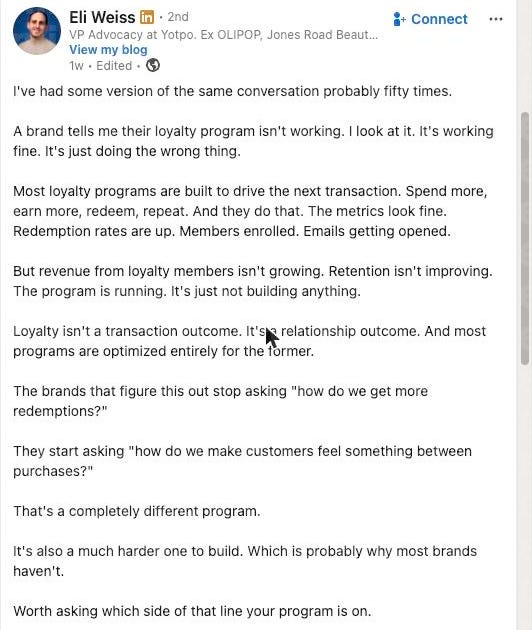
13. Eli Weiss: Loyalty is a feeling, not a points balance
Eli’s distinction: a loyalty program and a loyalty strategy are not the same thing. The most loyal customers share one trait. The program makes them feel something, not just earn something.
He may be biased but he has a great point.
Read the full post on LinkedIn →
Quick Summary
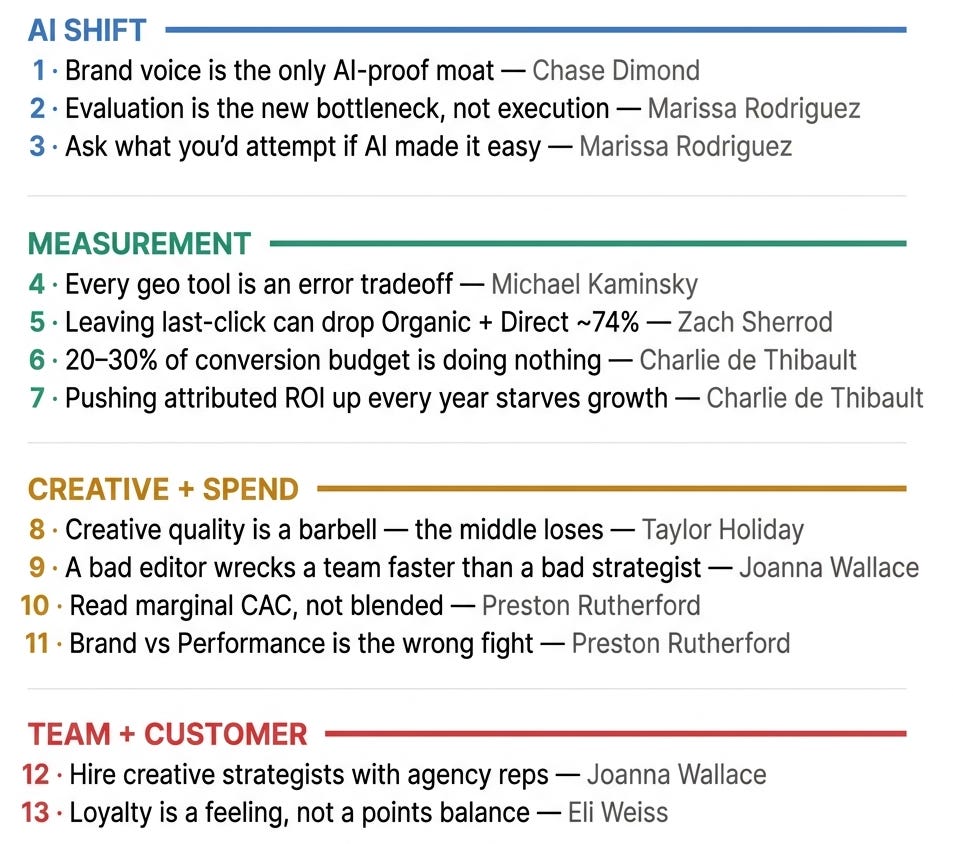
Read these back to back and a pattern shows up. Almost every one is about the gap between what a number says and what’s actually true.
Voice versus generic output.
Evaluation versus execution.
What you’d attempt versus what you’d save.
Real lift versus tool error.
Paid versus the credit it gets.
A budget working versus a budget that just exists.
The dashboard improving versus the business growing.
Marginal versus blended.
Brand-versus-performance versus what actually compounds.
A good editor versus a safe one.
Feeling versus points.
That’s the whole game right now. The tactics are mostly known. The edge is in seeing the real number under the convenient one.
Happy Friday!
Curtis
(p.s. please do follow all these people, all great educators)