

Creative is everything on Meta - here are 100 things, grouped so you can jump to what you need. Not all of these apply to every ad. That’s the point. Run down the list, use it for ideas, for improvements, and go.
Use this list to make more ads, not less.
The Hook (Your First 3 Seconds)
The open is a separate product from the rest of the ad. Spend lots of time here. Think about engagement. Test a lot. But focused on qualifying people over entertaining them.
Lead with the problem, not the product. Name the exact pain in the first line before you show what you sell.
Get motion into the first 8 frames. A static product shot loses. A zoom, a swipe, a hand entering the frame wins.
Put on-screen text in the first second that names a problem or makes a claim. “I stopped buying foundation” beats “New from Brand X.”
Open on a human face. Faces lift thumbstop roughly 30% over product-only openers, per Meta’s own Creative Hub guidance.
Try a curiosity gap or open loop. Start something the viewer has to keep watching to close.
Ask a direct question that triggers a silent yes or no. The internal answer is engagement before anyone clicks.
Use a pattern interrupt: street interview, subway clip, behind-the-scenes. Break the visual rhythm of the feed so it reads like anything but an ad.
Hook first, brand later. Hold the logo until 5-8 seconds in. Nobody stops scrolling for your logo.
On a static, put your strongest element in the top third. That’s the part that survives the crop and the half-second glance.
Read hook rate as a triage metric, not a trophy. Under 15-20% is invisible, 25-30% is solid for cold, 30%+ earns scale, and Reels run 5-10 points higher than Feed. Rework anything under 25%. Over that - just focus on qualifying. Don’t aim for 80%.
Cut the dead first second from your losers. Most of them waste a logo or a slow zoom before anything happens, and you’re paying for it.
Formats & Pattern Interrupts
Master the four foundational formats before anything trendy: UGC testimonials, statics, short video, carousels. These should be 70-80% of your library.
Don’t sleep on statics. They drive 60+% of conversions on a lot of accounts, produce faster, and iterate easier than video.
Try the Snapchat-style 3-second lead-in. A quick, raw, real-moment open makes the whole ad feel organic instead of produced. It came up as a top pattern in a creative call this week.
Run skits and relatable in-car testimonials. Both are consistently top performers right now. Put them in every test batch.
Use multi-frame, fast-cut scenes with one unexpected stop moment. A seasonal product ad I broke down this week won by stacking quick scenes around a single visual surprise, then a clear CTA.
Test the pet-led hook: a dog POV, an unexpected pet, a “my lab drinks my mushroom coffee” angle. High uniqueness that still lands the benefit.
Spin one winning angle into 15-20 variations before you reinvent. Your winners are worth exhausting, not abandoning. Just make them visually different so they hit different audiences.
Recut your long-form winners tighter. An old 90-second testimonial that’s fatiguing often comes back recut to ~40 seconds for current pacing. Have extra footage? Do the opposite!
Save carousels for education and comparison products. Card 1 hooks with a problem, the middle builds tension, the product and CTA wait for the last card.
Build 9:16 first, then 4:5. Vertical covers Reels, Stories, and Feed.
Match the format to the audience’s emotional state. For an anxiety product, the format has to evoke the anxious moment while still feeling fresh.
Production: Lo-Fi, Polished & AI
Default to low-fidelity, phone-shot, creator-driven content. Smartphone-quality beats studio about 80-90% of the time in my experience.
Remember low-fi means low-fidelity, not low-effort. The selling points, the editing, and the creator still have to be sharp. Sloppy is not a style.
Know why polished usually loses. High production signals “this is an ad,” and viewers skip ads. Reserve studio for the categories that reward it: luxury, complex demos, some fashion.
Test captions - sometimes they outperform sometimes they dont. Test by category not for the whole brand (organic content may perform better without it for example).
Keep DR videos to 15-30 seconds. Past that you’re paying for watch time that rarely converts cold.
Use AI where it’s actually good: short hooks, product animation, voiceovers. That’s where it earns its keep today.
Don’t ship a fully AI-generated ad without a human editor. They don’t scale clean, they get copied fast, and the comments flag them.
Layer AI on top of real production, don’t replace it. The hybrid (AI generates, humans refine, AI scales) is what’s outperforming today, not pure AI.
Great place to use AI is background generation, image expansion, text variations. One brand saw +45% ROAS from AI backgrounds alone at zero added cost.
Messaging, Copy & Offers
Talk to one person. “You” beats “customers,” and a message built for one reader lands harder than one built for a market.
Lead with the benefit, not the feature. What it does for them, before what it is.
Be specific. “Lost 23 lbs” beats “lose weight.” Specificity is the cheapest credibility you can buy.
Stack multiple selling points on screen. A dog supplement ad I reviewed this week won by calling out competitors, listing benefits on-screen, and adding personal testimony.
Use “because” to give a reason. People comply far more often when a reason follows, even a simple one. Don’t make a claim you could be backing with a “because.”
Address the top objection inside the ad. Name the doubt and answer it on screen before they think it.
Power words work, until they don’t. Free, new, proven, limited, instant, guaranteed all pull, but stack seven of them and the reader is numb by the time you reach the CTA. Use one, not all of them. Make it convincing not cheap.
Use review language verbatim. Your customers already wrote your best copy. Lift their exact words.
Make the offer visible inside the creative. Show the dollar-value deal and the bundle math on screen. Don’t make people read to find the value.
Use “free” where it’s honest, and check the law where it isn’t. It’s one of the most persuasive words but also regulated.
Give one clear instruction, not three. One imperative CTA: shop now, get started today. Say it on screen and out loud.
Add a risk reducer next to the CTA: Afterpay, free shipping, money-back. Remove the last objection at the moment of decision.
Give gifts that feel high quality - cheap gifts can be a drag on performance. Cost =/= high value.
Proof & Trust
Lead with social proof in skeptical categories. When trust is the barrier, a customer’s words open the ad better than yours do.
Use real testimonials in real settings. The whole reason UGC works is that it’s hard to fake. Real customers over actors, every time.
Demonstrate the result. Show the transformation or the product working. Don’t just claim it.
Run whitelist and partnership ads from real, credible pages. Ads from an actual persons page beat fabricated publisher pages.
Test out partnership ads for as many as you can - founder ads, employee ads can work as well!
Use credible logos and press as trust shorthand. “As seen in” does quiet work in a half-second glance.
Put proof in the body as evidence, not as a second intro. One hook, then proof that backs the promise, not two openings competing.
Let the creator’s authentic voice carry believability. The moment it sounds scripted, the trust evaporates.
Show the product in use, not sitting on a table. Context beats catalog.
Structure, Pacing & Hold Rate
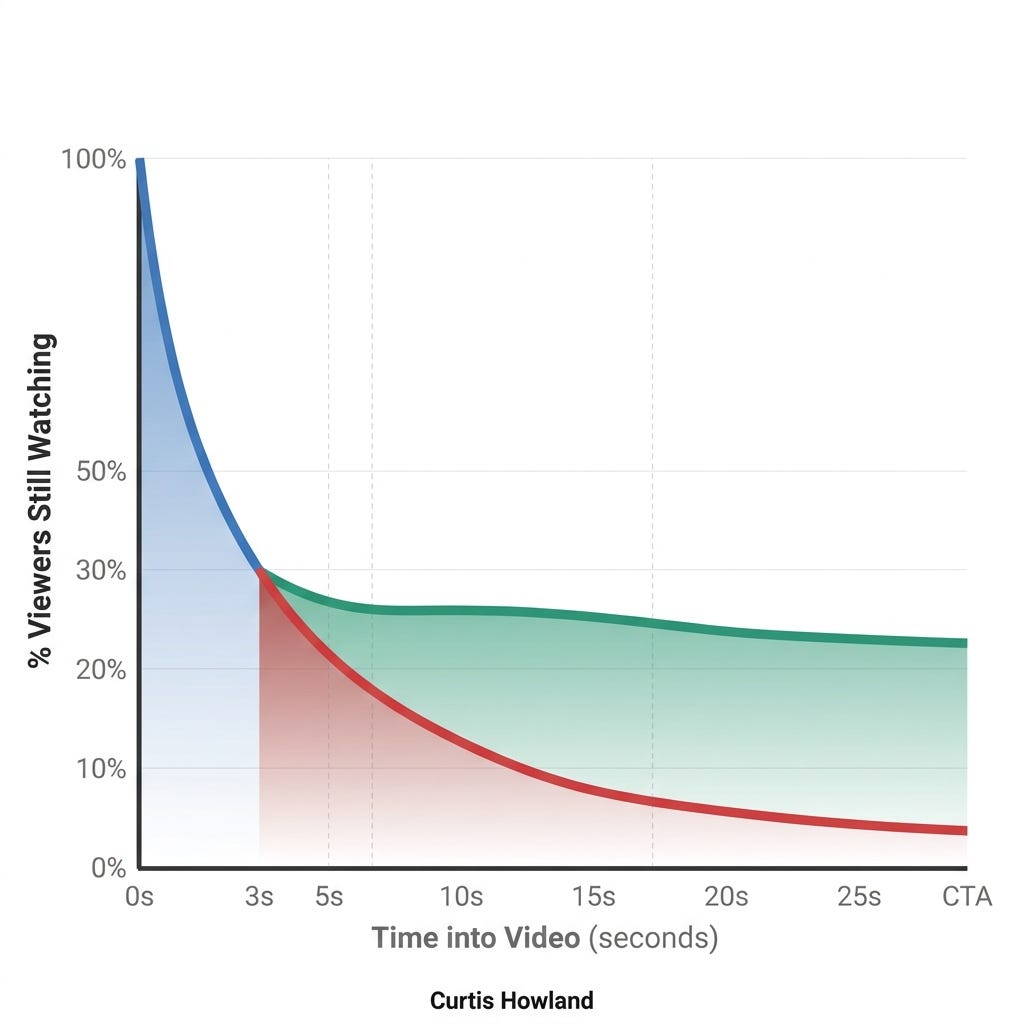
Track hold rate, not just hook rate. Two ads can share a 30% hook and post a 6x ROAS gap because one held 22% of viewers to the CTA and the other held 4%. In 2026 a hook is required, the second 3-15 seconds (thruplay) is where the money is.
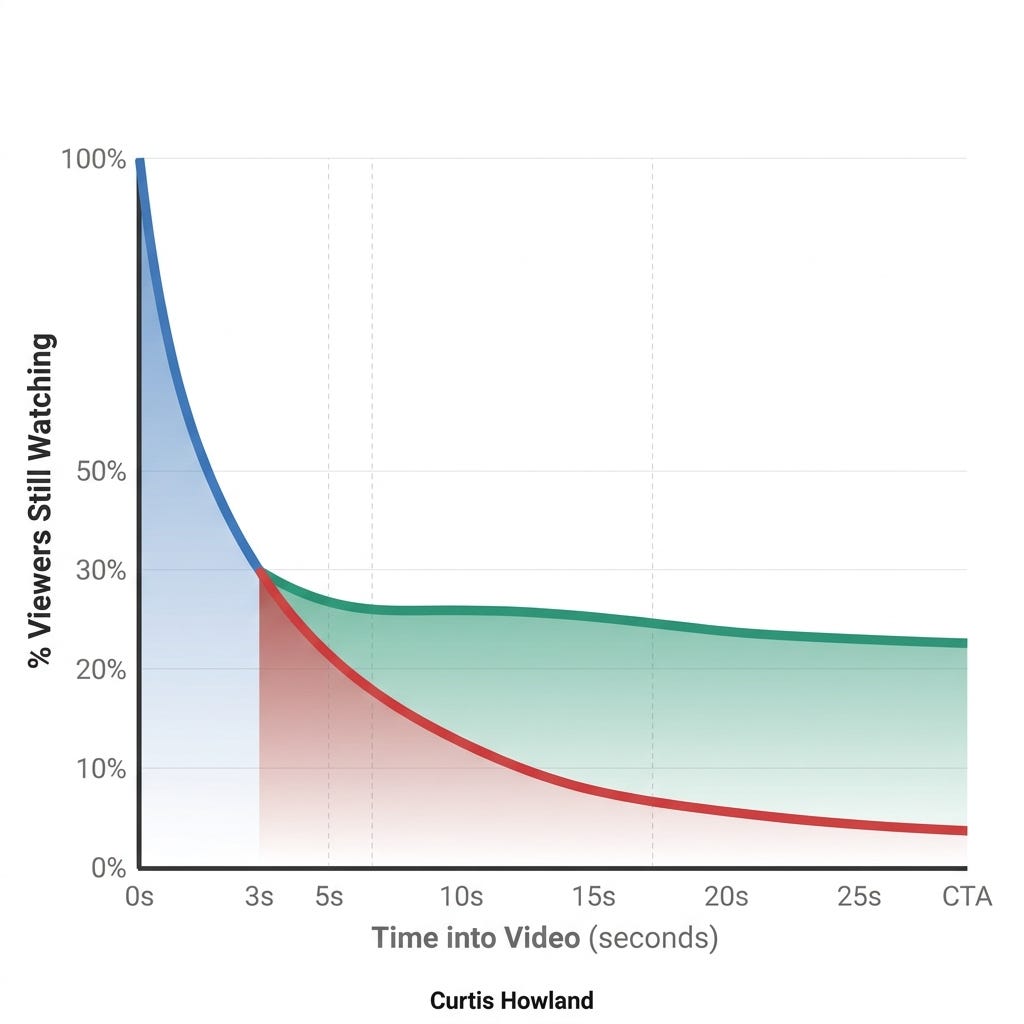
Find the cut where viewers leave and put a pattern interrupt there. Diagnose the dead zone before you reshoot the whole thing.
Use the arc: hook, problem, solution, proof, CTA. After you name the pain, move straight to proof. Don’t meander.
One core idea per ad. Don’t split the viewer’s attention. Confused buyers don’t buy.
Earn each next second. Every beat has to justify the one before it or you lose the viewer.
Put your strongest proof right before the CTA. Send them into the decision on the highest note.
Cut dead air. Fast transitions, no lulls. The pace itself is a retention tool.
End on the offer and a single action. The last frame is the one they act on, so make it the offer, not your logo.
Design the first frame as if it were the whole ad. If it can’t sell on its own, the rest of the ad rarely gets seen.
Creators & Briefing
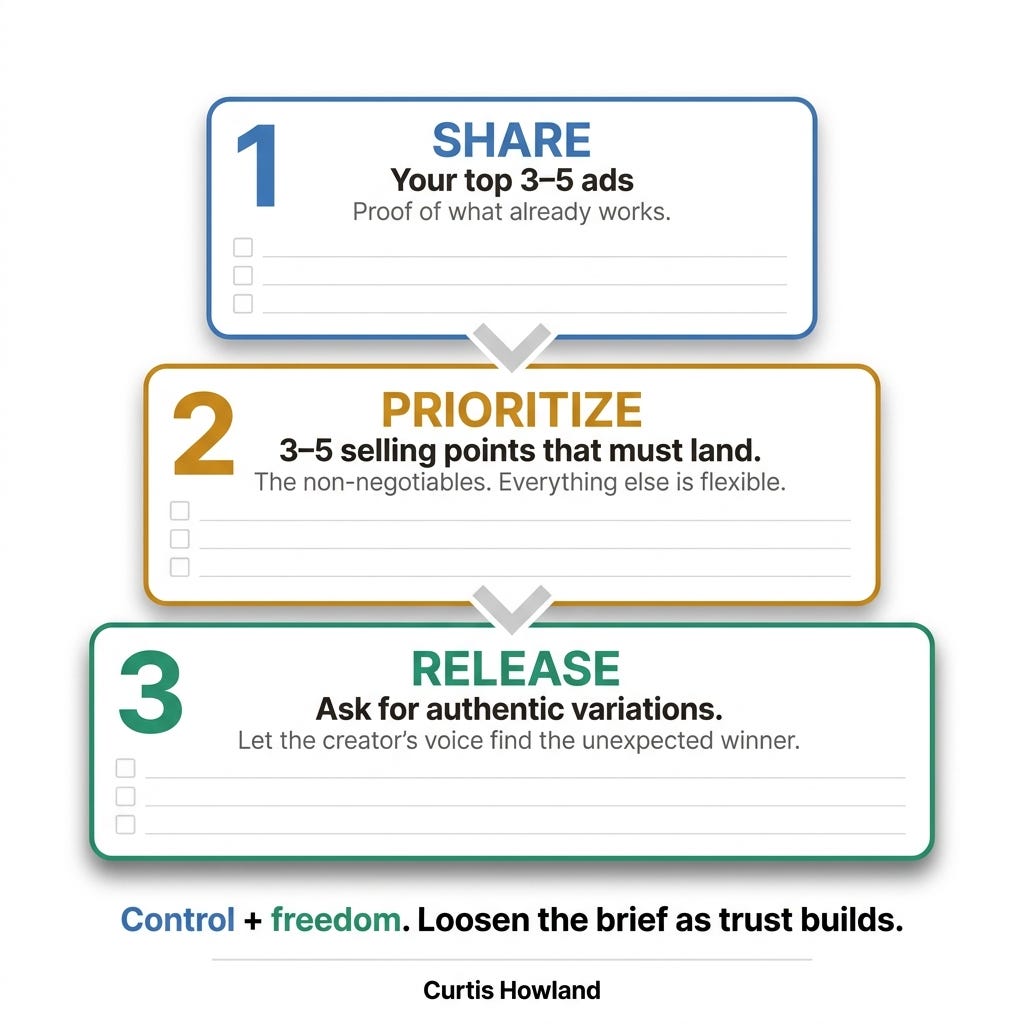
Use the hybrid brief: share your top 3-5 ads plus the 3-5 prioritized selling points, then ask for authentic variations. Control plus freedom is where breakout ads come from.
Loosen the brief as the creator earns trust. Winners come from creators you let run, not creators you script.
Match the creator to the persona, not the follower count. Fit beats reach for performance creative.
Be cautious with expensive influencers unless the fit is tight.
Consolidate down, not up. Three to five higher-quality creators plus one DR agency beats a long tail of small ones. Test wide then consolidate down once you find the winners. Repeat, don’t keep them all rolling.
Run partnership ads from the creator’s own handle. (Yes this is worth repeating)
Source creators continuously, and run a small paid test before you scale any of them. Don’t bet budget on an unproven voice.
Brief on the emotional state, not just the product. Tell the creator the feeling to evoke and let them find the words.
Circulate winning creator cuts internally. A great hook from one brand is a starting point for another. Build the library.
Differentiation & Feeding the Algorithm
Be different from your own past ads. Similar creatives compete in the auction and trigger sequencing that quietly kills both.
Be different from your competitors. Novelty to the viewer is what lowers your CPMs.
Put the hours where the leverage is. If creative is 70-80% of performance, your team should spend its time there, not rerunning budgets.
Make it entertaining or genuinely engaging. A strong hook rate alone can pull CPMs down 30-40%, and engagement earns organic reach that compounds your paid scale.
Run 8-15 conceptually different ads, not headline swaps. The algorithm penalizes redundancy now.
Match big-spend creatives to a big audience and a top product. A niche SKU can’t sustain a million-dollar creative. Top-funnel has to speak broadly to justify the spend.
Vary before you repeat across platforms. Running the identical cut everywhere accelerates fatigue and sequencing penalties.
Start broad (10M+ interest audiences) and let Advantage+ expand. If you’re still building 500K detailed stacks, you’re over-constraining the algorithm. Turn on Advantage+ creative features while you’re at it, they average +22% ROAS.
Treat your best organic post as a paid ad you haven’t run yet. The organic-paid line is gone. Ask your team to forward the organic posts beating Meta and test them.
Testing, Scaling & Portfolio
Launch enough volume for the top 1% to emerge. Don’t optimize the median ad. Creative returns are fat-tailed, and a handful of breakout winners carry the whole account.
Don’t kill near-winners too fast. Because the returns are fat-tailed, the ad that looks mediocre on day three is sometimes the one that scales. Give it room.
Test 3-5 hooks per concept and let thumbstop rate pick. The cheapest way to find a winner is to vary the open, not rebuild the whole ad.
Aggregate before you judge. Single-ad reads are noisy. Wait for 10-12 purchases per concept before you decide on something important like an angle.
Kill at 2-3x target CPA with no purchase. Don’t nurse a clear loser hoping it turns.
For top-funnel creatives, tolerate 10-20% over CPA target when the qualitative signals (comments, watch time, engagement) say product fit. Pull back around 40-50% over.
Overscale your proven top-funnel winners. The best ones lift overall account performance 10-30%, not just their own line.
Force-test your under-spent, high-efficiency ads. Meta starves some good creatives. Pull 6-10 of them (look back 90 days, include paused), drop them in a dedicated ABO set for 5-7 days, then cut and scale. If one won’t scale, the cause is usually one of three: not enough data, sequencing, or decay during scale, and each has a different fix.
Volume tends to pay. Shipping 10+ fresh creatives a week often cuts CPA 20-40% over time, because you’re giving the tail more shots at a breakout.
Study your longest-running ads. Longevity is a winner signal. The ad that’s been live a year is telling you what your account actually wants more of.
Fatigue & Measurement
Run the production math: one new ad per $3,000 in monthly spend. At $150K/mo that’s ~50 new ads a month just to stay even, and 50-100+ active.
Watch the fatigue signals: CTR under 1%, a 20%+ week-over-week CTR drop, frequency over 3.0 on prospecting, or CPA rising with nothing else changed.
Don’t over-rely on a single hero creative. Double down AND diversify.
Use publisher whitelisting to revive fatigued creative.
Don’t read creative performance off click tracking alone.
Use the right tool for the question. MTA for ad and campaign-level creative decisions, MMM and incrementality for channel-level allocation. They answer different things.
Tag your creative consistently. A clean taxonomy beats a clever one, make it functional
Build the promo playbook outside black friday. Put ~20-30% of spend on dedicated promo ads (mostly your top performers with promo banners) and update the site copy for urgency. Use seasonal hooks beyond Black Friday: Memorial Day, Fourth of July, even a birthday-month angle.
Treat the landing page as part of the creative. Run PDP copy and CTA tests measured on conversion rate and revenue per visitor.
Trust the data over your taste. Your winners often won’t look “good” to you. Ugly ads beat polished more often than anyone wants to admit, and the longest-running, highest-spending ad in your account is usually the proof. Ship the thing the numbers like.
That’s the list. There will be exceptions to them all, thats the joy of marketing, hope it helps!